

It seems that NASA’s Transiting Exoplanet Survey Satellite (TESS) is an overachiever.
When NASA launched TESS in 2018, the satellite had one job: watch nearby stars for the tiny dips in brightness caused by planets passing in front of them. It has done that spectacularly well, discovering hundreds of new worlds. Now scientists have realized TESS was also collecting evidence for something it was never expected to find.
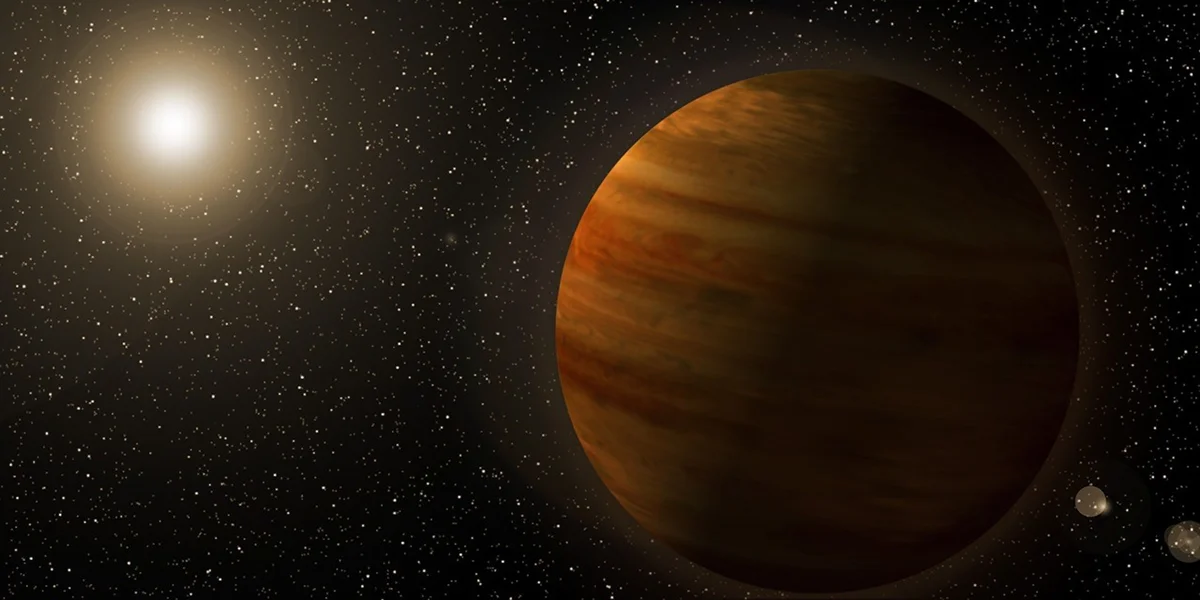
In a study published July 1 in the Astrophysical Journal Letters, researchers report that TESS captured the signal of Gaia23bra b, a planet orbiting a star nearly 40,000 light-years away—more than 250 times the distance of the nearby stars TESS was designed to study.
On supporting science journalism
If you’re enjoying this article, consider supporting our award-winning journalism by subscribing. By purchasing a subscription you are helping to ensure the future of impactful stories about the discoveries and ideas shaping our world today.
It’s a bit like pointing a backyard bird camera at your feeder and later realizing you also captured wildlife on another continent.
Even more surprising, TESS found the planet using a technique it wasn’t designed to use.
The discovery began in April 2023, when the European Space Agency’s Gaia spacecraft spotted a brief brightening of a distant star. That flash was caused by gravitational microlensing, a phenomenon predicted by Albert Einstein.
When two stars align almost perfectly from Earth’s perspective, the gravity of the nearer one bends and magnifies the light from the more distant star, acting like a cosmic magnifying glass. If that foreground star hosts a planet, the planet leaves ripples in the magnified light.
Gaia recorded the stellar brightening, but it didn’t collect enough observations to reveal the planet itself. Fortunately, less than a month later, TESS happened to be staring at the same patch of sky.
“Gaia’s observations were too sparse to pick up on the planet,” Mallory Harris, a Ph.D. candidate at the University of New Mexico and lead author of the study, said in a statement. “The TESS spacecraft happened to be monitoring the same area of the sky during the microlensing event, and its denser time coverage showed extra features in the light curve caused by a planet.”
But nobody noticed.
Why would they?
“When TESS launched, no one expected it to ever be capable of finding this kind of planet,” study co-author Diana Dragomir, an assistant professor at the University of New Mexico, said in the same statement.
The microlensing lineup between the two stars came and went in 2023, and the telltale planetary signal sat unnoticed in TESS’s archive for nearly three years before researchers connected the dots.
“The discovery implies that there are probably other so-called microlensing planets hiding in TESS’s data that we hadn’t previously thought to look for,” Dragomir said.
The find suggests one of NASA’s most successful planet hunters may still have plenty of surprises hiding in its archives.
It’s Time to Stand Up for Science
If you enjoyed this article, I’d like to ask for your support. Scientific American has served as an advocate for science and industry for 180 years, and right now may be the most critical moment in that two-century history.
I’ve been a Scientific American subscriber since I was 12 years old, and it helped shape the way I look at the world. SciAm always educates and delights me, and inspires a sense of awe for our vast, beautiful universe. I hope it does that for you, too.
If you subscribe to Scientific American, you help ensure that our coverage is centered on meaningful research and discovery; that we have the resources to report on the decisions that threaten labs across the U.S.; and that we support both budding and working scientists at a time when the value of science itself too often goes unrecognized.
In return, you get essential news, captivating podcasts, brilliant infographics, can’t-miss newsletters, must-watch videos, challenging games, and the science world’s best writing and reporting. You can even gift someone a subscription.
There has never been a more important time for us to stand up and show why science matters. I hope you’ll support us in that mission.
