

This article is brought to you by Qualcomm Technologies.
For many consumers, much of the promise and appeal of AI is personal. Consumers are looking past generic tools and want to know how these technologies will help them in their daily lives. These trends coincide with the advent of new classes of wearable devices that, in addition to being able to leverage powerful frontier models, feature built-in intelligence that understand the context of a user. Where are they? What are they seeing and hearing? What are their habits, their preferences, their schedules?
It’s an astonishing pivot, from passive accessories that served mostly to send users smartphone notifications to proactive, intelligent companions. The smartphone is no longer the center of that universe; though it’s still incredibly important, in this personal AI paradigm, the AI is the UI. And it shifts the focus toward you, the user.
These new technologies are exciting. But what do consumers really want?
A Personal AI report, commissioned by Qualcomm Technologies, built on a survey of more than 12,000 people across key geographies worldwide (the U.S., U.K., Germany, India, Brazil, and China) focused on the rise of personal AI in intelligent wearables looks deeply at these developments.
The smartphone is no longer the center of that universe; though it’s still incredibly important, in this personal AI paradigm, the AI is the UI.
Survey respondents are less interested in single devices and are responding more to the idea of connected ecosystems. As people expand their roster of devices, it only makes sense. Instead of relying entirely on a smartphone and a laptop, respondents also have connected technology in their cars, as well as intelligent wearables like smartwatches, smart glasses, hearables, and other wearables like rings, pins, and pendants. They want those devices to work in concert, and the way to do that is to decentralize any single one of them. Instead, the AI agent that knows the user and works across all of those devices becomes the unifying factor.
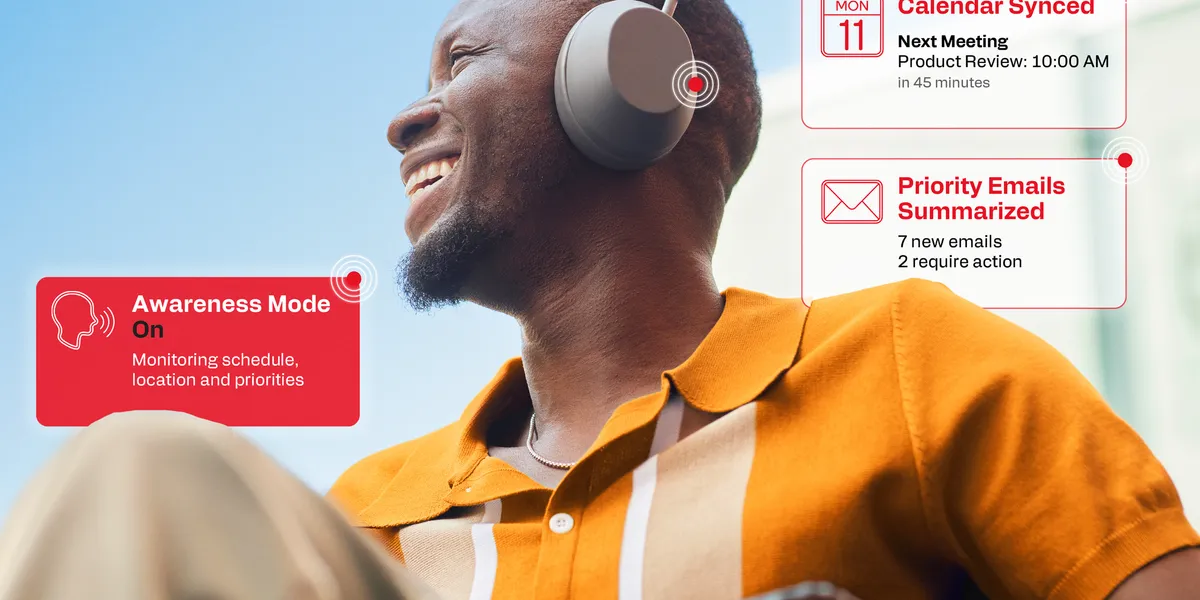
Consider a typical workday: A user’s watch detects it is time to leave for a meeting and, with permission, their AI agent factors in calendar details, real-time traffic and battery status across their devices. In the car, it suggests the best route and briefs them on their meeting agenda. As they arrive, smart glasses surface a discreet reminder, such as the meeting location or the name of a new contact, while the phone stays in their pocket. No one device has to do everything; each plays the role it is best suited for, coordinated by a personal AI agent that understands the user’s context and acts only at the user’s direction.
With this in mind, simply adding more hardware to the mix isn’t sufficient. Even though respondents will be open to new form factors, they’ll demand more from their ecosystem of devices. They’ll be sensitive to points of friction and needless complexity, and they’ll require each new device to bring something new to the table — “incremental intelligence, convenience, or contextual awareness that their existing devices cannot deliver on their own what the report,” reads the report.
The usage trends are up. The report found that those who own wearables are already using AI frequently (60 percent use it at least weekly), which indicates that it’s becoming less of a fun experiment for early adopters and more of a critical mass habit.
The “always-on” nature of intelligent wearables appears to be winning respondents, too. The report found the following statistics on average continuous wear among users:
- True wireless earbuds – 3 hours
- Wireless headphones – 3 hours
- Smart glasses – 5 hours
- Audio glasses – 6 hours
- Smartwatches – 9 hours
- Smart rings, necklaces and pendants – 8 hours
Consumers want AI that is personal and understands their context — they’re looking for smooth, intuitive experiences that are marked by privacy, security, and user control.
Consumer Trust Is Hard-Won
But for all the excitement and engagement around intelligent wearables, there’s a gating factor: trust. As use cases for intelligent wearables expands to more personal and persistent experiences, trust is a necessity for Personal AI.
The top reported issues around adoption are privacy, security, and user control. The data points to a certain amount of caution around deeply personal use cases, like voice, health, and location, as almost 60 percent of respondents want to keep data from their wearables private, or at least insist on gaining approval before it gets shared.
In other words, even though premium features like high-quality audio, perception sensing, battery life, and comfort whet consumer appetites (and agentic AI capabilities drive upgrade intent), true adoption will come only with consumer trust. They want security, privacy, transparency and control.
Notably, the report found that respondents expressed more interest in adopting intelligent wearables when Snapdragon was introduced as the enabling platform. This reinforces the value of having an established, trusted technology foundation in the mix.
The Industry Remains Fluid
The report shows that consumer appetite for AI is high, with 60-70 percent of those surveyed expressing interest in advanced AI as they consider a new device. That’s a constant. But remaining purchase drivers differed between device categories.
Audio playback quality is the most influential purchase driver for true wireless earbuds and headphones. For smartwatches, it’s display quality and responsiveness. Respondents are less concerned about technical specifications than aesthetics like materials and finish when it comes to devices like smart rings and pendants. And for smart glasses, it’s all about the type of control, whether it’s voice, gesture, or touch.
Alongside these purchase drivers is another key finding: Consumer appetite for Personal AI agents has gone mainstream. The report says that 70 percent of respondents “express strong interest in an AI assistant that can interact naturally through voice and seamlessly manage devices, apps, and everyday tasks.” With each individual as the center of their own ecosystem, voice becomes the most critical, natural method for interacting with agents.
The Opportunity
The industry for intelligent wearables is exciting. It’s clear that consumer demand for Personal AI is high, and this report dives deeply into the specifics of what respondents want out of it. They want AI that is personal and understands their context, and they want it to be proactive and helpful instead of merely reactive. They’re looking for smooth, intuitive experiences that are marked by privacy, security, and user control.
Intelligent wearables comprise much of the hardware of this “ecosystem of you.” Consumers are interested in ecosystems instead of single devices, and they’re looking for agentic AI capabilities that understand and act on their behalf.
Yet so much of the industry remains undefined. OEMs and technology makers have an enormous opportunity right now to innovate and iterate on the strong technological foundations that platform makers are building. And the roadmap for what consumers want is clear.
All percentages, consumer behaviors, and attitudes stated in this report are based only on the responses of the individuals who participated in our survey.
