

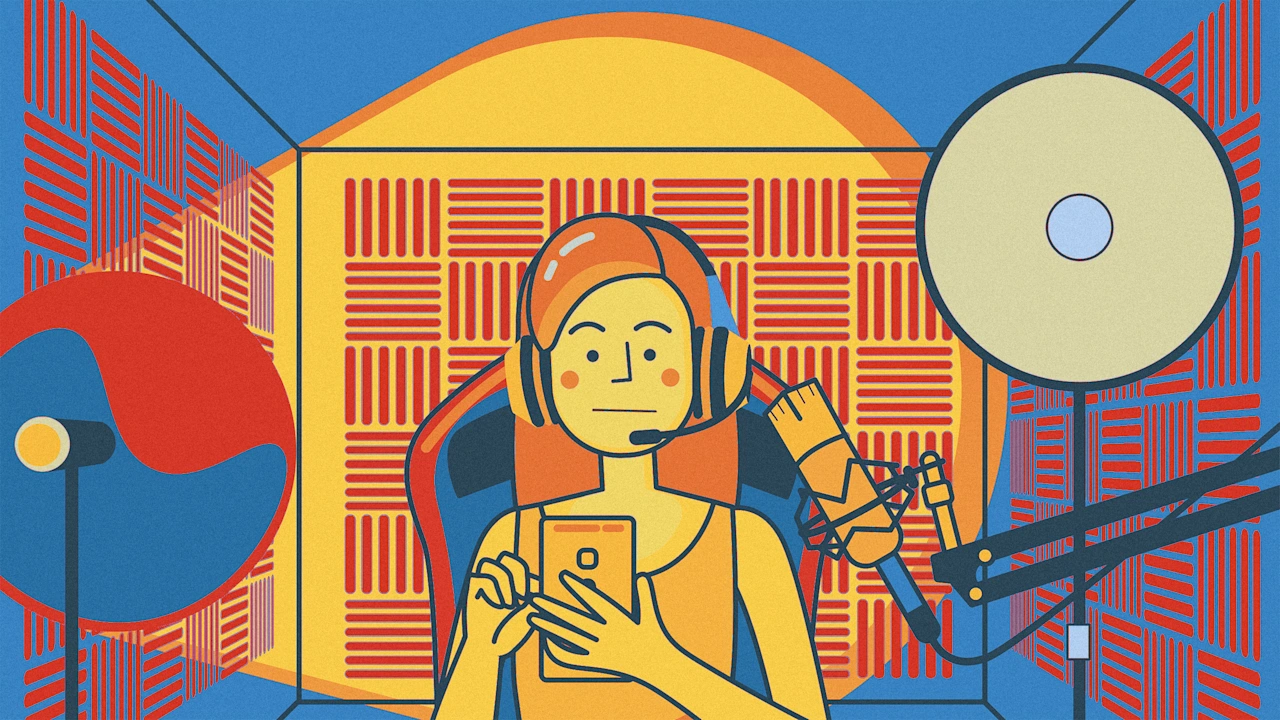
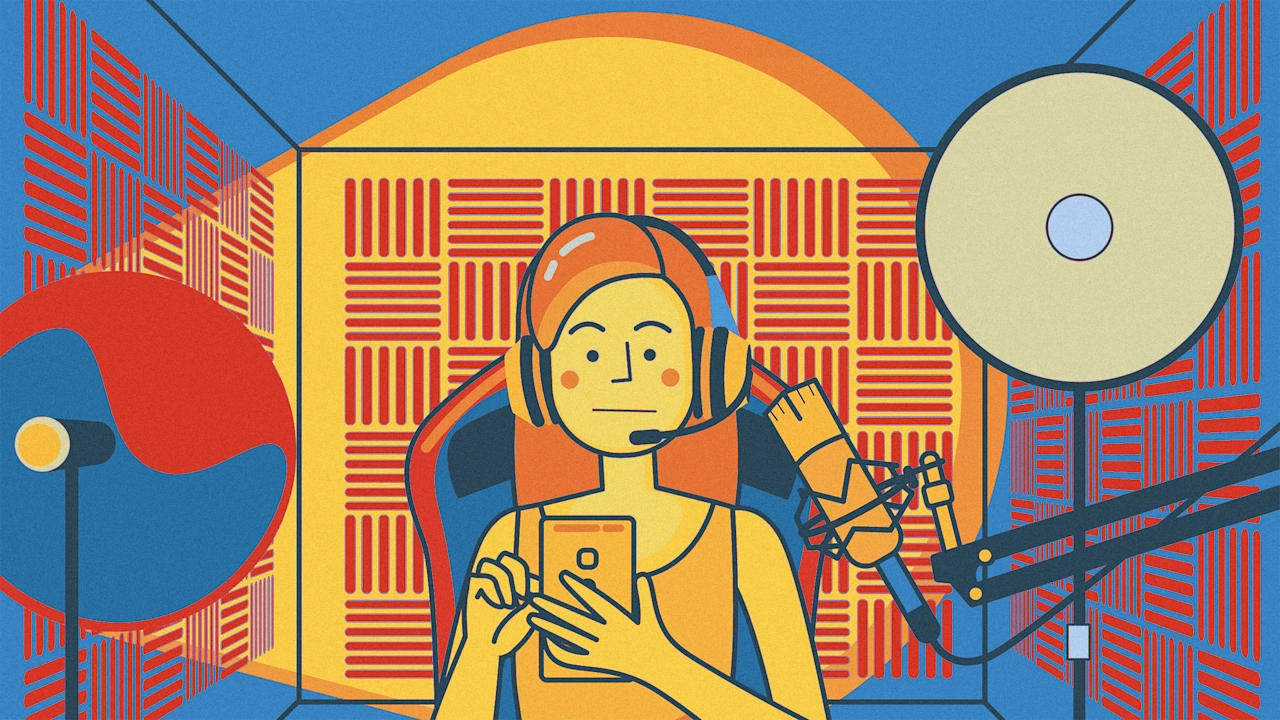
With Netflix now streaming original podcasts and Apple announcing a “category-leading video experience” on its app this spring, the meaning of the word “podcast” has grown increasingly diffuse.
It was much easier to pin down during the medium’s mid-aughts infancy. Back then, a podcast was simply asynchronous talk radio—the natural next step after moving from terrestrial radio, to satellite platforms like SiriusXM, to a new and purely digital format that could be downloaded and consumed on demand.
In the years since, the definition has vastly expanded. Essentially, any form of episodic audio or video content that involves people speaking into microphones can now be considered a podcast. We’ve drifted so far away from the original context and definition of the word that perhaps it’s time for semantics to catch up.
“The consumption is moving more and more toward video-based podcasts,” says Jonathan Miller, a former Fox digital media and NBA executive and current CEO of Integrated Media Co. “At some point, there needs to be a new name. But it’s not going to happen easily.”
Pivoting to video
Originally coined in early 2004 by British journalist Ben Hammersley, the word “podcast” was an ingenious turn of phrase at the time. The punny portmanteau succinctly describes the then-emergent format of a broadcast that emanates from one’s iPod.
The only problem? That title assumed a world in which iPods hung around for the long haul, rather than entering obsolescence just three years later with the invention of the iPhone. (The iPod ultimately remained in circulation for another 15 years, until Apple ceased manufacturing them in 2022.)
Anyone on the younger end of the prime podcasting demographic of 18 to 34 years old has likely never used an iPod, and might regard one with the same anthropological curiosity they would a VCR or rotary phone.
If the podcast’s outdated nominal inspiration weren’t enough reason for a rebrand, though, the popularity of video may be what cinches it.
As more and more podcasters have started putting their shows on camera, YouTube has become the top podcast platform in the U.S., with over 1 billion active users logging on for them each month.
Meanwhile, Apple’s audio-only app loses a little more of its market share every year, going from 15.7% of monthly podcast listeners’ preference in 2022 to 11.3% in 2025.
Perhaps the company’s forthcoming video experience will help Apple regain some of that ground—if Netflix and its competitors all inevitably throwing their hats in the ring doesn’t erode that number further.
But if a podcast is no longer something audiences hear but watch, is it even the same medium?
“What we’re witnessing isn’t a departure from podcasting—it’s an evolution,” says Matt Sandler, general manager of creator services at Amazon. “The content itself has evolved from interviews into ensemble conversations, documentary-style storytelling, live experiences, and hybrid shows that blur the lines between what we’ve traditionally seen on social [media], podcasts, and TV. As a result, podcasts have naturally moved from audio-only experiences to screens.”
As popular as the video format is getting, not everyone sees it as a full industry takeover. “I don’t see a pivot to video but an addition,” says Adam Curry, the former MTV VJ whose early adoption of podcasting earned him the nickname “The Podfather.”
Of course, the addition of video to an audio format has always been disruptive, to say the least.
The revolution will not be podcasted
Before it became known as television, one of the invention’s developers, Charles Francis Jenkins, dubbed it “radiovision.” There must have been very little doubt among the public about which technology TV was intended to replace.
The introduction of TV solved the problem of how boring and undynamic it must have been to gather one’s family around a radio and listen to Fibber McGee and Molly on a Thursday night. It created a dazzling new galaxy of programming possibilities that revolutionized show business, and just about every other kind of business.
TV obviously didn’t kill radio, but it drastically diminished radio’s appeal and quickly supplanted it as the top option for home entertainment.
Among the reasons radio has flourished well beyond TV’s invention is because people also wanted to be entertained outside the home. It turned out there were many situations where the dynamism of a visual component proved unnecessary—while driving, working, or shoveling snow, for instance.
The main distinction between the rise of video podcasts and the rise of television is that, unlike the medium that TV disrupted, podcasts were originally made precisely for such moments of divided attention. People mostly consume them while their eyes are focused elsewhere.
In fact, according to a YouGov survey from 2023, the topmost popular podcast-consuming situations are while doing chores, commuting, or working out.
“I want something I can listen to like an audiobook when I’m driving, riding the subway, or walking in the park,” says Dave Winer, a software developer, writer, and pioneering podcaster.
Though it’s technically possible to watch a long-form podcast while doing all those things, it’s not exactly practical.
Still, the medium is now in a weird straddling moment in which many podcasters have not yet figured out for which of their audience’s senses they’re primarily creating content.
It’s now quite common for the hosts of a podcast to pantomime actions, make faces and hand gestures, or employ some other visual aid that provokes an in-studio laugh, followed by a reflexive explanation to “our listeners” about what just happened on-screen.
Will they eventually stop explaining? Or will they instead stop playing to the camera?
Either way, it might be helpful to know that not as many people may be watching podcasts as it seems. According to Triton Digital’s annual podcasting report, only 7% of audiences exclusively watch their favorite podcasts, while 13% exclusively listen to them, and the remaining 80% now alternate between the two options.
These results hint at an epidemic of video podcasts playing inside listeners’ jean pockets as they go about their business.
Maybe not for long, though.
What’s in a name
Whichever way people prefer to consume video podcasts, the popularity of these shows has big business implications.
As the recent cancellations of both Kelly Clarkson‘s and Sherri Shepherd‘s TV shows indicate, podcasts are coming for daytime TV. They’re also coming for the ailing late-night TV industry, and any other talky TV format that could technically be made with a tiny crew and no union involvement.
(After launching without union coverage and incurring some blowback, Netflix’s The Pete Davidson Show has since signed with SAG-AFTRA.)
“Talk television is set to become a derivative of video podcasting,” says Miller.
Fewer traditional talk show options will inevitably mean more video podcasts with high-wattage guests, like Amy Poehler’s Good Hang and Matt Rogers and Bowen Yang’s Las Culturistas. That means more people will likely start consuming their podcasts on smart TVs while curled up on the couch with a second screen.
In a scenario where that mode of consuming podcasts becomes more dominant, the word podcast will feel even more dissonant than it does now.
Part of the reason any medium needs a definitive name is to quantify audience consumption for advertisers. As an industry, video podcasts are now roughly at the point where streaming series were at about a decade ago, when it was still common to call them TV shows.
Nielsen struggled to adjust its language when TV moved to streaming, and remains stuck in a swamp of acronyms like SVOD (subscription video on demand), OTT (over-the-top), and CTV (connected TV).
Keeping the podcast label would cleanly delineate shows like the Kelce brothers’ New Heights and Call Her Daddy for the remaining years of linear television.
But if the word were to be replaced, what would we start calling podcasts instead?
“We might call it ‘Social media TV,” says Henry Jenkins, a media studies professor at USC Annenberg School for Communication and Journalism. “The format is a longer and mostly unedited discussion compared to what’s possible via broadcasting. It’s consumed asynchronously. Both of these overlap with podcasts as we have understood them.”
But with video, the medium is now yet another step removed from that original meaning, adds Jenkins. “What I like about ‘Social media TV’ is it conveys the hybrid nature of this new format,” he says. “I much prefer understanding it as something new than to allow it to define what podcasting becomes.”
Miller thinks a potential linguistic change might be simpler, though.
“What a podcast really refers to is a unit of something—one pod is one episode,” he says. “So maybe, at the end of the day, they simply become known as ‘episodes.’”
Just because video podcasts have become the dominant commercial format, though—to the point of possibly redefining the medium—doesn’t mean the original format is on its way out.
“If podcasting becomes video, and audio podcasting disappears . . . we’ll just boot up podcasting again with a different name,” Winer says.
But don’t be surprised if the word sticks around as the industry evolves around it.
“We still use paperclip icons to attach a file, and a floppy disc icon to save something,” Curry notes.
Similarly, there’s a reason why iPhones still have the word phone in them, even though making phone calls is now among the device’s more marginal functions. Sometimes, words continue to survive long after the idea that inspired them becomes redundant. One such word, which originally referred to sowing seeds by scattering them over a wide area, is broadcast.
