

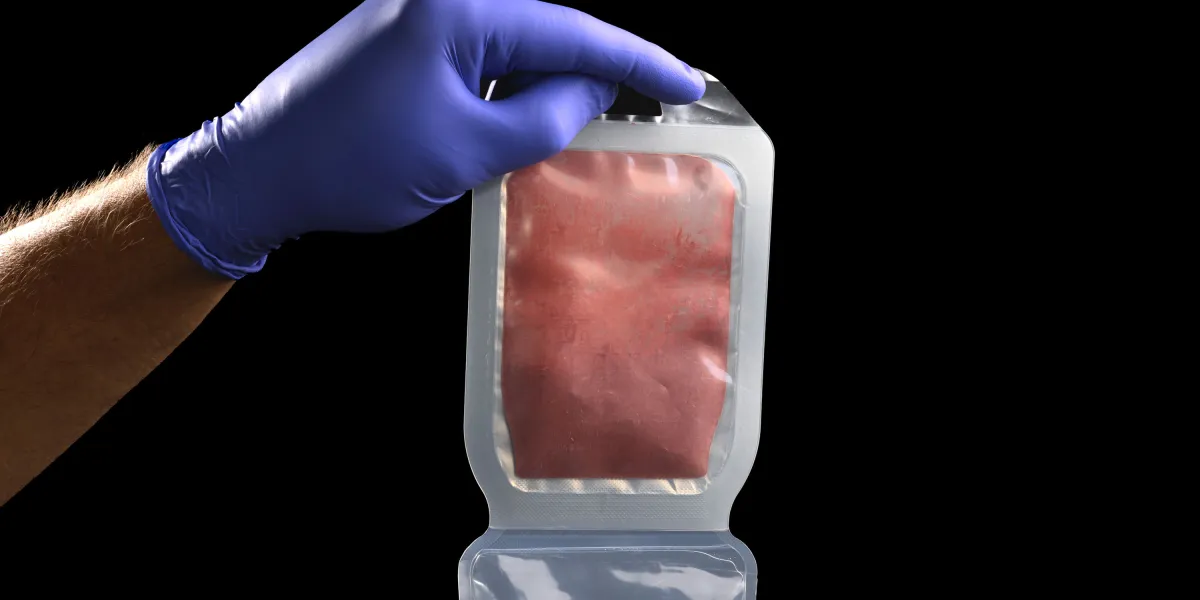
The product, called ErythroMer, is essentially a new kind of HBOC. The membrane prevents breakdown, limits dangerous scavenging of nitric oxide, and also helps the hemoglobin take up and release oxygen. Each ErythroMer cell includes a lipid called KC-1003, which acts like a sentry: In response to high pH in the lungs, it signals another small molecule within ErythroMer to move away, allowing oxygen in. Then, in tired tissue, where pH is lower, KC-1003 brings the small molecule back, releasing the oxygen.
Using a well-understood process called lyophilization, similar to one that World War II–era scientists used with plasma, the team freeze-dries its product to store at room temperature, where it can remain stable for two years. In a 2016 study of mice and rats with up to 70% of their blood removed, ErythroMer stabilized blood pressure and oxygen delivery—without the devastating constriction of blood vessels that sank HemAssist. FSHARP furthered that work, helping fund studies on how the HBOC interacted with plasma and platelets.
Much like the handle of a Swiss Army knife, the synthetic platelet has specialized attachments—peptides that serve as the biological equivalents of a corkscrew or a nail file.
KaloCyte, though, still has plenty to figure out. Haynes says the company can source only about 1,000 to 2,000 units of expiring hemoglobin a month. So it has licensed a yeast strain that it aims to use to create its own hemoglobin in the lab.
Over a video call from her desk, Haynes showed me a sample of ready-to-use ErythroMer. It was encased in a heavy-duty storage bag with two chambers. One was full of scarlet powder—the hemoglobin product—and the other of sterile water to rapidly rehydrate it in the field. Eventually, she explained, under Murray’s master plan, “you’ll have another container with the synthetic platelet, and then a third container with the plasma.”
But achieving that vision depends on finding a synthetic platelet that works.
To do that, DARPA has turned to Anirban Sen Gupta, a bioengineering professor at Case Western Reserve University. “Traditionally platelets were thought of [as] blood cement, but it’s not that simple,” he explains. “They are, in my opinion, like drones, surveilling the blood vessel wall continuously, looking for signs of injury.” Sen Gupta’s team, which also includes collaborators at the University of Pittsburgh, used FSHARP funding to continue work on a product called SynthoPlate. Fabricated from a lipid nanoparticle that he likens to the handle of a Swiss Army knife, it has specialized peptide attachments—the biological equivalents of a corkscrew or a nail file. The first version has three: One binds to a chemical called von Willebrand factor, which helps platelets stick to the walls of injured blood vessels; another attaches to collagen, which acts as a scaffold for regrowing cells; and the third mimics a blood protein called fibrinogen, which acts like a Lego connector that allows the synthetic platelets to stick to real ones near a wound. Like ErythroMer, the product is freeze-dried and can be reconstituted with sterile water. It keeps for over a year at room temperature and at least three months at a desertlike 122 °F.
In a 2026 paper in Advanced Science, the researchers showed that SynthoPlate cut bleeding time and blood loss by more than half in mice with low platelet counts. In a separate study, they also safely injected the faux platelets into rats’ bone marrow—a more useful delivery site, given that a bleeding patient might not have an available vein. Sen Gupta and a colleague have spun this work out into a company called Haima Therapeutics.
The good news, as he sees it, is that the pharmaceutical industry excels at mass-producing millions of billions of lipid nanoparticles—witness Operation Warp Speed, in which these blobs of fat held delicate snippets of mRNA in covid shots. “The magic of the artificial platelet is in all those peptides that are decorating the surface of the particle, but the scalability of the platform is very well established,” he says.
Around the world, prospective blood alternatives abound. Researchers at Cambridge University in the UK are trying to pharm red blood cells for people with rare blood types or blood disorders like sickle cell anemia, and other researchers have also cultured platelets and red blood cells. Japanese scientists are already testing their own version of encapsulated human hemoglobin in human subjects.
