





This article was originally published by Canary Media.
The geothermal startup Fervo Energy is now selling power to the grid from its Cape Station project in Utah — marking the first time a utility-scale, next-generation geothermal facility has achieved such a feat worldwide.
The Houston-based firm turned on an initial 33-megawatt unit late last week and has been testing and ramping up output since then. On Thursday, Fervo will officially begin commercial operations, supplying carbon-free electricity to Shell Energy, a retail power provider in California.
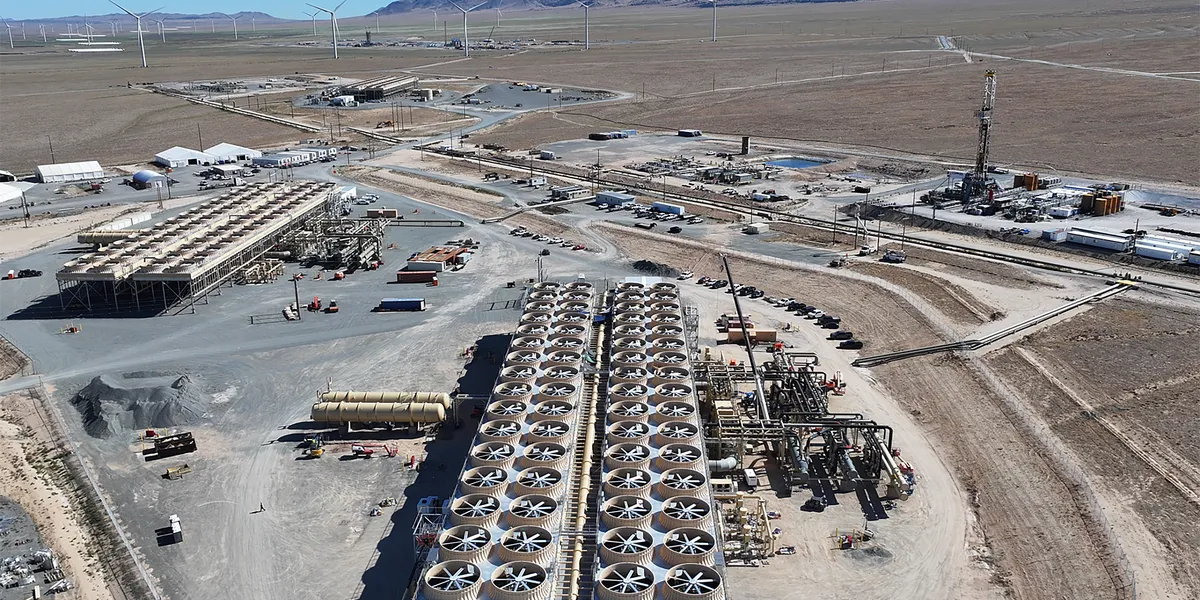
Cape Station, a $2 billion project that will eventually be 500 MW, is unique among the world’s commercial geothermal plants. While other facilities draw on naturally occurring hot water and steam, Fervo has engineered its own geothermal resource deep underground. The startup uses drilling techniques from the oil and gas industry to create reservoirs in hot, dry rocks that generate steam to produce electricity.
“Traditional geothermal would have never been done in southern Utah,” says Dawn Owens, Fervo’s senior vice president and head of development and commercial markets.
With the first unit online, Fervo says it is working to commission two more 33-MW power blocks by 1 January, 2027. The project’s remaining 400 MW — which is supported by a new agreement with Google — is under construction and slated to come online in 2028.
Fervo’s Next-Generation Geothermal Journey
Fervo already operates a 3.5-MW commercial pilot plant in Nevada, which went online in late 2023. Owens says the pilot, called Project Red, was important for demonstrating the technology itself. But firing up Cape Station proves that Fervo’s approach can achieve utility scale and export power to wider markets.
“This is massive for both Fervo and the geothermal industry at large,” she says.
Fervo, which went public in May, is leading the fast-growing movement to develop clean, always-on geothermal power to meet soaring demand from data centers and balance growing supplies of intermittent solar and wind energy. Next-generation geothermal firms have raised billions of dollars in private capital in recent years to develop and deploy technologies that can harness energy in harsh, deep environments.
Drilling continues at Fervo Energy’s Cape Station geothermal plant in Beaver County, Utah, where the company plans to ramp up production to 500 MW. Fervo Energy
Today, geothermal represents just 0.4 percent of total U.S. electricity generation every year. Expanding geothermal’s share of the mix will require not just building more projects like Cape Station but also tackling high upfront drilling costs and other economic and regulatory barriers — all while working to limit potential impacts on communities and the environment, experts say.
“Fervo’s first power achievement shows investors the size and scale of the opportunity to fuel many more such milestones across developers and sites in the future,” says Mitchell Smith, who serves as grid lead for the Mountain West Geothermal Consortium. The bipartisan initiative is calling for increased public and private financing “to help bring more projects online responsibly and at the speed of demand,” he added.
Enhanced Geothermal Energy Gets Cheaper
Fervo has declined to disclose the terms of its power purchase agreements for in-progress and future development, which together represent about 1,000 MW, or enough to power roughly 1 million U.S. homes every year. Phase 1 of Cape Station is set to deliver power at $7,000 per kilowatt, while Phase 2 should come at $5,500 per kilowatt, the company previously told Canary Media. (By comparison, the average cost to build a natural gas–fired power plant was $2,157 per kilowatt in 2025.)
Along with slashing drilling costs, enhanced geothermal projects could improve their economics by delivering power when it’s most valuable to utilities, according to researchers. While geothermal plants traditionally provide around-the-clock, baseload power, next-generation facilities might operate flexibly during certain periods — like in the evening, when solar output declines — to reduce overall grid costs. Geothermal plants could also operate “behind the meter” to directly power data centers, so that the costs of adding new electricity capacity aren’t passed on to utility customers, Owens says.
“We’ve been saying all along that our technology makes geothermal more scalable and affordable in more places,” she says. On Cape Station’s powering-up, she adds, “That’s just something no next-generation geothermal company has ever been able to do before.”
From Your Site Articles
Related Articles Around the Web


