


Presented by Splunk
Every day, organizations learn things their AI systems never get to use.
A security analyst corrects an AI-generated investigation. A network engineer identifies the root cause of a recurring outage. An observability team discovers that a pattern of latency, logs and infrastructure changes predicts service degradation. A customer operations team learns which signals indicate an escalation is likely.
Each moment contains valuable organizational knowledge. But in most enterprises, that knowledge disappears into tickets, dashboards, chat threads, post-incident reviews and the minds of individual experts. It may help solve the immediate problem, but it rarely becomes part of a reusable system that improves future AI-driven decisions.
That is the next challenge for the agentic enterprise.
The future will not be defined simply by who has the most capable model or the most autonomous agents. Many organizations will have access to similar frontier models. Many will deploy agents across security, IT, engineering, customer service, and business operations.
The real differentiator will be whether those agents can learn from the organization around them.
Not by constantly retraining the underlying model, but by capturing operational experience, converting it into institutional knowledge and making that knowledge available to future agents, workflows, and decisions.
The agentic enterprise is not just an enterprise that uses AI. It is an enterprise that learns through AI.
Agentic enterprises allow AI systems to learn from them
The AI conversation has been dominated by model capability: larger context windows, better reasoning, faster inference, stronger tool use, and more sophisticated agentic behavior.
Those advances matter. But in the enterprise, a model is only one part of the system.
A model does not automatically know how a specific organization operates. It does not inherently know which remediation step solved last month’s outage, which analyst correction improved a threat investigation, which network signal preceded a service disruption, or which internal policy should override an otherwise plausible recommendation.
That knowledge belongs to the enterprise.
For agentic systems to improve, organizations need a way to capture that knowledge and make it reusable. In many cases, that does not require changing the model itself. It requires changing the ecosystem around the model: the knowledge base, retrieval layer, prompts, policies, guardrails, routing logic and workflows that shape how agents behave.
The model may remain the same. The learning system around it becomes smarter.
Feedback loops turn every outcome into a teachable moment for agents
Every agentic workflow creates signals.
An agent receives a request. It retrieves context, reasonsthrough possible actions, calls tools, and generates answers. A human accepts, rejects, or modifies that answer. Downstream systems reveal whether the action worked.
That entire chain is valuable.
AI observability gives organizations visibility into what happened: the prompt, response, reasoning path, tool calls, data sources, intermediate steps, failure modes and outcomes. Without that visibility, organizations cannot understand why an agent behaved the way it did, let alone improve it.
But observability alone is not enough.
The larger opportunity is to turn observed behavior into institutional knowledge. A trace should not only help a developer and operators debug an agent. It should help the enterprise understand what the agent learned, what the human corrected, what outcome followed, and what should change before the next similar event.
That is the shift from monitoring AI to teaching AI.
In the agentic enterprise, feedback loops connect action to outcome, outcome to knowledge and knowledge back to future action.
A learning system in practice across security, observability and the network
Consider a service experiencing intermittent degradation.
An observability agent detects unusual latency and error rates. A network agent identifies packet loss across a specific path. A security agent notices that the same time window includes suspicious authentication behavior and unusual traffic from a previously unseen source.
Individually, each agent has only a partial view. Together, they create a richer operational picture.
The first time this incident occurs, human experts may need to intervene. A network engineer confirms that packet loss was caused by a misconfigured routing change. A security analyst determines that the suspicious traffic was not an attack, but a side effect of a misrouted internal service. An SRE connects the network event to the application degradation.
That resolution contains knowledge the organization should not have to relearn.
A mature agentic learning system would capture the traces, human corrections, topology context, security findings, observability signals and final remediation steps. It would preserve the relationship between those signals: latency pattern, network path, identity behavior, routing change and remediation.
The next time a similar pattern appears, agents would not start from zero. They could retrieve the prior case, compare current conditions, recommend the proven diagnostic path and escalate with better context.
The underlying frontier model did not need to be retrained.
The enterprise learned.
The architecture of the learning agentic enterprise
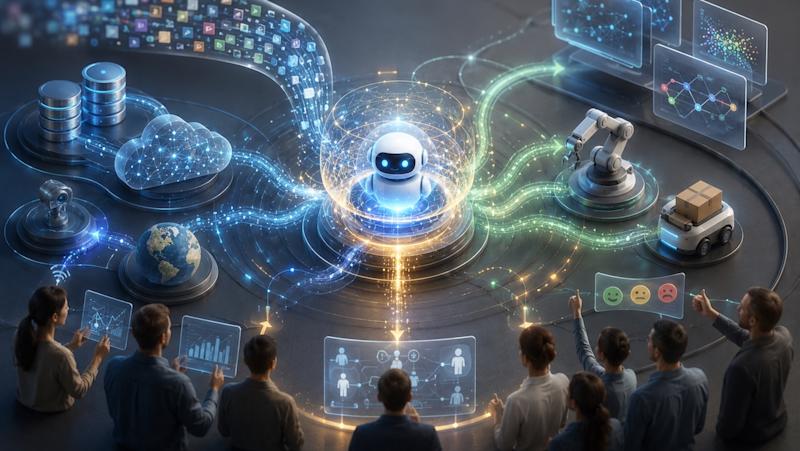
A learning-oriented agentic enterprise needs more than a model or chatbot. It needs an architecture that can capture experience, turn it into usable knowledge, connect that knowledge to operational context, and govern how it changes future agent behavior.
Memory preserves what happened: what the agent saw, what it did, where humans intervened, and what outcomes followed.
Knowledge bases turn that experience into reusable guidance, including playbooks, examples, policies, procedures, and evidence.
A data fabric connects the operational environment. The signals agents need live across logs, metrics, traces, tickets, identity systems, security tools, network telemetry, collaboration platforms, and business applications. A data fabric makes those signals discoverable, correlated, governed, and usable in context.
AI observability explains how agents behave by capturing prompts, tool calls, intermediate steps, responses, feedback, and outcomes. That visibility helps organizations understand where agents succeed, where they fail, and what should improve.
The control plane governs how learning becomes change: what knowledge is promoted, which prompts or policies are updated, which agents can use new information, what approvals are required, and how changes are audited.
Together, these capabilities allow AI systems to improve over time in a controlled, trustworthy way that allows the enterprise to learn from its own operations.
The organizations that learn fastest will win
The next era of AI will not be won by models alone. It will be won by organizations that can capture what they learn from every workflow, expert correction, incident, investigation, and outcome.
The most advanced agentic enterprises will not simply deploy more agents. They will build systems that allow every agent to benefit from the collective knowledge of the organization.
That means connecting operational data through a data fabric. It means observing agent behavior deeply enough to understand it. It means preserving experience in memory and institutionalizing it in knowledge bases. It means using a control plane to govern how learning changes agent behavior.
The future of AI is not a single autonomous agent acting alone. It is an ecosystem of agents, humans, data and controls that learns over time.
The organizations that build that ecosystem will create AI systems that get better with every interaction. Not because the model is constantly changing, but because the enterprise itself is becoming more intelligent.
Learn more about how Cisco Data Fabric powered by the Splunk Platform is accelerating agentic operations.
Hao Yang is Vice President AI at Splunk, a Cisco Company.
Sponsored articles are content produced by a company that is either paying for the post or has a business relationship with VentureBeat, and they’re always clearly marked. For more information, contact sales@venturebeat.com.
