

Long before biomimicry had a name, humans were practicing it. We have always studied living things for clues about how to build, move, heal, and survive. Nature wasn’t a separate category from technology so much as the place where many of our technological ideas began.
Modern engineering has made the connection easier to spot. High-speed trains have borrowed from the shape of kingfisher beaks. Adhesives have been modeled on mussels. Synthetic fibers have taken inspiration from spider silk. Even artificial neural networks trace their conceptual origins to the organization of neurons in the brain.
So the idea that nature can teach us how to innovate is hardly new. What is new is the scale at which we can look.
For most of human history, our access to nature’s accumulated knowledge was limited by what we could observe directly and gradually understand. Today, sequencing, imaging, sensors, bioinformatics, and artificial intelligence are opening biological systems to investigation at levels that were previously inaccessible.
In Living Tech: The Convergence of Biology and Innovation, Singularity expert Robert Suarez describes biology as perhaps “the largest dataset that has ever existed.” That is a useful way to think about what is changing. Biology represents roughly four billion years of evolutionary experimentation, and we are developing much better tools for reading the results.
Biology Is Becoming Legible
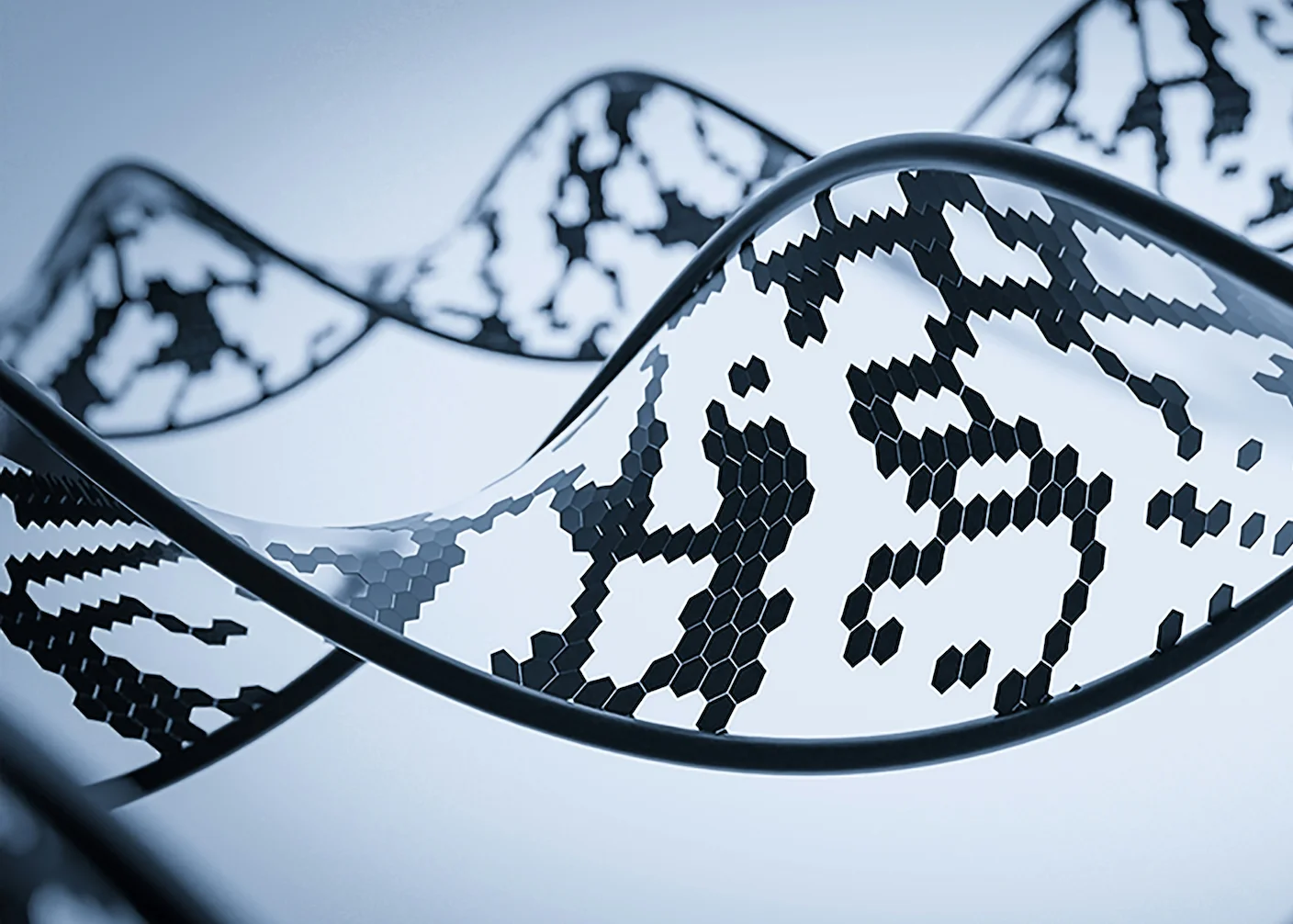
Advances in biotechnology have steadily converted more of the living world into information that computers can analyze. Researchers can sequence genomes, monitor gene expression, map neural connections, track changes inside cells, and collect increasingly detailed information about organisms and ecosystems.
This does not mean that we’ve turned the natural world into a textbook that anyone can understand. If anything, better measurement tends to reveal how inadequate many of our simpler models have been. But it does mean that biological processes once accessible only through painstaking observation can increasingly be analyzed computationally.
AlphaFold is one of the clearest examples. Determining the three-dimensional structure of a protein traditionally required difficult experimental work and could take years. DeepMind’s AlphaFold demonstrated that artificial intelligence could predict protein structures computationally with extraordinary speed, and subsequent versions have expanded that capability to interactions involving proteins and other biomolecules.
AI gives researchers another way to navigate the enormous space of biological possibility. Instead of testing every candidate in a laboratory, computational tools can narrow the field, identify patterns, and suggest where researchers should investigate next.
This offers a new way to approach innovation. Rather than simply noticing that an organism does something useful and trying to imitate it, researchers can increasingly start with a problem and ask where evolution may already have encountered something similar.
What Has Nature Already Figured Out?
Take, for example, transportation networks.
Slime mold is a single-celled organism with no brain or central nervous system. Yet as it searches for food, it creates a network that balances efficiency with resilience. In a well-known experiment, researchers arranged food sources to approximate cities around Tokyo. The slime mold developed a network comparable to the Tokyo rail system in cost, efficiency, and fault tolerance.
The point isn’t that transit authorities should surrender network planning to slime mold. Municipal governments have enough problems without giving procurement authority to an amoeba. The more interesting lesson is that evolution has spent enormous amounts of time working against many of the same underlying constraints humans face.
Living systems must move resources, regulate temperature, store information, respond to disruption, make use of imperfect inputs, and accomplish all of this under severe energy constraints. Once those problems are framed at that level, biology becomes relevant to fields that do not look remotely like biotechnology.
Data centers provide a good example. Cooling is one of their fundamental engineering challenges, while organisms across the natural world have developed an extraordinary variety of ways to manage heat. The opportunity is not necessarily to copy one particular animal or plant, but to examine biological strategies for thermal regulation and ask whether any of their underlying principles can be useful elsewhere.
The same applies to information storage. DNA packs enormous amounts of information into very little physical space. Instead of merely treating that as a curiosity of life, researchers are investigating whether DNA itself could eventually become a medium for storing digital information.
Mining provides another, stranger example. Certain plants known as hyperaccumulators naturally take up unusually high concentrations of metals from soil. Researchers have explored phytomining, in which plants could help recover valuable metals from places where conventional mining might be difficult or uneconomical. The Living Tech report goes a step further, considering how genetic tools might eventually enhance capabilities biology already possesses.
From Learning From Biology to Building With It
There is another difference between traditional biomimicry and what is happening now.
Historically, learning from nature generally meant studying a biological solution and recreating some version of it using human-made materials and machines. Observe flight, build an aircraft. Study adhesion, develop an adhesive. Examine the structure of a shell, design a stronger material.
Synthetic biology expands the possibilities because the biological system itself can become part of the technology.
Humans have manipulated living systems for thousands of years through agriculture, domestication, selective breeding, and fermentation. What has changed is the precision with which we can increasingly read, alter, and design biological processes.
Molecular biologist and Singularity expert Tiffany Vora describes synthetic biology in Living Tech as applying engineering and computer-science principles to the building blocks of life. Once genetic information has been digitized, biology begins to look less like something that must merely be observed and more like a medium that can also be manipulated.
That opens a different class of possibilities. A metal-accumulating plant might not merely inspire a new mining technology; the plant could become part of the mining process. Microorganisms can act as manufacturing systems, converting one substance into another. DNA may not simply inspire dense storage technologies; DNA itself could become the storage medium.
The boundary between biology and technology starts to get fuzzy at that point, which is one of the central ideas behind Living Tech. Biology can inspire technologies, digital technologies can help us understand biology, and synthetic biology can combine the two into systems that do not fit neatly on either side.
Four Billion Years Is a Considerable Head Start
There is a temptation, particularly when AI enters the conversation, to assume that making biology computable means we are close to understanding it. The evidence points in a less tidy direction.
PigeonBot II is a useful reminder.
Researchers from Stanford University and the University of Groningen developed the bird-inspired robot to study how birds achieve stable flight without the vertical stabilizers used by conventional airplanes. The robot could adjust its wings and tail in ways modeled on pigeons and successfully demonstrated stable rudderless flight.
But the researchers ran into a problem when trying to reproduce the performance of feathers. Synthetic alternatives did not match some of the useful mechanical properties of the real thing, so PigeonBot II incorporated actual pigeon feathers.
There is something appropriately humbling about building an advanced robotic bird and discovering that evolution has already manufactured one of the components better than you can.
Examples like this are important because they temper the idea of biology as a dataset. Digitization gives us unprecedented access to living systems, but a digital representation is not the system itself. The more closely researchers examine cells, brains, ecosystems, and organisms, the more often they discover additional layers of interaction that earlier models ignored.
The ebook offers several examples of this pattern. Brain cells once considered largely structural have turned out to play active signaling roles. Parts of the genome once dismissed as “junk” appear to contain additional functions. Researchers continue to discover biological entities that do not fit comfortably into existing categories. Better tools are increasing our knowledge, but they are also increasing the number of things we know we don’t understand.
Four billion years of evolutionary experimentation is a considerable head start.
Biology as a Platform for Innovation
This is why biotechnology may be too narrow a label for what is happening.
Most people still associate biotech primarily with pharmaceuticals, healthcare, genetics, and perhaps agriculture. Those applications are important, but they can obscure the broader possibility that biology is becoming a platform for innovation across industries.
A data-center engineer might look to thermal regulation in living systems. A materials scientist might examine how organisms produce strong materials without the heat, pressure, and chemical treatments common in industrial manufacturing. A mining company might find itself hiring plant scientists. Infrastructure designers might discover useful network principles in fungi or slime mold.
Computing followed a comparable trajectory. It began as an identifiable technology sector and eventually became part of almost every other sector. Artificial intelligence is now going through much the same process. The Living Tech thesis is that biology could increasingly do the same, affecting manufacturing, computing, architecture, transportation, agriculture, and other fields that do not traditionally think of themselves as biotech.
Humans have always looked to nature for ideas. That part is ancient. What is changing is our ability to see biological systems in much greater detail, search for patterns across enormous amounts of information, and increasingly move from observing biological solutions to adapting or directly using them.
Nature has been running experiments for four billion years. We’re getting much better at figuring out what it learned.
This article draws on Living Tech: The Convergence of Biology and Innovation, a Singularity report exploring how biology and technology are converging across fields ranging from manufacturing and computing to agriculture, architecture, neuroscience, and organizational design. Read the full report here.
