


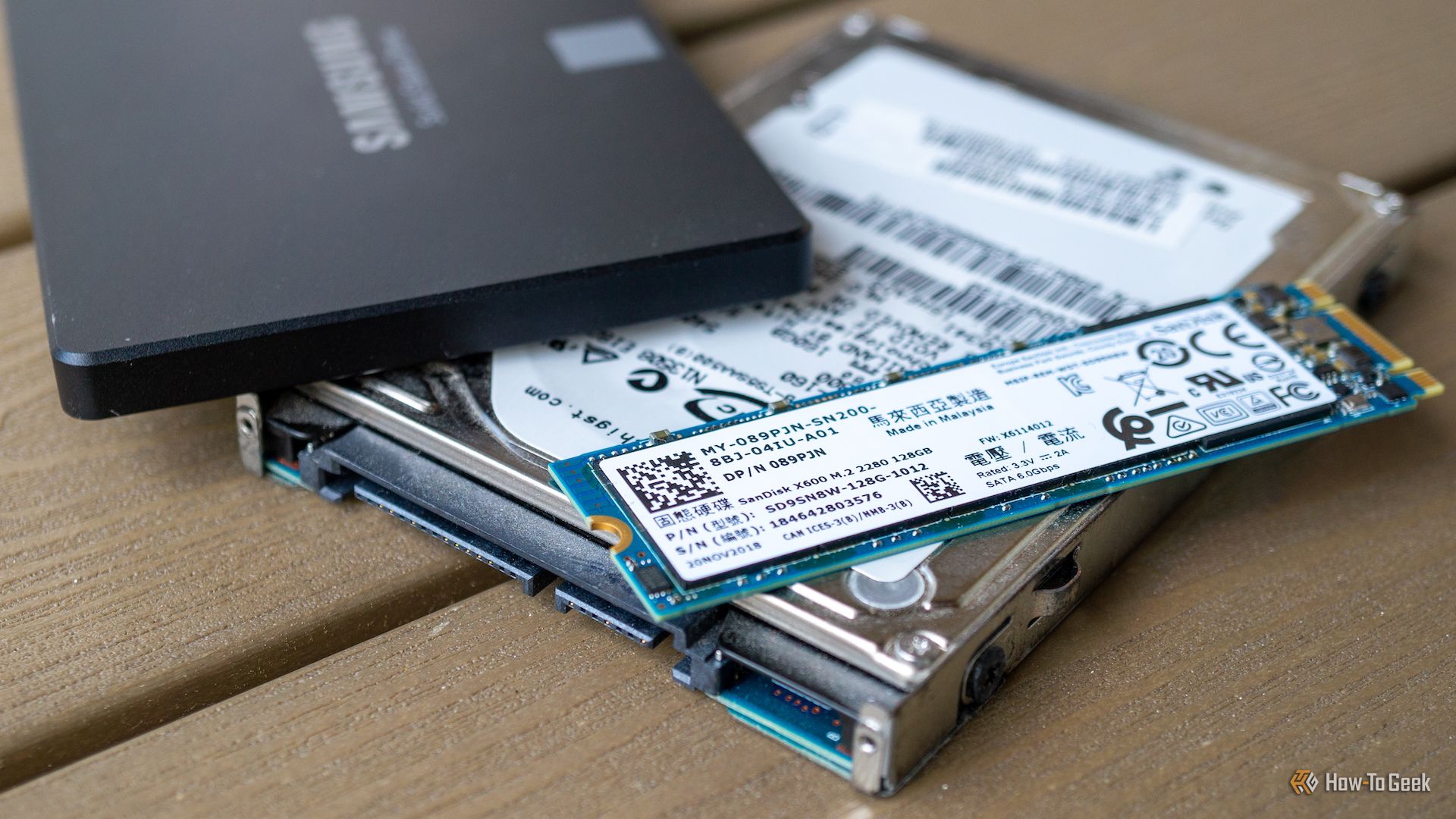
Hard drives fell out of favor with many PC users years ago due to their sluggishness compared to SSDs and the rising affordability of SSDs, which are now the default storage option in desktops and laptops. However, thanks to Western Digital, they could soon stage a grand comeback.
High-bandwidth, dual-pivot drives will sweep past SATA SSDs
Credit: Lucas Gouveia/How-To Geek | reumont/Shutterstock
Western Digital held its Innovation Day 2026 early this week, during which it unveiled a slew of exciting HDD innovations. Considering the glacial pace of hard drive improvements over the last decade or so, it’s surprising to see just how many innovations have been shared at once.
The most important part of the presentation includes two projects designed to close the bandwidth gap with SATA SSDs and potentially exceed them in the future.
The first one, dubbed High Bandwidth Drive, features multiple heads that can read or write data on separate tracks simultaneously. Right now, HDDs can have more than 20 heads, but the current technology allows only a single head to be active at a time.
But on a hard drive featuring High Bandwidth Drive technology, one head can write data while the other reads data from a separate track at the same time, or both can read or write data simultaneously.
Credit: Western Digital
At the current development stage, Western Digital is achieving 2x the bandwidth of regular HDDs (around 550MB/s) without using more power, since the heads of an HBD hard drive can access two tracks simultaneously. This is already as fast as SATA SSDs, which can reach up to 600MB/s on paper, but are closer to ~550MB/s in practice. In the future, the technology should scale up to 4x or even 8x (up to around 2.2GB/s), with up to eight tracks accessible at the same time.
The second project, called Dual Pivot, equips HDDs with a second actuator, located at the opposite end of the drive, allowing the two actuators to access the platters independently. Compared to the current dual-actuator drives, Dual Pivot drives don’t sacrifice capacity. In other words, you’re getting higher sequential and random performance and tons of storage space on a single drive.
Credit: Western Digital
Western Digital’s end goal is to combine High Bandwidth Drive and Dual Pivot technologies into a single drive, which could deliver up to four times the bandwidth of current HDDs—around 1.2GB/s—without using more power than a standard HDD.
According to Western Digital, the theoretical maximum speed of future drives combining the two technologies is close to 4.8GB/s, which is faster than what PCIe 3.0 NVMe SSDs can deliver. What’s more impressive is that WD claims such a hard drive wouldn’t cost much more than an enterprise-class HDD. Just imagine a 24TB hard drive that’s faster than any PCIe 3.0 SSD and costs just a tad more than a regular 24TB HDD. Color me intrigued.
Related
This risky storage trick makes old HDDs feel fast—here’s when you should use it
Make old hard drives fast again—why gamers should actually use RAID 0
We can also expect HDD capacities to exceed 100TB
Credit: Western Digital
Aside from becoming lightning-fast, hard drives will also get much more spacious. WD is working on developing a 100TB hard drive for the enterprise market based on HAMR (heat-assisted magnetic recording) technology, which should arrive by 2029.
Credit: Western Digital
On the other hand, the company’s ePMR (energy-assisted perpendicular magnetic recording) drives should reach 60TB in a few years as well. At the moment, the company is prepairing a 40TB ePMR HDD that’s expected to hit the market sometime this year.
New HDDs are targeting the enterprise market, but regular users will benefit too
Credit: Western Digital
Now, I don’t know about you, but I’m pretty excited about these developments. Hard drives have been almost forgotten among the regular PC builders, especially those focused on gaming. Sure, many people still buy and use HDDs for cold storage, servers, NAS devices, and data hoarding, but with SSDs being much faster and relatively affordable, HDDs are now no more than an afterthought for many PC owners.
The idea of having a hard drive faster than a SATA SSD—or even a PCIe 3.0 SSD—that doesn’t cost an arm and a leg sounds great. But there’s a massive caveat here. At the moment, both high-bandwidth and high-capacity HDDs are aimed at AI data centers, which are devouring every bit of memory and storage available and have triggered the RAM-pocalypse.
Now, the silver lining here is that, firstly, most enterprise innovations eventually trickle down to the consumer market. I’m positive we’ll be able to get our hands on one of these drives; we’ll just have to wait a few years. Secondly, you can purchase an enterprise-class HDD without issues even today in the middle of the RAM-pocalypse, so there’s no reason to believe these high-bandwidth HDDs won’t be available to regular PC owners shortly after they launch.
After all, they ought to use the regular 3.5-inch form factor and the SATA interface (at least until they exceed the SATA bandwidth limit), so the only issue here will be the price of admission.
But hey, once they become relatively affordable, I could see myself getting one to store everything on it, aside from the games I’m currently playing. Being excited about a hard drive—let alone one that won’t even arrive for a few years—was not on my 2026 bingo card.
Storage Capacity
8TB
Compatible Devices
SATA
The WD Red Plus hard drive line is designed specifically for NAS usage. This means the drive is build to withstand 24/7/365 usage, with up to a 180 TB per year workload rate. You’ll also get a 3-year warranty with the purchase of WD’s Red Plus drive lineup.
