

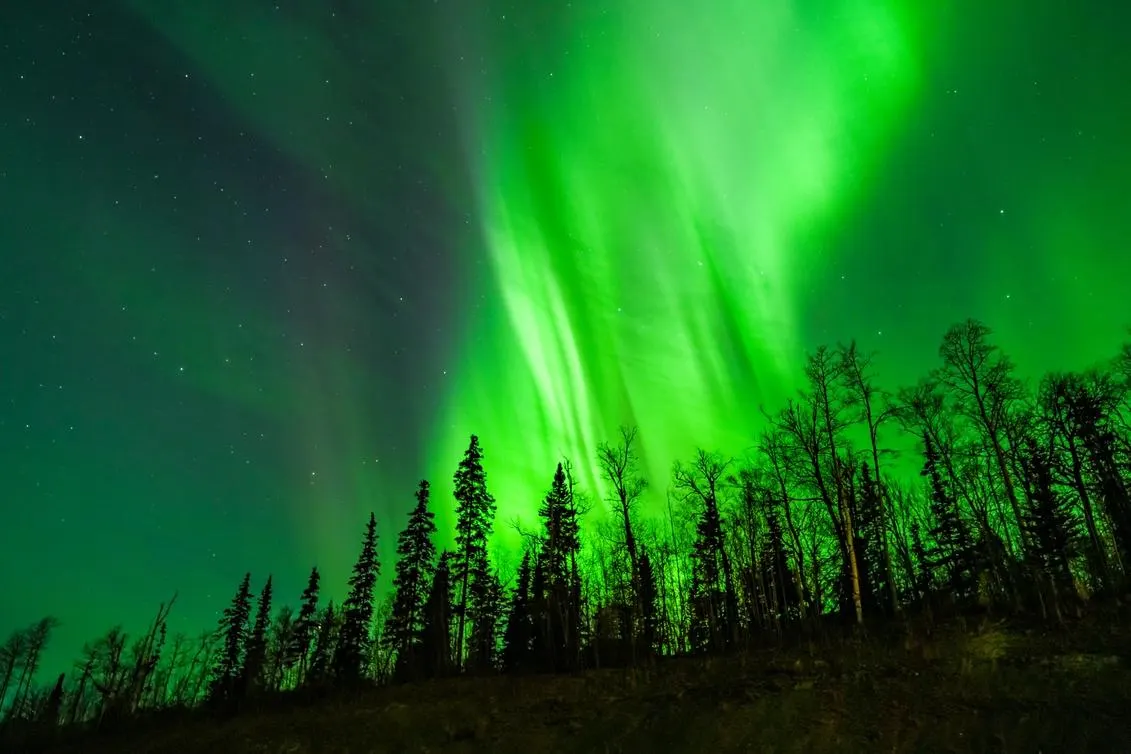
Intense northern lights (aurora borealis) above Kp5 were observed in Alaska’s Matanuska-Susitna Borough, around Chickaloon and Bonnie Lake, on the night of September 30 to October 01, 2025. (Photo by Hasan Akbas/Anadolu via Getty Images)
Anadolu via Getty Images
The Northern Lights may be visible from northern U.S. states and Canada as soon as it gets dark on Thursday, Oct. 16, 2025, as a coronal mass ejection travels towards Earth to cause a geomagnetic storm.
A coronal mass ejection is a cloud of magnetic fields and charged particles from the sun that stream into space at up to 1,900 miles (3,000 kilometers) per second. It’s often referred to as a CME by space weather forecasters. A CME can take a few days to reach Earth (if it’s Earth-directed).
The National Oceanic and Atmospheric Administration’s Space Weather Prediction Center (SWPC) published a geomagnetic storm watch. Its aurora alert is for a G2-rated geomagnetic storm, which could mean the Northern Lights being seen in northern U.S. states from New York to Idaho.
It follows several displays of aurora in northern U.S. states in recent weeks.
NOAA’s storm watch for a G2 geomagnetic storm on Oct. 16, 2025.
NOAA
Northern Lights Forecast: What To Expect
NOAA’s three-day forecast includes a minor geomagnetic storm, measured at a value of G2 on a scale of G1 to G5. According to NOAA’s forecast, the Kp index — which provides a rough guide to the intensity of aurora displays — may reach 5 or 6.
The latest has a G2-rated geomagnetic storm beginning around 21:00-0:00 UT (4:00-7:00 p.m. EDT) on Thursday, Oct. 16, though timings are approximate. “G1-G2 (Minor-Moderate) geomagnetic storm conditions are
likely over 16-17 Oct due to the arrival of multiple CMEs from 11-13
Oct,” states the forecast.
“The aurora may become visible over some northern and upper Midwest states from New York to Idaho,” reads the storm watch from NOAA. “Those wishing to see the aurora should visit our page for updates.”
To check the presence of aurora in real time, use NOAA’s 30-minute aurora forecast, or download apps such as Aurora Now, My Aurora Forecast or Glendale Aurora for up-to-the-minute alerts and live solar wind data.
Northern Lights Forecast: Where And When
NOAA’s latest aurora viewlines indicate that aurora displays are a possibility in northern U.S. states and Canada, with up to 12 U.S. states having a chance after dark on Thursday, Oct. 16.
U.S. states that may see aurora include Alaska and (northerly parts of) Washington, Idaho, Montana, Wyoming, North Dakota, South Dakota, Minnesota, Wisconsin, Michigan, New York and Maine.
Dark northern skies away from urban light pollution are likely to offer the best views. To escape urban glow, drive 30–60 minutes from city centers to a Dark Sky Place or use a light pollution map to locate darker skies. The rule is simple — the darker the northern sky, the more vibrant the display, even during moderate geomagnetic storms.
Northern Lights Forecast: Watch The ‘Bz’
Aurora-chasers frequently use the Kp index to predict the intensity of a geomagnetic storm, but for aurora displays, the interplanetary magnetic field’s Bz component is more important (you’ll find it in some of the above apps and on SpaceWeatherLive.com).
Bz determines how easily solar energy enters Earth’s magnetosphere. When Bz points north, Earth’s field resists it; when Bz swings south, the two fields connect, allowing plasma to stream in. A sustained southward Bz of −5 nT or stronger usually signals an imminent display of aurora.
The sun on Oct. 15, 2025, showing a coronal hole rortating away from Earth.
NASA SDO
What Causes The Northern Lights
Streams of charged particles flowing from the sun and interacting with Earth’s magnetic field — the solar wind — are what cause the Northern Lights. While most of those particles are deflected, some accelerate down magnetic field lines toward the poles, colliding with oxygen and nitrogen atoms high in the atmosphere. These collisions excite the gases, causing them to release energy as shimmering light.
The solar wind becomes fast-moving and turbulent when there’s heightened activity on the sun. The incoming displays originate from a particular sunspot — a darker, cooler area on the sun — that tends to produce solar flares and CMEs, such as the three headed towards Earth. Most of them come from active sunspot 4246, one of the largest and most magnetically disorganized sunspots of the present solar cycle, according to SpaceWeather.com. “Although the CMEs are individually faint and relatively slow, they could combine to cause a G1 or G2-class geomagnetic storm when they arrive on Oct. 16-17,” reports the website.
Northern Lights Forecast: How To Photograph Aurora
A mirrorless or DSLR camera is ideal (ISO 1600, 2-10 seconds, f2.8), though newer smartphones are increasingly capable of stunning results. If your smartphone has a Night Mode or Pro Mode, you can capture a great-looking aurora photo with these steps:
- Use your main lens, not the ultra-wide, for sharper results.
- Stabilize the camera using a tripod or rest it on a firm surface such as a car roof, wall, or post. Or just bring your elbows in to your chest to steady your phone.
- Shoot in RAW format if available, for easier post-editing.
- Expect long exposures between five and ten seconds (and up to 30 on a tripod). Even faint glows that look grayish to the eye often appear vividly green, purple or red in photos.
Wishing you clear skies and wide eyes.
