
Close Menu
Tech Nova Mindset – Empower Innovation and Forward Thinking

    Subscribe to Updates

    Get the latest creative news from FooBar about art, design and business.

    What's Hot

    This Week’s Awesome Tech Stories From Around the Web (Through August 1)

    August 1, 2026

    Nobody Knows if OpenAI’s and Anthropic’s AI Hacking Sprees Are Illegal

    August 1, 2026

    The Man Who Understood Risk: Robert N. Charette retires.

    August 1, 2026
    Facebook X (Twitter) Instagram
    Trending
    • This Week’s Awesome Tech Stories From Around the Web (Through August 1)
    • Nobody Knows if OpenAI’s and Anthropic’s AI Hacking Sprees Are Illegal
    • The Man Who Understood Risk: Robert N. Charette retires.
    • 7 States’ Water Systems Hit by Cyberattacks Likely Tied to Iran
    • Gemini Robotics 2 Brings Google’s AI Into the Physical World
    • This AI Assistant Wants to Make Up for Your Boyfriend’s Incompetence
    • Europe Approves Bionic Eye to Restore Vision Lost to Blindness
    • Chinese AI Researchers Are Finding Their Voice on X
    Tech Nova Mindset – Empower Innovation and Forward Thinking
    • Home
    • Gadgets
    • Reviews
    • Tech News
    • Future Tech
    • AI & Robotics
    • How-To Guides
    • More
      • Cybersecurity
      • Startups & Innovation
    Tech Nova Mindset – Empower Innovation and Forward Thinking
    Home»Future Tech»The Universe Is Full of ‘Impossible’ Black Holes. Now Scientists Know Why
    Future Tech

    The Universe Is Full of ‘Impossible’ Black Holes. Now Scientists Know Why

    kirklandc008@gmail.comBy kirklandc008@gmail.comMay 24, 2026No Comments3 Mins Read
    Facebook Twitter Pinterest LinkedIn Tumblr Email
    The Universe Is Full of ‘Impossible’ Black Holes. Now Scientists Know Why
    Share
    Facebook Twitter LinkedIn Pinterest Email

    An international team of astrophysicists has found evidence that the universe recycles black holes, merging them to form even larger ones. Gravitational waves recorded in recent years show that some of the heaviest black holes within star clusters exhibit clear signs of being “second-generation” black holes—products of past collisions—and therefore could not have originated from the collapse of a massive star.

    Impossible Black Holes

    The evolutionary theory of stars explains that, at the end of the lives of the most massive stars, their cores compress until they form a point so dense that it curves space-time to infinity. This is the classic black hole, with masses 10 to 40 times that of the sun. There are also supermassive black holes, in the center of galaxies, with millions or billions of solar masses, whose origin is related to processes that occurred in the earliest moments of the universe.

    Between these two extremes lies a contested category: black holes with masses between 40 and 100 solar masses. They are too heavy to be born after the death of a star, but they do not reach the necessary dimensions to emerge from the collapse of a gigantic cloud of matter. Conventional stellar physics considers them “impossible,” yet they appear frequently in detections.

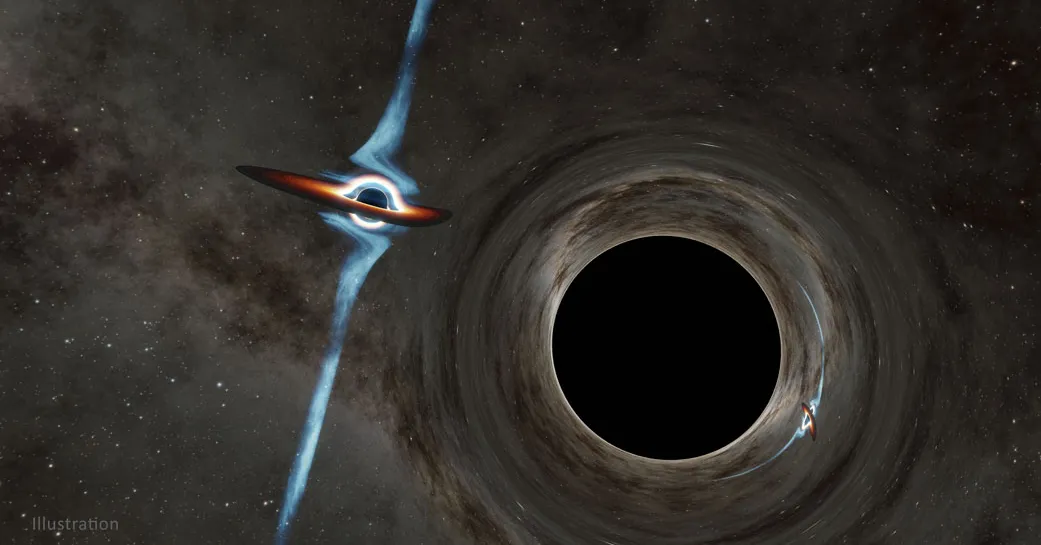
    A “normal” sized black hole, isolated in space.

    Courtesy of Space Telescope Science Institute Office of Public Outreach

    Astrophysicists propose that these massive black holes could form by the merging of two or more smaller, ultradense objects. The idea was plausible, but it needed evidence. Until relatively recently, there was no way to obtain it.

    Then gravitational wave detectors came on the scene. These instruments use lasers to measure the micro-distortion of space-time generated by the collision of extremely dense objects. The first detection, in 2015, confirmed a merger between black holes. Since then, each new signal has allowed for a better characterization of these structures and revealed that these collisions occur much more frequently than previously imagined.

    The Second-Generation Signature

    The study, published this month in Nature Astronomy, analyzed a transient catalog of gravitational waves generated by the world’s three leading observatories. The database included 153 reliable detections of black hole mergers. Among them, 34 corresponded to particularly heavy objects.

    By comparing all the signals, the team identified two distinct populations. The lighter black holes, up to about 40 solar masses, showed small, aligned spins, as expected for objects born from the collapse of a star. But from a certain point, around 45 solar masses, a completely different population appeared: heavier black holes, spinning rapidly and in chaotic directions—a statistical signature that can arise only when the object has already participated in a previous merger.

    “This is the exact signature you would expect if black holes repeatedly merged into dense stellar clusters,” said Isobel M. Romero-Shaw, coauthor of the research, in a statement from Cardiff University.

    So far researchers have not directly observed any of these “impossible” black holes. They do not appear in x-rays or in the visible spectrum, unlike supermassive ones. However, their collisions vibrate space-time, and that vibration reveals masses that stellar physics cannot explain.

    This study shows that the heaviest black holes are built rather than born. They arise from previous generations of collisions, assembled in the densest environments in the cosmos.

    This story originally appeared in WIRED en Español and has been translated from Spanish.

    Black full Holes impossible Scientists Universe
    Share. Facebook Twitter Pinterest LinkedIn Tumblr Email
    kirklandc008@gmail.com
    • Website

    Related Posts

    Why Scientists Redesigned the Botox Enzyme With AI

    July 28, 2026

    Scientists Are Designing CRISPR Gene Editors With AI

    July 24, 2026

    How AI helps scientists design the next generation of medicines

    July 24, 2026
    Leave A Reply Cancel Reply

    Top Posts

    Nothing CEO says phone prices are going to keep going up

    June 12, 20267 Views

    Google DeepMind Plans to Track AGI Progress With These 10 Traits of General Intelligence

    March 21, 20263 Views

    The AirPods 4 and Lego’s brick-ified Grogu are our favorite deals this week

    October 12, 20253 Views
    Stay In Touch
    • Facebook
    • YouTube
    • TikTok
    • WhatsApp
    • Twitter
    • Instagram
    Latest Reviews

    Subscribe to Updates

    Get the latest tech news from FooBar about tech, design and biz.

    Recent Posts
    • This Week’s Awesome Tech Stories From Around the Web (Through August 1)
    • Nobody Knows if OpenAI’s and Anthropic’s AI Hacking Sprees Are Illegal
    • The Man Who Understood Risk: Robert N. Charette retires.
    • 7 States’ Water Systems Hit by Cyberattacks Likely Tied to Iran
    • Gemini Robotics 2 Brings Google’s AI Into the Physical World

    This Week’s Awesome Tech Stories From Around the Web (Through August 1)

    August 1, 2026

    Nobody Knows if OpenAI’s and Anthropic’s AI Hacking Sprees Are Illegal

    August 1, 2026

    The Man Who Understood Risk: Robert N. Charette retires.

    August 1, 2026

    7 States’ Water Systems Hit by Cyberattacks Likely Tied to Iran

    August 1, 2026
    Facebook X (Twitter) Instagram Pinterest
    • About Us
    • Contact Us
    • Privacy Policy
    • Terms and Conditions
    • Disclaimer
    © 2026 TechNovaMindset. Designed by By Pro.

    Type above and press Enter to search. Press Esc to cancel.