

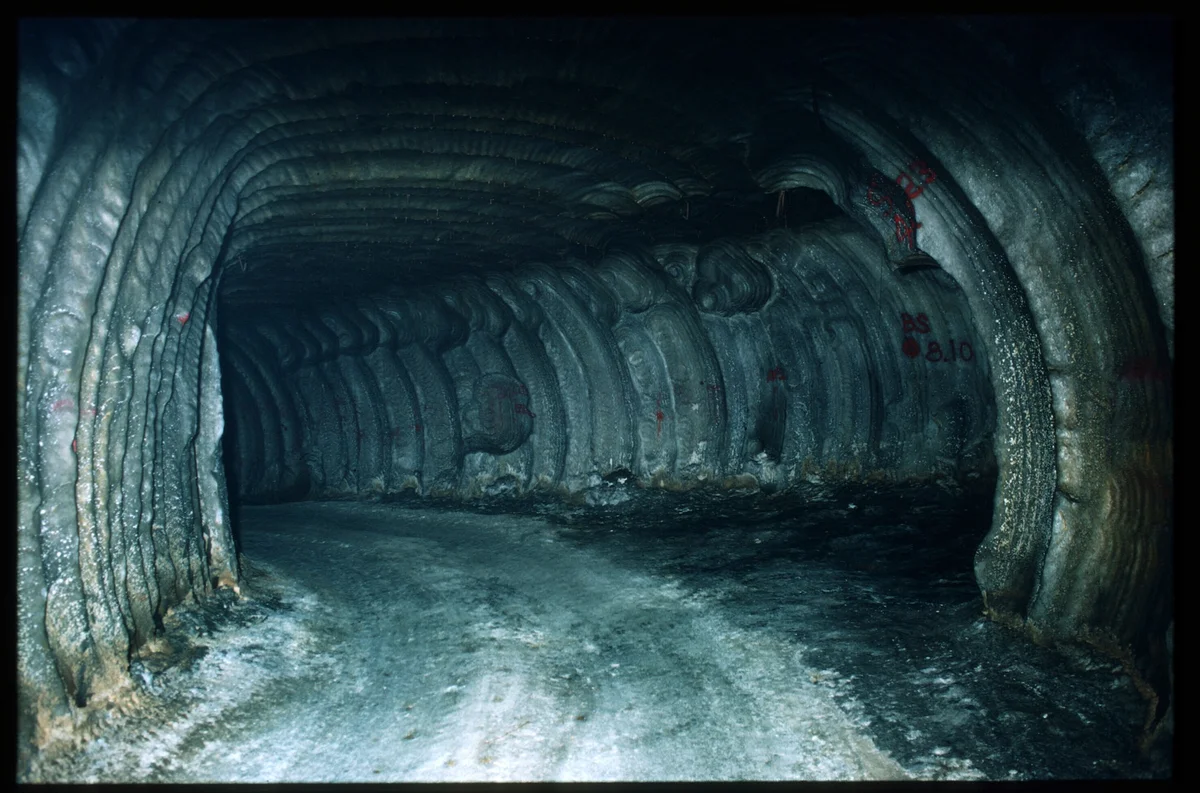
Since the war with Iran began, the Trump administration has drawn down the U.S.’s emergency oil reserve to near its lowest level since the Reagan era. In a bid to keep exports flowing and reduce domestic gas prices while a fifth of the world’s oil supply remains trapped behind the Strait of Hormuz, the administration has pulled out 66 million barrels and counting from the Strategic Petroleum Reserve (SPR), a set of colossal underground salt caverns in Texas and Louisiana that house the nation’s buffer of crude.
This raises certain questions. Could the depletion prompt a market panic, raising prices even higher? When will the reserve be replenished? And wait a second—we store oil where?
Beyond its political and economic dimensions, the story of the SPR is one of geology. It begins not with the energy crisis of the 1970s, which spurred the U.S. government to create a stockpile of oil, but 160 million years earlier, during the late Jurassic.
On supporting science journalism
If you’re enjoying this article, consider supporting our award-winning journalism by subscribing. By purchasing a subscription you are helping to ensure the future of impactful stories about the discoveries and ideas shaping our world today.
Around then, a rift formed between what is now the Gulf Coast and Mexico’s Yucatán Peninsula. As the land masses slowly drifted apart, a basin opened between them. For a time, this basin was isolated from the world’s oceans, so rainwater runoff from upland had nowhere to go—the water simply evaporated, leaving behind whatever dissolved minerals it carried. Chief among them was halite, the mineral form of sodium chloride, better known as table salt. After untold cycles of evaporation, the basin became a “big hole filled with salt,” says Mark Rowan, a geology consultant who specializes in salt tectonics.
Today the vast Gulf Coast salt deposits lie thousands of feet underground. At that depth and pressure, salt doesn’t behave like the seasoning in your kitchen, nor does it behave like other minerals. Most rocks are porous and permeable, meaning they’re filled with interconnected spaces that enable liquids, including oil, to seep through. But salt has special properties that make it impermeable—it flows and deforms, more like plastic than rigid rock, allowing it to self-heal incipient cracks.
“It’s a fantastic seal,” Rowan says. “If you want to store something and not have it leak out into the surrounding ground or earth, then salt is a fantastic place.” And the seal works both ways, according to Shangyou Nie, a former strategy adviser at Shell and editor of the American Association of Petroleum Geologists’ Well Read newsletter. Salt’s ability to deform “also prevents other things from getting into the caves,” he says, “so the oil will not be contaminated.”
To make room for oil, the government drilled into the salt at various locations, injected massive amounts of fresh water to dissolve it, then pumped out the brine. This resulted in some 60 massive caverns with a combined capacity of 714 million barrels of oil. (The largest could easily fit Chicago’s 110-story Willis Tower.) This storage method, according to the Department of Energy, is up to 10 times cheaper than aboveground tanks and 20 times cheaper than hard rock mines.
When it’s time to withdraw from the SPR, workers take advantage of the fact that oil is lighter than water: they inject fresh water into the bottom of the caverns, forcing oil to float to the surface, where it can be distributed via pipeline to refineries around the country. Most of it doesn’t have to go far—Texas and Louisiana account for roughly half the nation’s refining capacity.
Salt caverns are among the most secure ways to store large quantities of oil, but even they aren’t perfectly impermeable. “Nothing is,” Rowan says. “If you have enough pressure, and there’s a weak point, then you’ve got a problem.” Researchers monitor pressure daily to ensure the caverns remain structurally sound, and earthquakes are rare in the Gulf Coast region. Still, there’s precedent for failure: the German government stored radioactive waste in salt caverns for decades before groundwater finally penetrated, rendering the site unstable.
As for the economic implications of depleting the SPR, Nie isn’t concerned. Companies purchasing the oil are required to replenish it, and the Trump administration is coordinating its withdrawals with 31 fellow member countries of the International Energy Agency, the goal being to calm global oil markets. Besides, draining the reserve right now is “just smart business,” according to Nie. “You should buy when the oil price is low, to fill it up,” he says, “and you should sell or release when the oil price is high.”
It’s Time to Stand Up for Science
If you enjoyed this article, I’d like to ask for your support. Scientific American has served as an advocate for science and industry for 180 years, and right now may be the most critical moment in that two-century history.
I’ve been a Scientific American subscriber since I was 12 years old, and it helped shape the way I look at the world. SciAm always educates and delights me, and inspires a sense of awe for our vast, beautiful universe. I hope it does that for you, too.
If you subscribe to Scientific American, you help ensure that our coverage is centered on meaningful research and discovery; that we have the resources to report on the decisions that threaten labs across the U.S.; and that we support both budding and working scientists at a time when the value of science itself too often goes unrecognized.
In return, you get essential news, captivating podcasts, brilliant infographics, can’t-miss newsletters, must-watch videos, challenging games, and the science world’s best writing and reporting. You can even gift someone a subscription.
There has never been a more important time for us to stand up and show why science matters. I hope you’ll support us in that mission.
