

Getting a DNA sample is simple. Rub a Q-tip a few times inside your cheek, and voilà.
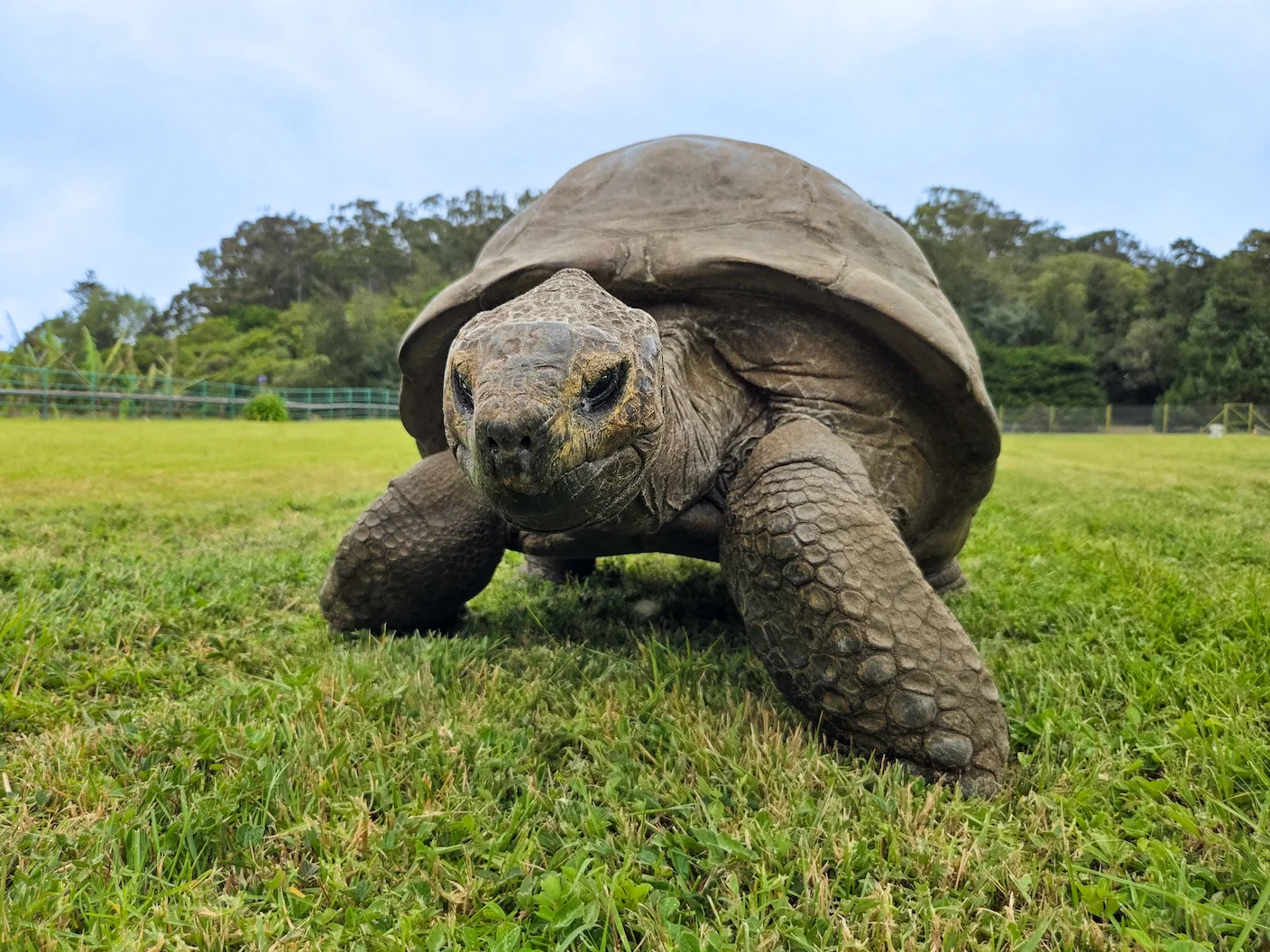
Not so with a 400-pound Aldabra giant tortoise. At the age of roughly 194, Jonathan is the oldest known living land animal on Earth. He’s spent most of his life lounging on the manicured lawns of the governor’s residence on the island of St. Helena, where he arrived as an adult. Though blinded by cataracts, Jonathan still chows down on grub and has excellent hearing.
Even among long-lived tortoises, Jonathan is exceptional. He’s lived around a century longer than others of his kind. Now, thanks to his DNA, an intrepid team of scientists may know why.
Jonathan (left) arrived in St. Helena in 1882, around the time of this photograph. Image Credit: A.L. Innes
Getting a sample was tricky and dangerous. Jonathan’s veterinarian, Joe Hollins, lured him in with fresh greens, then quickly wedged his mouth open to scrape cells from inside his cheek. The tortoise tolerated the unusual procedure for only a few seconds. Any longer, and Hollins might have faced the wrath of Jonathan’s razor-sharp beak.
But the maneuver paid off. After sequencing the sample, the team found that Jonathan’s genome was better maintained compared to tortoises roughly a century younger.
As animals age, their DNA accumulates mutations. Telomeres, the protective end caps of chromosomes, shrink. Chemical tags that control which genes are turned on or off also go awry, straying from their normal patterns and settling on unexpected spots across the genome.
For study author Stephen Clark, founder of the nonprofit Kallel Foundation, this growing disorganization, called entropy, is central to aging. Yet Jonathan has weathered plenty of biological wear and tear despite his advanced age.
“Nature has already solved the puzzle of aging in remarkable ways, and Jonathan’s genome provides a blueprint for cellular resilience,” said Clark in a press release.
Aging Outliers
Animal research has given us clues to how we might live healthier, longer lives.
At one end of the spectrum are short-lived creatures. Studies of lowly roundworms and fruit flies—often squished or swatted—have uncovered genes and molecular pathways that let cells sense nutrients, withstand stress, and clear cellular waste. These processes falter with age.
At the other extreme are animals that seemingly don’t age. Take the hydra, a tiny, carnivorous jellyfish-like animal. In long-term studies, some species showed no detectable rise in mortality or lower reproduction with age and retained the ability to regenerate after severe injuries. Their “immortality” may come from a steady supply of stem cells and resilience against senescent cells that no longer work properly.
Naked mole rats have also caught scientists’ attention. These nearly hairless rodents can live more than 30 years, roughly 10 times longer than a mouse of similar size. They resist many types of cancer, maintain strong hearts and muscle mass into old age, and rarely develop Alzheimer’s disease, even with toxic protein buildup. By studying these animals’ genetics, scientists have discovered ways they preserve gene expression machinery and maintain protein stability as the clock ticks on.
Tortoises offered more inspiration. In 2019, scientists sequenced the genome of Lonesome George, the last known Pinta Island giant tortoise, who died at an estimated 100 years old. His genome revealed beneficial adaptations in DNA repair, immune function, and inflammation. A subsequent study comparing multiple turtle lineages found shared genetic changes associated with cellular resiliency against stress and cancer protection.
“Each of these long-lived species has some kind of special trick,” biologist Steve Austad at the University of Alabama at Birmingham told The New York Times. “And some of those may turn out to be relevant to human aging.”
But as the oldest land creature, Jonathan is irreplaceable. Hidden in his DNA may be another set of tricks for keeping cells, and maybe the entire body, functioning for longer.
Spirited Supercentenarian
Collecting Jonathan’s DNA without getting bitten or kicked was only the first hurdle. Shipping the precious cargo across the ocean without damaging it was another. Then came the headache of piecing his genome together.
Cheek cells yield shorter DNA fragments that must be stitched together, and samples can be contaminated with bacteria. The first try at reconstructing Jonathan’s genomic blueprint had gaps, so the team, led by the Nashville-based nonprofit Kallel Foundation, used DNA from a younger tortoise to fill them in. Roughly 95 percent of the resulting Frankenstein genome was Jonathan’s.
A blood draw, the gold standard for DNA sequencing, might have yielded a clearer map. But St. Helena officials ruled it out because of the risk of infection.
Even so, Jonathan’s genes revealed intriguing differences compared to four other Aldabra tortoises roughly a century his junior. Of the 287 genes unique to Jonathan, many were involved in DNA repair or preventing telomeres from shortening—both of which help keep the genome stable. Roughly a dozen of Jonathans’ genes overlapped with genes implicated in naked mole rat longevity and that of other long-lived animals, hinting at shared evolutionary strategies.
But the surprise finding related to his epigenetics, the system of chemical tags, or DNA methylation, that regulates gene activity. Young animals tend to maintain relatively consistent methylation patterns between cells, coordinating which genes switch on or off. With age, some of these marks disappear while others attach chaotically, making gene activity less predictable.
Clark calls this growing disorganization entropy. As expected, Jonathan’s epigenome showed higher overall entropy than his younger peers. But some genes were spared.
Those involved in mitochondrial function kept a surprisingly youthful profile, comparable to that of a five-year-old Aldabra. Mitochondria, the cell’s energy producers, are closely linked to aging and age-related diseases. Maintaining mitochondrial health may have helped fuel DNA repair systems and warded off disarray in the epigenome—potentially creating a virtuous cycle to keep disorganization in check.
The findings echo genetic research on a woman who lived past 117. Although she harbored clusters of mutated blood cells and signs of DNA damage, her mitochondria appeared healthier than those of women decades younger.
How genes behave is just one piece of the aging picture. Diet, exercise, environment, and mental health all play roles. Jonathan mostly lived a life of luxury, with abundant fresh food, a safe home, and his veterinarian, Hollis, close at hand.
These comforts may have contributed to his longevity. But the results point to potential biological pathways that the body uses to stay spry for longer. The team plans to map the genomes of more Aldabra tortoises and other long-lived creatures. By studying these outliers, we may better grasp our own longevity and learn how to fight off age-related diseases.
“Our goal is to take these evolutionary insights and immediately translate them into practical, affordable treatments for everyday people,” said Clark.
