





Financial markets have always relied on timely information, and the drive for timeliness has always adapted to the latest technology. From clipper ships transiting the oceans to telegraph wires connecting cities to fiber-optic cables conducting trades in microseconds, traders have embraced any advantage to get the most up-to-date information. Indeed, the history of finance is really a story about how fast you can move information and who controls the interface.
It’s only natural that people also figured out a way to profit by supplying that market intel. In 1841, for example, the Mercantile Exchange (predecessor to Dun & Bradstreet) began selling proprietary business information to its U.S. clients. The following decade, Paul Julius Reuter began selling news services and stock price information. To supplement the company’s telegraph dispatches, he sent pigeons between Aachen, Germany, and Brussels; each bird carried a cylinder containing slips of paper with that day’s stock prices. In 1867, an inventor named Edward Calahan introduced the first telegraphic ticker-tape machine, which spooled out stock price information in near real time; Thomas Edison improved upon the design with his patented version in 1871.
The Dow Jones Industrial Average debuted in 1896 as an index of 12 key businesses listed on U.S. stock exchanges. It included gas, oil, coal, and electric companies, as well as enterprises dealing in leather, rubber, and tobacco. Messengers delivered quotes from the trading floor to brokerage offices, while stock tickers kept investors informed of prices. By the time New York City held its first official ticker-tape parade, in 1919, telegraphy in Western Europe and the United States had become the chief means for quick transmission of vital stock information.
In 1960, the first paperless financial service debuted, when Quotron introduced its electronic screens for displaying market quotes. Over the next two decades, other companies rolled out similar innovations for distributing financial news and data.
So when Michael Bloomberg decided to enter this well-established industry in 1981, the big question was: How would his new company stand out?
The Birth of the Bloomberg Terminal
Bloomberg had cofounded Innovative Market Systems (IMS) after being fired from the investment bank Salomon Brothers. Landing on his feet with his US $10 million equity payout and joined by former Salomon colleagues Thomas Secunda, Duncan MacMillan, and Charles Zegar, Bloomberg pursued his belief that Wall Street would pay a premium for specialized financial data. He’d earned an electrical engineering degree from Johns Hopkins University and an MBA from Harvard, and he’d built computerized financial systems for Salomon. IMS focused on developing a computer terminal that not only provided up-to-date information but could also do instant quantitative analysis based on historical data.
Michael Bloomberg believed Wall Street would pay a premium for access to specialized financial data. Karjean Levine/Getty Images
At the time, most financial data still circulated through telephone calls, printed price sheets, and specialist publications, and analysis involved a fair amount of gut instinct guided by human expertise. Companies such as Reuters and Dow Jones provided subscription-based services for access to business news. But traders still had to assemble information from multiple sources and perform their own calculations and analysis.
IMS proposed an integrated system with a single interface. Its Market Master terminal consisted of a monochrome CRT monitor, a custom keyboard, and a communications/controller unit that connected to the company’s private network. At launch, it provided only U.S. government bond prices and bond-calculation tools, but the dream was much bigger: a dedicated terminal that would sit on a trader’s desk and run different market scenarios, produce yield curves, and support investment calculations.
IMS initially had just one client, Merrill Lynch, which invested $30 million (about $110 million today) in exchange for a 30 percent stake in the company and exclusive rights to the terminals for five years; Merrill waived that right in 1984. The first 22 Market Master terminals were delivered to Merrill in 1982, in the middle of a global recession. The timing was fortuitous. Worldwide, stock markets were transitioning to electronic trading, and the U.S. Federal Reserve was allowing more freely floating interest rates. Bond prices were more volatile, and investors were eager to figure out how to value them accurately. Bloomberg’s specialized financial terminals provided the data and the analytical tools to process and comprehend those sweeping changes.
Five years after its launch, IMS rebranded as Bloomberg LP and expanded its clientele, and the Market Master became known as the Bloomberg Terminal.
How Did the Bloomberg Terminal Work?
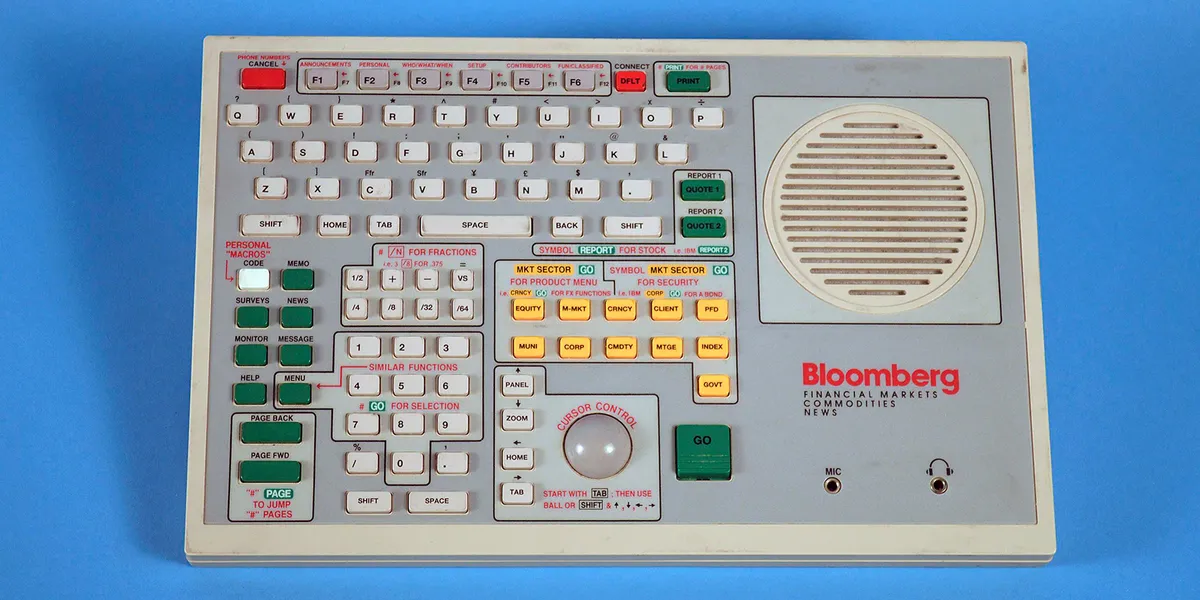
The Bloomberg Terminal’s keyboard was designed with traders and analysts in mind. The function keys were color-coded and given labels specifying their usage, so that users didn’t have to remember. The original keyboard, affectionately referred to as “the Chiclet,” was hand assembled. A cable ran from the keyboard to the Bloomberg Controller, which had a dedicated phone line to connect to a local hub. The internet wasn’t commercially available yet, so the company basically built its own closed network, with centralized computers that maintained large databases and performed most of the calculations. Commands entered on the keyboard sent a request to the hub, which processed the information and sent back the result.
The Chiclet keyboard for the Bloomberg Terminal was introduced around 1983. Although it looks like a generic keyboard, its function keys were finance-specific hot keys.National Museum of American History/Smithsonian Institution
Hot keys let traders easily call up data on government securities, corporate debt, and currency markets, among other things. A series of keystrokes would pull up other historical and real-time data, run an analysis, or place a trade. Learning how to use the terminal and digest the vast amount of information, which was presented mostly in tabular form, became a rite of passage for users.
In 1990, Bloomberg added a trackball to the keyboard, which helped the user navigate the multiple windows and menus typically displayed on screen. Two years later, the keyboard gained a built-in speaker, to support multimedia information; this design also included telephone, headphone, and microphone jacks. One of the most popular features was Instant Bloomberg, which allowed users to chat directly with fellow Bloomberg Terminal users over the proprietary network. By 1996, Bloomberg had keyboards that supported 23 different languages. In the early 2000s, the company began incorporating biometric authentication for terminal login, via a fingerprint reader on the keyboard.
As the company’s business model evolved, the Bloomberg Terminal added services well beyond its initial offerings. In 1990, for example, worried that Dow Jones would stop providing access to its news stories, Bloomberg set up its own news service. It recruited Wall Street Journal reporter Matthew Winkler to oversee a dozen reporters; their stories on market and securities movements used graphs and calculations that served as advertisements for the terminal’s capabilities. These days, the Bloomberg news empire includes Bloomberg Businessweek, Bloomberg Radio, and Bloomberg Television.
Bloomberg’s subscription-based financial model included the leasing of a Bloomberg Terminal with its specialized keyboard and other hardware, access to a dedicated private network, and a suite of services. In 1999, a subscription to a single Bloomberg Terminal cost $1,600 per month with a minimum two-year contract and a discount on each additional terminal. Today the annual price is upwards of $32,000 (trending a little below inflation). In 1995, the company launched a suite of “Open Bloomberg” software products that ran on the customer’s own PC; five years later, it stopped leasing dedicated terminals. Current customers also have access to mobile applications that allow terminal functions to run on phones and tablets. Today, “Bloomberg Terminal” has come to refer to the integrated data, analytics, news, communications, and trading environment.
The Legacy of the Bloomberg Terminal
Although the shift away from dedicated terminals was a logical response to the rise of the internet and publicly available market data, it altered the material culture of financial work. For nearly two decades, Bloomberg Terminals commanded an aura of power and financial prowess. They were emblems of market mastery, with a brand that was distinct from other office computers. With Open Bloomberg, users were no longer tied to a single desk or a fixed set of monitors.
And so, cast-off Bloomberg Terminals found their way into museum collections. They’re a physical embodiment of the ethereal nature of financial markets, and a manifestation of mathematical calculations, network infrastructure, and business culture.
The Bloomberg keyboard used by “Bond King” Bill Gross has his login and password taped on the front.National Museum of American History/Smithsonian Institution
The Smithsonian Institution’s National Museum of American History has a number of Bloomberg keyboards in its collection, but my favorite is object number 2014.0012.02, which was used by “Bond King” Bill Gross during the 1990s and 2000s at Pacific Investment Management. Gross had cofounded PIMCO in 1971 and built it into a $2 trillion bond investment firm. I especially love that Gross taped his login and password directly on his keyboard, which makes the object more relatable. I may never know what it’s like to manage billions in assets from a Bloomberg Terminal, but I absolutely understand the trial of remembering my passwords.
Part of a continuing series looking at historical artifacts that embrace the boundless potential of technology.
An abridged version of this article appears in the October 2026 print issue as “The Keyboard That Moved Markets.”
From Your Site Articles
Related Articles Around the Web


