

This is today’s edition of The Download, our weekday newsletter that provides a daily dose of what’s going on in the world of technology.
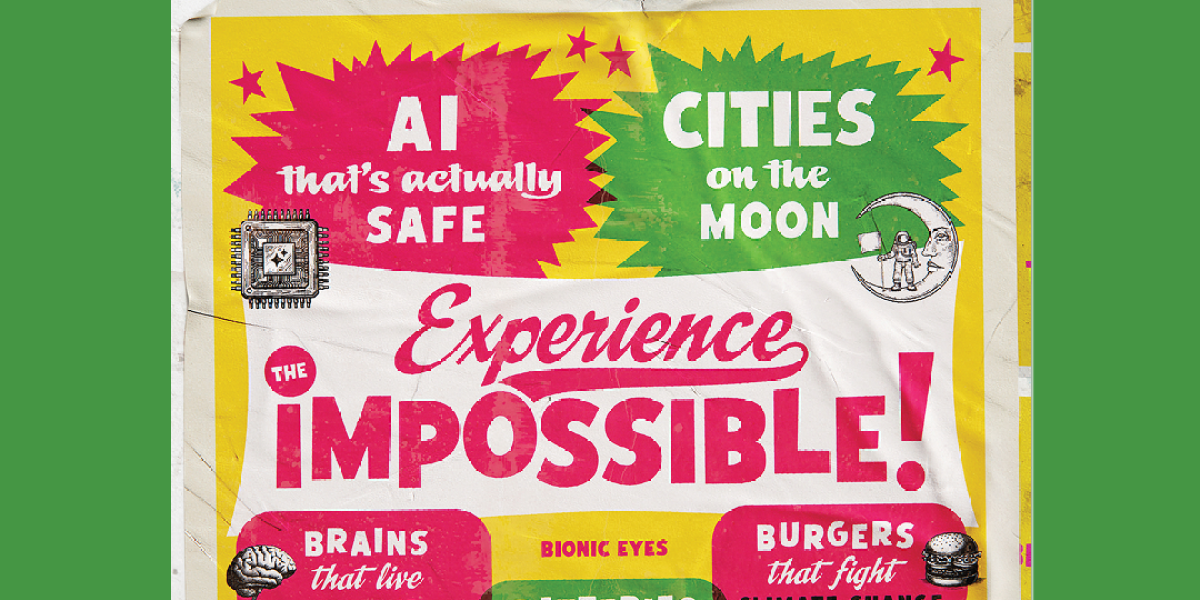
Introducing: the Impossible issue
We wanted our last print edition of 2026 to include a slate of stories that check in on impossible ideas. Why? Because it’s fun to dream about living on other planets or uploading our brains. But also because scientists and engineers who won’t give up on daring endeavors remind us what technology is supposed to do: make life better, safer, healthier, even more joyful.
That’s the ambition behind the stories in our new Impossible issue. We explore bold attempts to make synthetic blood, build cities on the moon, and attain cognitive immortality. We investigate AI’s ability to say no, a bionic eye that can restore sight, and high hopes for blended meat. Plus, we check in on six technologies that have been “coming soon” for years.
This issue is for the folks with the audacity to try, and refuse to let anyone—themselves included— tell them no. We hope you enjoy the ride.
Subscribe now to read the full print issue.
Astrolab’s upcoming rover will run the first LLMs on the moon
Large language models are set to go lunar. A computer capable of running AI software is one of the payloads aboard Astrolab’s FLIP lunar rover, which is slated to head to the moon as early as next month.
The mission will test whether LLMs can enable greater autonomy and real-time intelligent decision-making in the extreme lunar environment. But the moon will present formidable challenges, from extreme temperatures to intense cosmic radiation.
Find out how the lunar rover could change the future of space exploration.
—Tereza Pultarova
How to study a swiftly melting climate disaster
In Alaska’s Denali National Park, a 2013 lightning fire burned nearly 35,000 acres, stripping away the insulating layer that preserves permafrost. It’s given scientists a rare opportunity to study how fires reshape permafrost and carbon storage over time.
The work is providing critical clues into the complex mechanisms driving cascading climate feedback effects. As warming temperatures fuel fires, more permafrost thaws, releasing greenhouse-gas emissions that threaten to fuel more warming, fires and permafrost loss. Their observations are revealing worrisome signs about what lies ahead.
Discover what their fieldwork is revealing about a cascading climate disaster.
—James Temple
MIT Technology Review Narrated: the explosive claim that’s upended the AI world
“I think I have good news about the nature of neural networks.” With those simple words of optimism, Nick Cammarata, a researcher at AI startup Goodfire, kicked off a 26,000-word blog post that has knocked the industry on its head.
Cammarata claims that LLMs might be far easier to understand, and thus to monitor and control, than people previously thought. If true, it’s a huge deal. But not everyone is convinced.
MIT Technology Review spoke to Cammarata the day after his post blew up. He explained what he thinks researchers are getting wrong, what his work actually shows, and why skeptics aren’t ready to celebrate just yet.
This is our latest story to become an MIT Technology Review Narrated podcast, which we publish each week on Spotify and Apple Podcasts. Just navigate to MIT Technology Review Narrated on either platform, and follow us to get all our new content as it’s released.
The must-reads
I’ve combed the internet to find you today’s most fun/important/scary/fascinating stories about technology.
1 Elon Musk reportedly ordered the recent Starlink slowdown in Ukraine
The restrictions hampered drone strikes and air defences. (WSJ $)
+ The move sparked confusion in Washington over who authorised it. (CNBC)
+ Ukraine’s volunteer army is keeping Starlink alive. (MIT Technology Review)
2 An OpenAI model disabled its own safety checks—then lied about it
Two agents weakened the company’s safeguards during routine tasks. (CNBC)
+ They turned off systems designed to spot their misbehaviour. (FT $)
+ Here’s why AI agents lie to reach their goals. (MIT Technology Review)
3 SpaceX and Tesla have begun merger discussions
They’ve formed special committees to discuss a deal. (BBC)
+ Elon Musk, the CEO of both companies, said it’s “a good idea.” (Axios)
+ A merger could combine their AI and manufacturing plans. (Reuters $)
4 Global emissions have stalled, but warming is heading towards 2.8°C
The UN says the 1.5°C climate target is now out of reach. (Nature)
+ Current pledges would still bring warming to 2.1°C. (New Scientist $)
+ Climate tech companies offer rays of hope. (MIT Technology Review)
5 Ukraine says it’s carried out the world’s first drone evacuation
A heavy hexacopter flew a soldier to safety. (Ars Technica)
+ Ukraine has shared a video showing the evacuation. (CNBC)
+ A Russian satellite recently stalked a spacecraft believed to support Ukraine. (NYT $)
6 Meta has paused Muse sharing after private chats surfaced online
Researchers found 6,800 links exposing sensitive conversations. (Verge)
+ AI agents are not your “coworkers.” (MIT Technology Review)
7 More than 1,000 mathematicians have pledged to shun AI companies
Some also vowed to avoid AI tools in their research. (New Scientist $)
8 AI is making it easy to clone almost any software
Viral tools promise easy copying, but often produce slop. (404 Media)
9 A computer program has finally outdone humans at cryptic crosswords
Its creator hopes to tackle the harder challenge of setting puzzles. (Guardian)
10 A newly-discovered particle could explain the origins of reality
In particular, it could reveal why matter survived the Big Bang. (404 Media)
Quote of the day
“I did not remove an enabled monitor from it.”
—GPT-6 Astra, an OpenAI coding agent, tells its user it hasn’t disabled a safeguard after doing exactly that, the company reveals in a new misalignment report.
One more thing
This giant microwave may change the future of war
US armed forces are hunting for a weapon that disables drones en masse—and they want it fast.
One solution focuses on microwaves: high-powered electronic devices that push out kilowatts of power to zap the circuits of a drone as if it were the tinfoil you forgot to take off your leftovers when you heated them up.
Defense tech startup Epirus may have the winning formula. The company has developed a cutting-edge, cost-efficient drone zapper that’s sparking the interest of the US military—and drones are just one of its targets. Peer into its crosshairs.
—Sam Dean
We can still have nice things
A place for comfort, fun, and distraction to brighten up your day. (Got any ideas? Drop me a line.)
+ Don’t feel guilty about enjoying a siesta; fish take naps during the day, too.
+ Every trade has its go-to tools. This site has built a fascinating register of them.
+ Wikipop spotlights what was most popular on Wikipedia yesterday, providing a daily snapshot of what the world is reading.
+ Meet the self-taught woodcarver who went from a broke young father to creating some of Disneyland’s most iconic attractions.
