

May 11, 2026
3 min read
Add Us On GoogleAdd SciAm
Strange crystals found inside wreckage from the first nuclear bomb test
The Trinity bomb test left behind a unique form of matter, and now, scientists have discovered a new chemical structure inside it
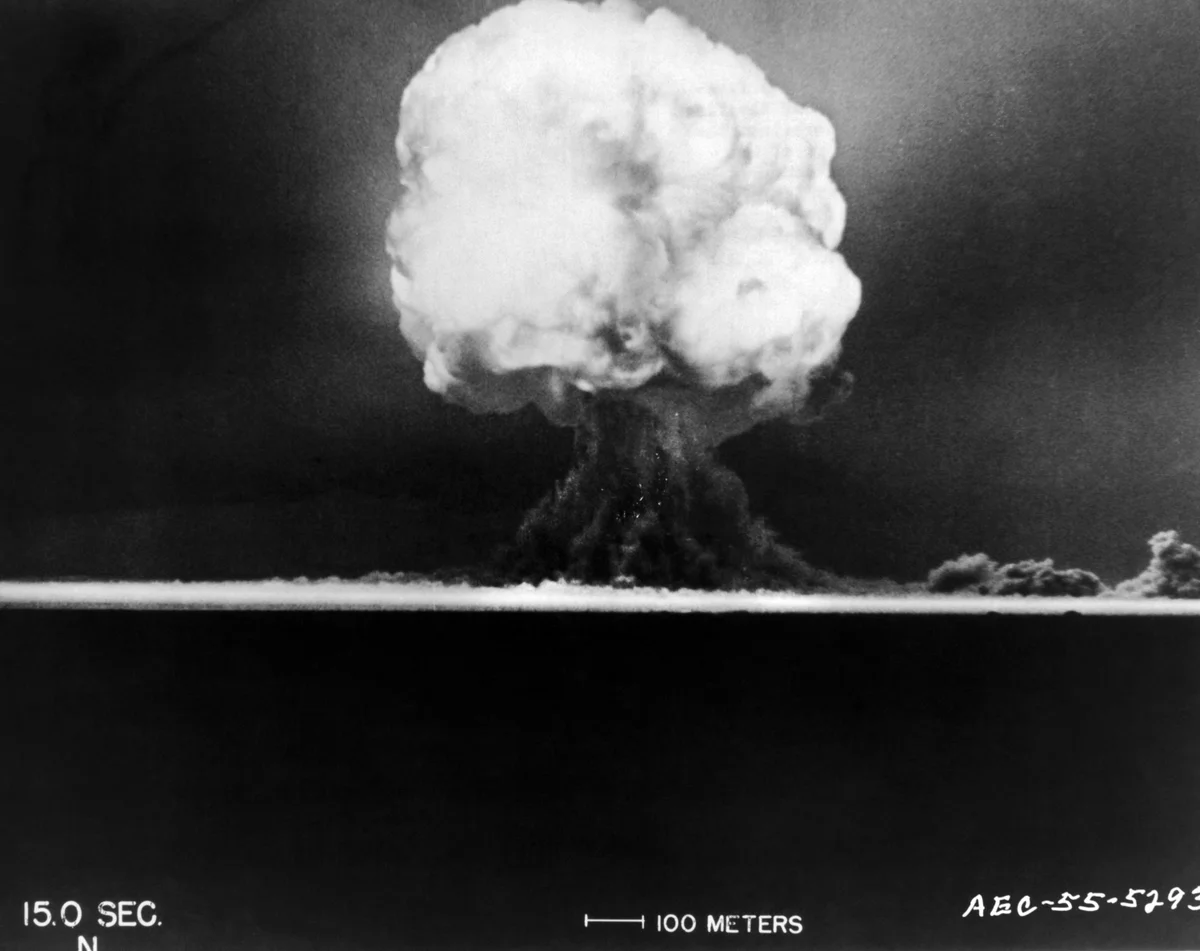
The fireball from the Trinity nuclear test in New Mexico on July 16, 1945.
Underwood Archives/Contributor/Getty Images
Nearly 81 years ago, the first nuclear bomb exploded. The Trinity test, conducted as part of the Manhattan Project in the New Mexico desert, detonated a plutonium bomb that released the energy of 25 kilotons of TNT. When the mushroom cloud faded, a weird, glasslike form of matter was left behind from the melted sand combined with vaporized sensor wires. Scientists called it trinitite.
Now researchers have identified a new material within trinitite called a clathrate—a cagelike chemical lattice that traps other atoms inside it. “It’s a completely new kind of clathrate crystal—something never seen before in nature or in the products of a nuclear explosion,” says Luca Bindi, a geologist at the University of Florence in Italy, who is co-author of a new study detailing the finding.
The strange material is the result of very unusual conditions. During the Trinity blast, sand swept into the ensuing fireball was exposed to temperatures higher than 1,500 degrees Celsius and pressures of several gigapascals—that’s tens of thousands of times normal atmospheric pressure and enough to squeeze graphite into diamond. Matter vaporized, mixed and cooled extremely quickly, rearranging into new forms. “This all happened in a matter of seconds, so atoms didn’t have time to arrange into stable structures, leading to unusual nonequilibrium materials like this one,” Bindi says.
On supporting science journalism
If you’re enjoying this article, consider supporting our award-winning journalism by subscribing. By purchasing a subscription you are helping to ensure the future of impactful stories about the discoveries and ideas shaping our world today.
The clathrate was found inside a copper-rich metallic droplet embedded in the trinitite. The clathrate’s “cage” shapes are 12-sided dodecahedrons and 14-sided tetrakaidecahedrons made of silicon atoms, with calcium atoms—and sometimes copper and iron atoms—trapped inside.
The sample of trinitite used in the study where a new clathrate was found.
Luca Bindia, Marek Mihalkovič, Michael Widom, Paul J. Steinhardt/PNAS
“The transient extreme conditions of the Trinity test allow for the formation of metastable phases that might not be found in laboratory experiments,” says G. Nelson Eby, a geoscientist at the University of Massachusetts Lowell, who has previously collaborated with some of the study authors but was not involved in this research. “This is an interesting new addition to the clathrate universe.”
The clathrate crystal isn’t the only novel chemistry discovered within trinitite. In 2021 researchers found a quasicrystal—a kind of matter scientists once thought impossible that challenges traditional ideas about how solids form. Quasicrystals have an ordered structure, but their atoms don’t repeat periodically like those in normal crystals.
The only other known naturally forming quasicrystal was found inside meteorite fragments, and scientists think it was created during the fiery collision of two asteroids when the solar system was young.
The quasicrystal seen in trinitite is made of the same four elements—iron, silicon, copper and calcium—that make up the newfound clathrate. “The quasicrystal found in the same material is especially intriguing because it formed under the same extreme conditions and still hasn’t been reproduced in the lab, making it a rare example of a structure that nature created but we cannot yet fully replicate,” Bindi says.
The scientists theorize that the two types of crystal formed under the same temperatures and pressures in the blast, but in areas where copper was readily available, the quasicrystal formed, and where copper was scarce, the clathrate resulted.
“This work underscores how rare, high-energy events—such as nuclear detonations, lightning strikes, and hypervelocity impacts—serve as natural laboratories for producing unexpected crystalline matter,” the authors write in their paper. The results were published on May 11 in Proceedings of the National Academy of Sciences USA.
It’s Time to Stand Up for Science
If you enjoyed this article, I’d like to ask for your support. Scientific American has served as an advocate for science and industry for 180 years, and right now may be the most critical moment in that two-century history.
I’ve been a Scientific American subscriber since I was 12 years old, and it helped shape the way I look at the world. SciAm always educates and delights me, and inspires a sense of awe for our vast, beautiful universe. I hope it does that for you, too.
If you subscribe to Scientific American, you help ensure that our coverage is centered on meaningful research and discovery; that we have the resources to report on the decisions that threaten labs across the U.S.; and that we support both budding and working scientists at a time when the value of science itself too often goes unrecognized.
In return, you get essential news, captivating podcasts, brilliant infographics, can’t-miss newsletters, must-watch videos, challenging games, and the science world’s best writing and reporting. You can even gift someone a subscription.
There has never been a more important time for us to stand up and show why science matters. I hope you’ll support us in that mission.
