

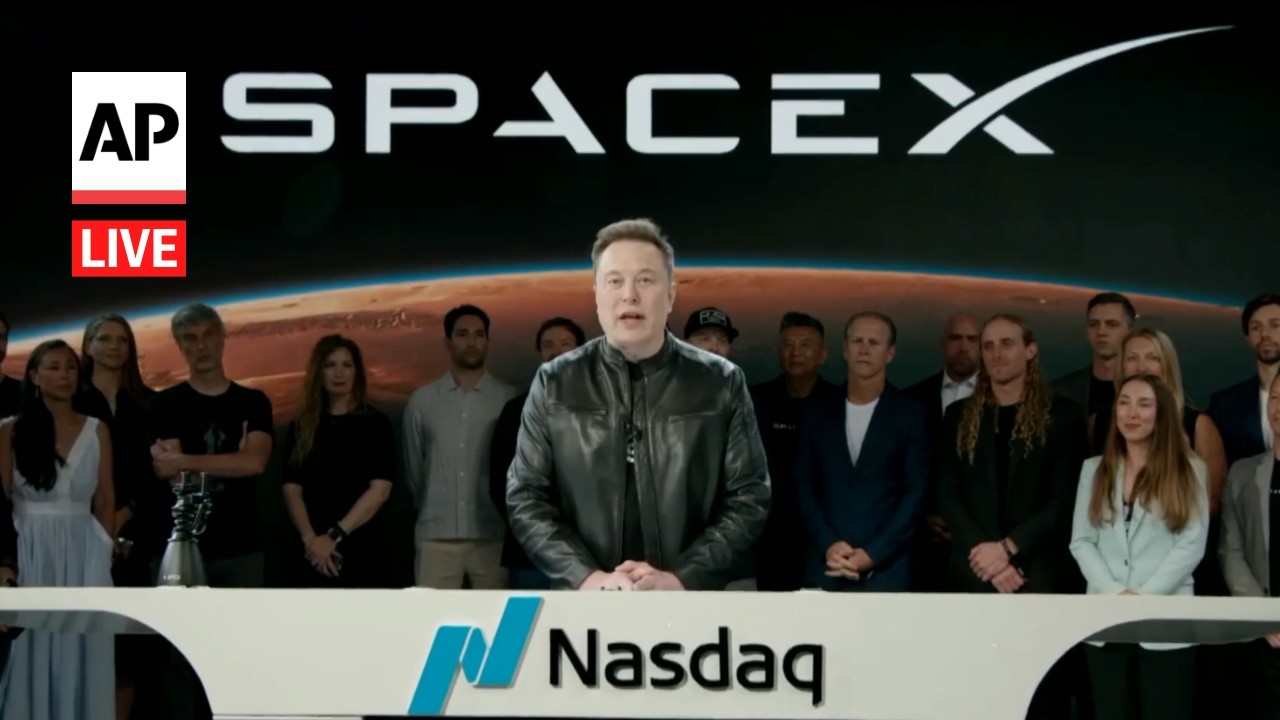
Elon Musk rings the opening bell for the SpaceX IPO on Friday morning.
Imagine missing the Tesla IPO. I understand the pull to invest in SpaceX (SPCX). But SpaceX at a $1.75 trillion valuation is a different ball game. Tesla went public at a valuation a thousand times smaller. And the Musk premium that powered Tesla’s run wasn’t baked into the IPO price. Investors got it for free. Neither is true at SpaceX. Those two differences aren’t even the most important argument to consider. If you’re still on the fence about buying SPCX: read on.
Two camps emerged from Thursday night’s pricing. The first sees the largest IPO in history, $75 billion raised, and reads it as a vote of confidence in American ambition. The second sees a $1.75 trillion valuation on a company that lost $4.94 billion last year on $18.67 billion in revenue and asks where the math comes from.
Both camps are answering the wrong question. The right one isn’t whether SpaceX is a great company. It is. The question is whether SpaceX is valued fairly.
The Tesla effect.
Tesla’s run from a $1.7 billion IPO to a trillion-dollar valuation trained a generation of retail investors to interpret Musk-led volatility as a buying opportunity. Drawdowns of 30, 40, 60 percent in TSLA were correct ex-post to hold through. The lesson has been internalized as a rule: when a Musk company drops, you buy. That rule worked spectacularly. It is now being applied, unconsciously, to a company starting at roughly 1,000 times the Tesla IPO market cap.
The discipline that worked when Tesla was a $1.7 billion company will not work when SpaceX is a $1.75 trillion one. The math is different. The opportunity set is different. The base rate is different. Position sizing built on a small-cap conviction rule, applied to a mega-cap, is not conviction. It is a category error.
The behavioral term is the lottery effect: chasing the small probability of an outsized payoff while ignoring the much larger probability of a mediocre or negative one. University of Florida finance professor Jay Ritter’s data on four decades of US IPOs shows that listings of unprofitable companies underperform the market by roughly 30 percent over the following three years. SpaceX lost $4.94 billion last year. The lottery framing is not a metaphor. It is what the historical data say happens to companies that go public losing this much money.
The most expensive mistake a Tesla winner can make is to assume the rule that minted them generalizes. It doesn’t. Tesla minted you because of where Tesla started, not because of who runs it. The starting valuation is the variable. At $1.75 trillion, that variable is set against you.
A few structural facts about the IPO itself reinforce the point.
The early price is engineered, not discovered.
SpaceX is floating roughly 4% of itself — some $75 billion of stock against trillions of dollars of global demand. The lockup is the tell. Instead of the standard 180-day cliff, the prospectus lays out a tiered release that lets insiders begin selling tranches after the first earnings report and continues in steps through day 180. Musk is exempt from the early provisions.
Add a microscopic float, MSCI fast-track inclusion 10 trading days after listing that triggers mechanical buying from passive funds tracking nearly $6 trillion in assets, a retail allocation originally targeted near 30 percent and cut to the low 20s as institutional demand overwhelmed the book, and a staggered insider exit that distributes into whatever pop the scarcity produces.
That isn’t price discovery. That is choreography.
We have seen this picture before. Saudi Aramco listed in December 2019 on a 1.5 percent float at a $1.7 trillion valuation, popped 10 percent on day one, briefly touched $2 trillion on day two, and now trades near 27 riyals against a 32 riyal IPO price, below where it came public more than six years later. Snowflake priced at $120 in September 2020, opened at $245, closed at $254, and today trades around $240. Opening-day buyers are still flat-to-negative on a five-and-a-half year hold. The opening weeks of SPCX will tell you nothing about what SpaceX is worth. They will tell you what scarcity, a Musk premium, and index flows produce when they collide.
S&P Dow Jones, notably, declined to fast-track SpaceX into the S&P 500. The profitability rule held. That should tell you something about what one major index committee thinks of the valuation.
The economics ask you to underwrite a company larger than any that has ever existed.
At the $135 IPO price, SPCX trades at roughly 94 times trailing revenue. To justify the valuation on a conventional discounted cash flow, SpaceX has to grow into something north of $1 trillion in revenue and a few hundred billion in annual profit. For reference, Amazon does about $740 billion in revenue today and Alphabet does about $130 billion in annual profit. SPCX has to outgrow both.
The bulls have an answer. Morgan Stanley and Goldman project $160 billion in 2028 revenue, roughly nine times last year. New Street models 60 percent compound growth through 2030 and lands at a $165 target. Those numbers require Starlink to become a SaaS giant, Starship to reach commercial cadence, and xAI (folded into SpaceX in February) to compete with OpenAI and Google for orbital compute.
Each is arguably plausible on its own (though as an AI guy, I’m particularly skeptical of xAI). At this IPO price, you are paying upfront for all three bets to land. In contrast, Morningstar puts fair value at $780 billion — $63 a share against the $135 offer.
Who actually runs SpaceX.
One more piece the coverage has glossed past. SpaceX is going public with Musk retaining 85 percent of voting power through Class B shares. Public shareholders will own an economic interest and almost no governance interest. There is no proxy fight available, no activist path, no board seat to recruit. If you disagree with how Musk is allocating capital between Starlink, Starship, and xAI, your only option is to sell.
Concentrated voting structures exist at other large tech companies. None of them are at $1.75 trillion with a CEO running multiple other major operations. The governance discount that should apply here is not modest. It is the difference between owning a piece of the seventh-largest company in the world and owning a piece of whatever the famously mercurial Musk decides it should be on a given Tuesday.
Where I could be wrong.
If Starship hits weekly commercial cadence in 2027, if Starlink’s direct-to-cell business scales the way Morgan Stanley assumes, and if orbital compute proves out before terrestrial AI infrastructure saturates, $1.75 trillion could look cheap. I would not bet against any one of those individually. I am betting against all three at once, today, at this valuation.
For most of us the decision isn’t binary anyway. The moment SPCX enters the major indices, anyone with an S&P 500 fund or a total-market ETF owns it. The active question is whether to take additional concentrated exposure on top of the passive slug coming your way. My answer is no, not yet. Wait for the first earnings report. Wait for the lockup cascade. Wait for Starship cadence data the bulls can’t hand-wave away. What you want and when to buy it are two separate decisions.
The stock may go up. That doesn’t change the math. At $1.75 trillion you aren’t investing in SpaceX. You are subsidizing it.
Disclosure: I’m not an investment advisor; follow my advice at your own risk. I have no position in SPCX and no plans to take one.
