

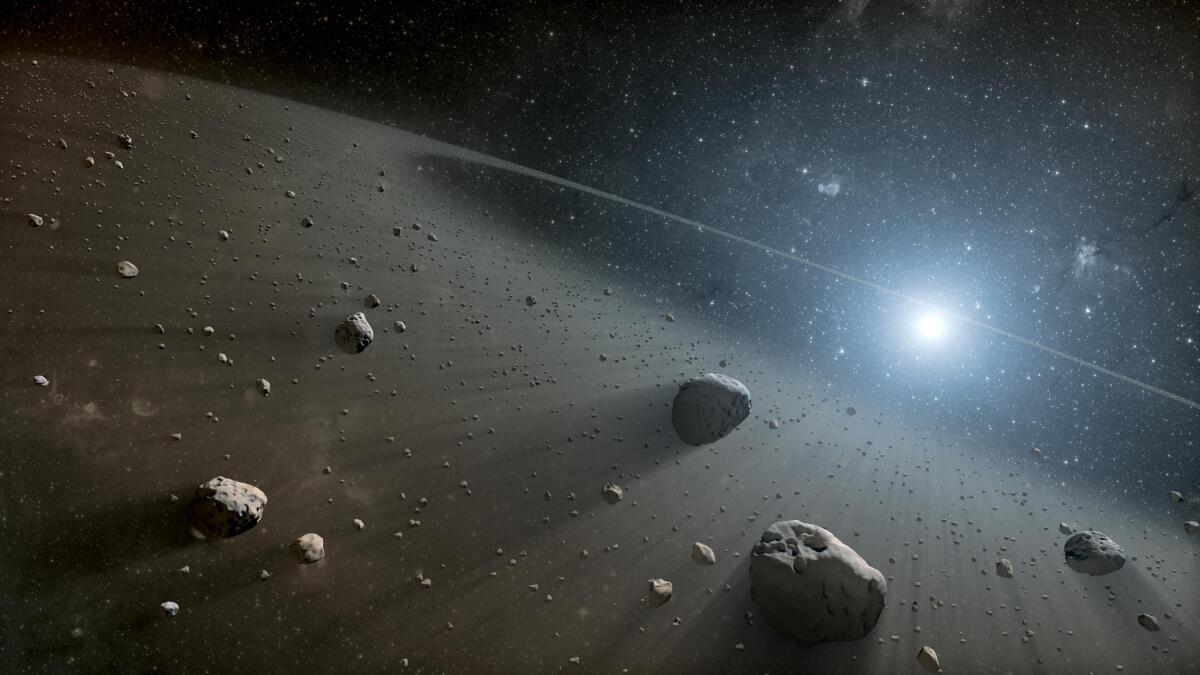
How do you find a good path, when every stop is moving relative to every other stop?
Credit: NASA/JPL-Caltech
A study published in the journal Informs Journal on Computing has an intriguing premise: How could we optimize a route through the solar system, if we wanted to stop at a large number of asteroids along the way?
In regular terms, this is called the traveling salesman problem, in which you try to find the most optimal route through a collection of points, such that you hit all points in the minimum amount of time. The more points there are, the more complex the calculation becomes.
But what if every one of those points were its own, separately orbiting body? How would the problem transform if every point were not merely a spot to pass through but a vehicle to ride along a known path?
That’s the problem, in the context of asteroids. If we assume a starting use-case of searching as many asteroids as possible for potentially mineable resources, then this study helps search a large field as quickly as possible.
There’s also the potential to use this approach to plan a series of asteroid transfers for efficient, low-power traversal of the solar system.
From the study, this charming little drawing illustrates a spaceship’s transfer between asteroids.
Credit: Rudich et al.
This international team of researchers calls their approach a solution to the Asteroid Routing Problem, and they actually looked to minimize both travel time and fuel consumption, though the two are obviously related.
The approach exploits close intersections between the paths of different asteroids, allowing a spacecraft to hop from one to another while they’re as close as possible. Relative speeds and trajectories are taken into account to minimize fuel use.
While the overall pattern is an evolved version of the traveling salesman problem, each individual transfer between asteroids is an example of Lambert’s problem, which asks how to calculate the optimal path between two moving objects.
In a complex context like the real solar system, this overall problem becomes extremely computationally intensive to solve. The team has had to work with abstractions and simplified versions of a real asteroid field to make their calculations work; doing the same thing on world-accurate data would, in principle, be possible but would probably require the real funding associated with a real mission.
This simple, proposed path shows how transfers can be made where object paths already naturally intersect.
Credit: Rudich et al.
The team thinks the research would dovetail with similar, everyday situations, like the most challenging supply chains and bus routes. Those use cases have considerations beyond sheer efficiency, though: A bus, for example, needs to cover a lot of road on purpose.
A spacecraft, though, is subject to virtually no considerations other than efficiency, and its need to conserve fuel is much greater. This sort of math-forward approach sometimes doesn’t apply as directly to the real world as mathematicians might like, but space is a rarified enough context that it functions almost like a math class thought experiment.
This research could help shave years off the time required to conduct a comprehensive survey of our solar system’s complement of asteroids.
With such a survey in hand, we could finally be on our way to realizing the mining of space rocks, like in all those dystopian science fiction stories.
