


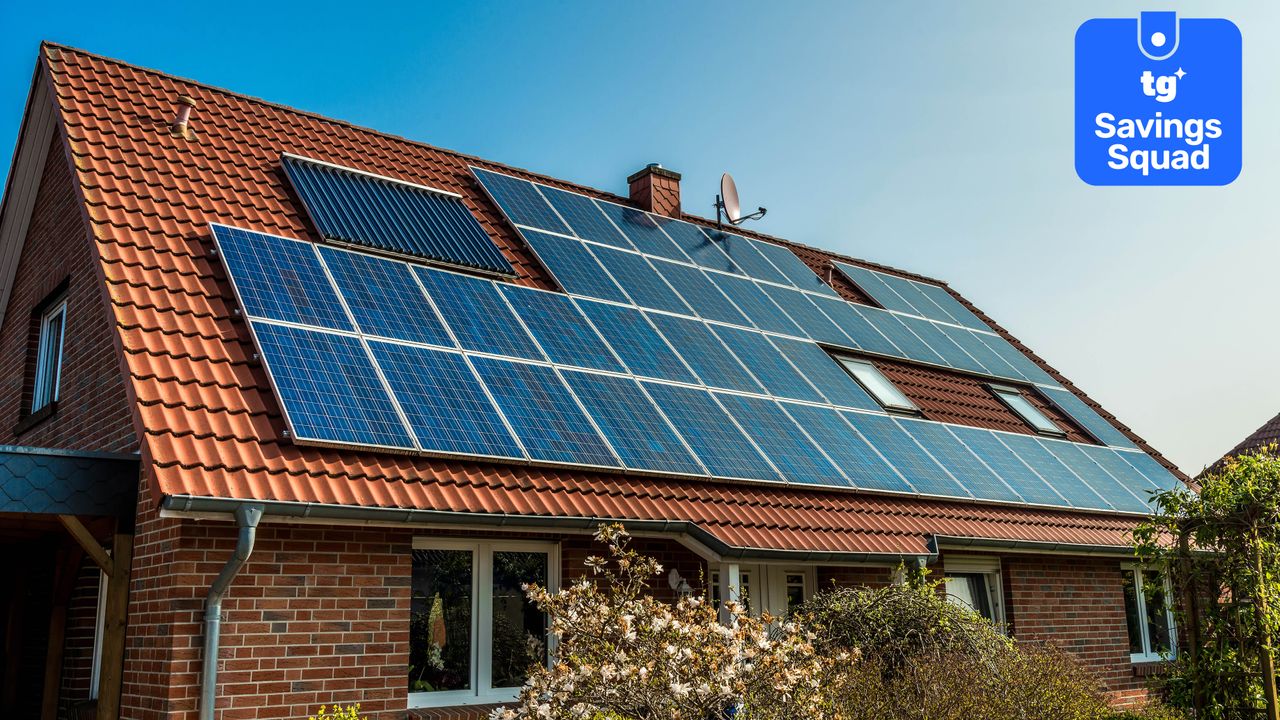
Everyone knows that solar panels work best when the weather is sunny and the skies are clear, but what actually happens when that doesn’t happen? Contrary to what your conspiracy-loving uncle may believe, solar panels do still work when it’s cloudy. To be sure, they don’t work as well as when the sun is out, but as long as there’s daylight, those panels are converting what they can into electricity.
I bring this up because last week was the hottest week of the year so far in the U.K., and where I live, outdoor temperatures peaked at around 91 degrees F. Needless to say, the skies were about as clear as they could be, and I took the opportunity to crunch some numbers and see just how much money I was saving by offsetting my electric bill with solar.
The past seven days have been a totally different story, though. It’s mostly been cloudy and raining, with the sun only making itself known at rare intervals. This got me thinking: how much of a difference has that made in my solar generation, in terms of both power generated and money saved.
Latest Videos From
How solar helped me during the heatwave
(Image credit: Shutterstock)
During the recent U.K. heatwave, I was able to generate 145.01 kWh of solar energy over the course of seven days — 59.88 kWh of which was exported back to the grid. My total energy consumption was recorded at 83.02 kWh, 18.5 kWh of which was imported from the grid. Those imports either happened overnight or when my electricity usage exceeded that of my solar generation.
Considering my 12-panel array rarely produces more than 2500W of power at any given moment, consumption can overtake generation pretty easily. Usually, all it takes is for a couple of kitchen appliances to be switched on at the same time.
You may like
Swipe to scroll horizontallyRow 0 – Cell 0
Consumed (kWh)
Imported (kWh)
Generated (kWh)
Exported (kWh)
May 22
9.11
2.23
20.69
12.79
May 23
9.53
2.37
18.63
10.25
May 24
9.22
2.18
21.63
13.38
May 25
14.01
2.19
21.98
8.78
May 26
15.78
3.64
21.41
8.06
May 27
14.91
3.13
22.07
9.03
May 28
10.46
2.76
18.6
9.59
Total
83.02
18.50
145.01
71.88
Had I imported all of my energy from the grid, my bill for the week would have been £21.30 (roughly $28.61). This hypothetical figure includes £18.41 ($24.73) for energy imports and £2.90 ($3.89) for a standing charge. This is a daily fee every home pays to cover the cost of maintaining an active grid connection. But, because my solar panels covered the lion’s share of my energy usage, my bill amounted to £7 ($9.40) — £4.10 ($5.51) of which was for imported grid energy.
Having those panels effectively saved me £14.31 ($19.22) over the course of the week, alongside an additional payment of £8.63 ($11.63) for the electricity I sold back to the power company. In the end, so long as you ignore my gas bill, I ended up making £1.63 ($2.20) of profit over the course of those seven days.
Swipe to scroll horizontallyRow 0 – Cell 0
Total usage (pence)
Grid Imports (pence)
Savings (pence)
Export earnings (pence)
May 22
201.97
49.44
152.53
153.48
May 23
211.28
52.54
158.74
123.00
May 24
204.41
48.33
156.08
160.56
May 25
310.60
48.55
262.05
105.36
May 26
349.84
80.70
269.14
96.72
May 27
330.55
69.39
261.16
108.36
May 28
231.90
61.19
170.71
115.08
Total
1840.55
410.15
1430.41
862.56
You can argue that the energy I generated isn’t free, because my panels are still several years away from paying for themselves. I have only had them for six years, and I don’t live in an area known for its annual sunshine. You could think about it as having paid for my energy bills in advance, but no matter what your perspective is, it doesn’t change the fact that these panels are reducing my monthly energy bills — especially in summer.
What happens when the clouds roll in?
(Image credit: Shutterstock)
I’ll admit, there hasn’t been a complete absence of sunshine over the past seven days. But compared to the heatwave, the weather has been positively dreary. Looking over the data, and it’s clear that the weather has made a huge impact on how much energy my solar panels were able to produce. But at the same time, the cooler temperatures mean I don’t have to worry about running the AC to cool myself and my house down. So my overall usage has been noticeably lower too. Take a look.
Swipe to scroll horizontallyRow 0 – Cell 0
Consumed (kWh)
Imported (kWh)
Generated (kWh)
Exported (kWh)
May 29
10.72
2.55
16.18
6.71
May 30
6.57
1.43
21.95
15.50
May 31
12.14
3.44
13.98
4.08
Jun 1
7.91
3.03
12.77
6.6
Jun 2
7.46
2.06
13.06
6.52
Jun 3
11.26
4.75
9.57
1.76
Jun 4
7.62
1.80
15.86
8.48
Total
63.68
19.06
103.37
49.65
As you can see, my total consumption for the week was 63.68 kWh, which is 19.34 kWh lower than the 83.02 kWh I used up during the heatwave. Running multiple fans and a portable air conditioner can really do a number on your finances if you’re too liberal with their use.
What to read next
Solar generation took a huge hit too, with the panels producing 103.37 kWh of power over the course of seven days. That’s a loss of 41.64 kWh compared to the heatwave week, where they managed to generate 145.01 kWh. Naturally, that meant my total export was lower, selling 49.65 kWh versus 71.88 kWh — a 22.23 kWh difference.
Less generation also meant I had to import more energy, though not quite as much as you might think. During the heatwave, I had to import 18.5 kWh, while the cloudy weather only required 19.06 kWh — a 0.56 kWh difference.
Reduced energy consumption definitely played a part in this, but I also have to consider that my own usage will generally fluctuate over time and no two weeks will be the same. At the very least, it’s clear that I was either using less energy at night or limiting how many appliances I had switched on at any given moment.
What does this mean financially?
(Image credit: Shutterstock)
Seeing energy figures in kilowatt hours is pretty meaningless if you can’t visualize them in a way that matters for you. So I crunched the numbers again to see exactly how much of a difference was made.
Swipe to scroll horizontallyRow 0 – Cell 0
Grid Imports (pence)
Total usage (pence)
Savings (pence)
Export earnings (pence)
May 29
237.66
56.53
181.13
80.52
May 30
145.66
31.70
113.95
186.00
May 31
269.14
76.26
192.88
48.96
June 1
175.36
67.18
108.19
79.20
June 2
165.39
45.67
119.72
78.24
June 3
249.63
105.31
144.33
21.12
June 4
168.94
39.91
129.03
101.76
Total
1411.79
422.56
989.23
595.80
If I had been completely solar-free, my total energy consumption would have cost me roughly £14.12 ($18.90), which is noticeably lower than the £18.41 ($24.73) I would have paid during the heatwave. Taking the standing charge into account would mean my total bill should have been £17.01 ($22.77)
Of course, my actual grid usage was higher this week, costing £4.23 ($5.66) compared to £4.10 ($5.51) last week. Meaning my actual energy usage cost me £7.13 ($9.55) once the standing charge was taken into account. This means having solar panels saved me a total of £9.89 ($13.24), which is quite the difference from my £14.31 ($19.22) savings while the sun was shining all week-long.
The reduced amount of generation also affected the export, limiting the amount of available energy I could sell back to the grid. In total, I managed to earn £5.96 ($7.98), compared to £8.63 ($11.63) last week. In other words, costs are higher, rebates are lower, and it means I have to pay the energy company more money.
My total bill during the heatwave should have been £21.30 ($28.61), but thanks to a combination of solar savings and export, the energy company actually owed me £1.63 ($2.20) at the end of the week. This week, my solar-free bill would have been £17.01 ($22.77), but solar savings and export income reduced that by £15.85 ($21.22) — meaning my bill is £1.16 ($1.55). It’s not a huge overall difference, but it is a little disappointing to have to owe money when I ended last week on such a high note.
Bottom line
(Image credit: Shutterstock)
It’s no huge surprise that solar panels are not as effective when there’s less direct sunlight. Generation is totally reliant on converting light into energy, and without as much light you end up with significantly less power coming out of your panels. Which means the amount of money you end up saving starts falling.
That said, there are still savings to be had even in pretty miserable weather. So even if they aren’t operating at maximum efficiency, they’re still generating some energy to help reduce the cost of your electric bill. Either earning you some profit, or helping pay off the initial cost of actually installing them.
There is a point where generation completely stops, and I’ve noticed that happen during abnormally heavy rainstorms. But just because the sun isn’t own threatening to burn your lawn to a crisp doesn’t mean your panels are sitting there completely useless.
Follow Tom’s Guide on Google News and add us as a preferred source to get our up-to-date news, analysis, and reviews in your feeds. Subscribe to Tom’s Guide on YouTube and follow us on TikTok.
