

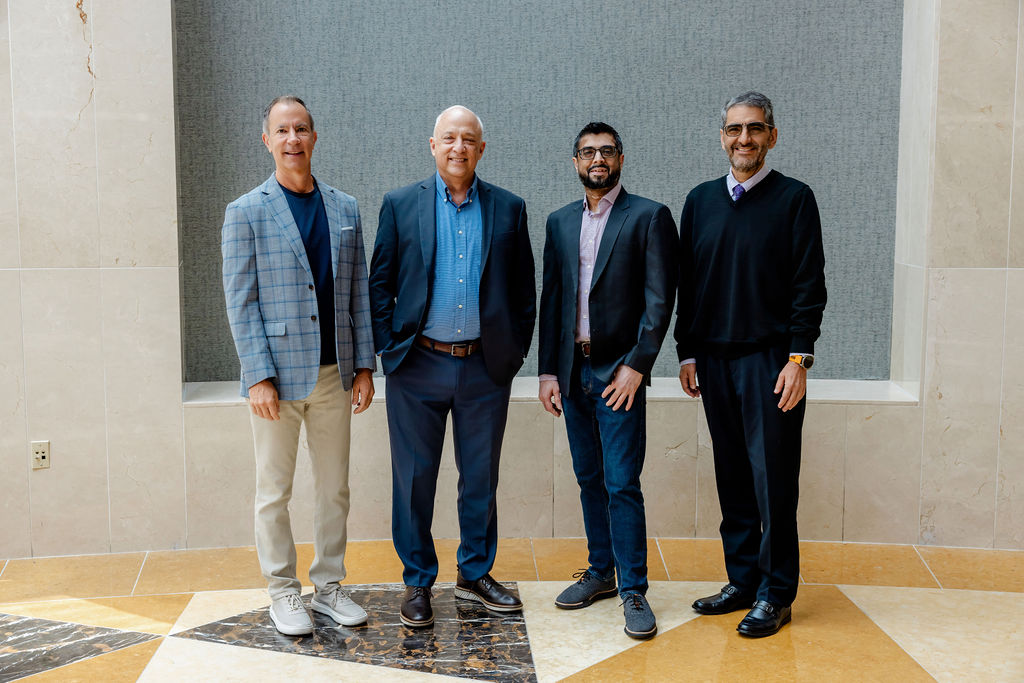
Vedana’s lealdership team, from left: Dr. Rob Lenz, board chair; Leon Garcia, co-founder and chief scientific officer; Anurag Agarwal, co-founder and CEO; and Dr. Ernesto Aycardi, chief medical officer. (Vedana Photo)
Vedana Therapeutics, a Seattle-based startup aiming to prevent migraine attacks, emerged from stealth Wednesday with $46 million and a leadership team of heavy-hitters in cutting-edge migraine treatment.
The new funding will allow the company to advance antibody therapies targeting migraine-related signaling pathways — candidates patients could eventually self-administer by injection at home.
Vedana’s goal is to become the definitive migraine therapy company — and its roster of leaders, board members and advisors have played essential roles in the sector already, helping develop antibody therapies against two types of proteins: calcitonin gene-related peptides (CGRP) and a newer target called pituitary adenylate cyclase-activating polypeptides (PACAP).
“We need to make medicines that will enable patients not to have a single migraine day,” said Anurag Agarwal, Vedana’s co-founder and CEO. “And that means targeting not one, but multiple biological pathways and layering them together to completely address this very complex and diverse disease.”
While CGRP medicines represented the first specialized therapies for migraine, roughly two-thirds of patients still suffer from the condition. A migraine attack can trigger a cascade of symptoms unfolding over days, potentially including nausea, light sensitivity and disrupted sleep; flashing lights or partial vision loss; moderate to severe headaches; and fatigue and brain fog.
Vedana’s lead drug candidate program is a next-generation PACAP antibody, and its second targets both PACAP and CGRP.
The multipronged approach is essential, said Dr. Ernesto Aycardi, chief medical officer, because it’s “not just one neurotransmitter, it’s not just one protein that is causing the problem. In addition, there’s a significant complexity from the patient perspective.” Patients respond to different treatments, he added, and even within an individual, a migraine can be triggered by different causes between episodes.
The startup has 14 employees. Its leadership includes:
- Agarwal previously worked as an investor at Osage University Partners, which helped commercialize academic research.
- Leon Garcia, co-founder and chief scientific officer, previously oversaw the discovery and development of both CGRP and PACAP antibodies at Alder Biopharmaceuticals, a Seattle-area company acquired by Lundbeck seven years ago for $1.95 billion.
- Aycardi, chief medical officer, previously led clinical development of the migraine drug AJOVY at Teva.
- Dr. Rob Lenz, executive chair of Vedana’s board of directors, is the former head of global development at Amgen, where he led the development of competing migraine treatment Aimovig.
While multiple Seattle-area biotech companies in general are pursuing medical therapies created using AI tools, Vedana touts the decades of its team’s experience as a huge advantage.
The antibodies from living organisms “are more robust than any LLMs that we have built. These have been built over billions of years of information, so I would say that we are leveraging that neural network,” Agarwal said. The company will use AI for later steps in the drug development process, he added.
Major biotech companies marketing approved CGRP antibody therapies include Amgen, Eli Lilly, Teva and Lundbeck. In the PACAP space, Vedana faces competition from Lundbeck, Mentari Therapeutics and Slate Medicines.
Vedana’s Series A round was co-led by Westlake BioPartners and Canaan Partners, with participation from Dawn Biopharma and Alexandria Venture Investments.
Editor’s note: Story updated at 10:35 a.m. to add additional comments from Anurag Agarwal and Dr. Ernesto Aycardi.
