

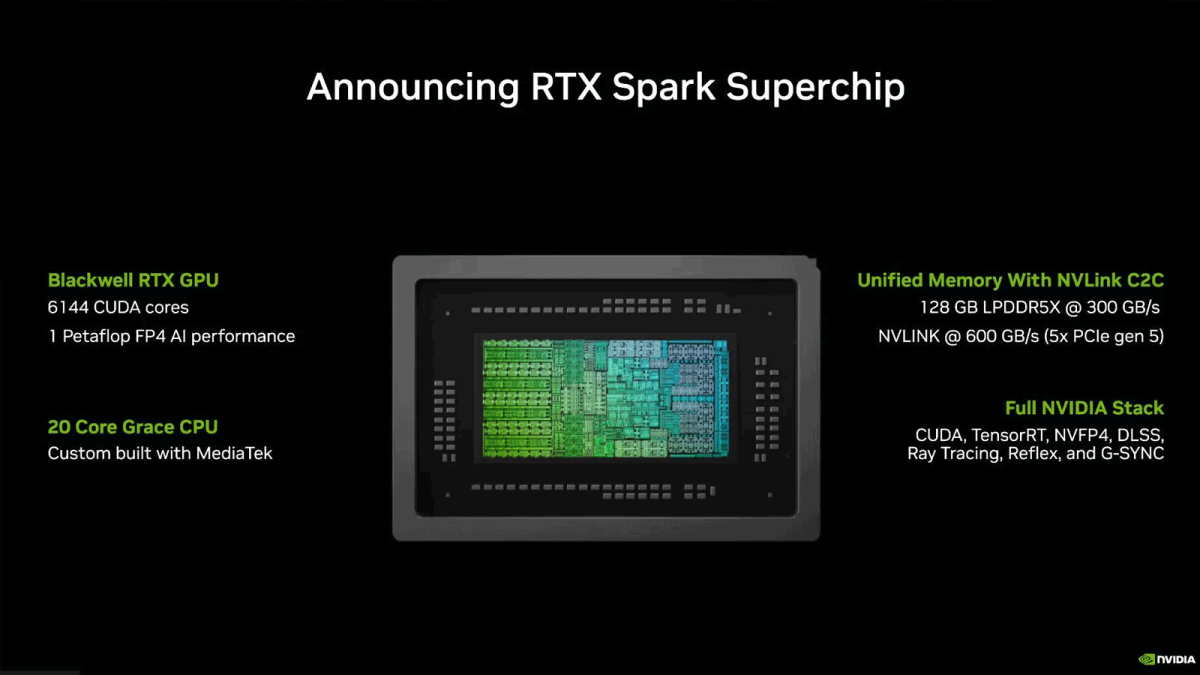
Nvidia announced its new RTX Spark platform at Computex 2026, targeting the desktop and mobile CPU market in a big way. Set to compete directly with Intel and AMD in a similar manner to Qualcomm’s X range of SoCs, the new chip combines 20 ARM CPU cores with 6,144 Blackwell CUDA cores for what could be a potent combination—though questions remain about compatibility and emulation.
Nvidia says this chip is designed to handle varied workloads, including AI development, content creation, and gaming. The top configuration will support up to 128GB of LPDDR5X unified memory, which Nvidia says will be linked to the CPU and GPU via its NVLink-C2C technology, delivering bandwidth comparable to PCIe 5 x5. As Videocardz highlights, this all but confirms this is a platform based on Nvidia’s previous AI-dev-first system, the GB10 in the DGX Spark.
The RTX Spark, however, is much more intriguing for consumers, especially since it will also be capable of gaming. The 6144 CUDA cores are the same number you’d find in an RTX 5070, although we’re told gaming performance should be closer to a mobile RTX 5070. That’s still incredibly impressive for a single chip, and when combined with DLSS and multi-frame generation, it should be plenty capable of playing just about anything at modest settings. VRAM shouldn’t be an issue.
NVIDIA used Indiana Jones and the Great Circle as an example of a AAA game with ray tracing that this chip can manage at up to 100 frames per second at 1440p. It is also designed to run AI agents locally, making it easier for consumers to play around with this burgeoning technology.
Partnering with Microsoft for the announcement, Nvidia also discussed how ARM-based cores would handle native x86 applications. The two companies are working together to improve native ARM availability for specific apps, with Photoshop and Premiere cited as examples that were being reworked for the RTX Spark platform. It’s also looking forward to better support for Blender, DaVinci Resolve, Maxon Cinema4D, Redshift, Topaz Photo, CapCut, Cubase, Bitwing Studio, and Affinity by Canva.
For other applications without that native support, Microsoft’s Prism emulator should handle the conversion, but performance won’t be as strong as with native support, and bugs may still occur. New platforms like this often require continued tweaking after release to get the implementation right across the wide range of Windows games and applications.
RTX Spark will ship in 14- and 16-inch laptops this year, with Asus, Dell, HP, Lenovo, Microsoft, and MSI all working on their own designs, many of which are set to release this fall. Nvidia also talked up lower-cost versions of the chip, some starting with just 16GB of memory and offering strong battery life and performance in the budget segment of the market.
It will be launching on desktop too, though it won’t be paired with discrete GPUs, which will limit its use in larger desktop platforms.
