

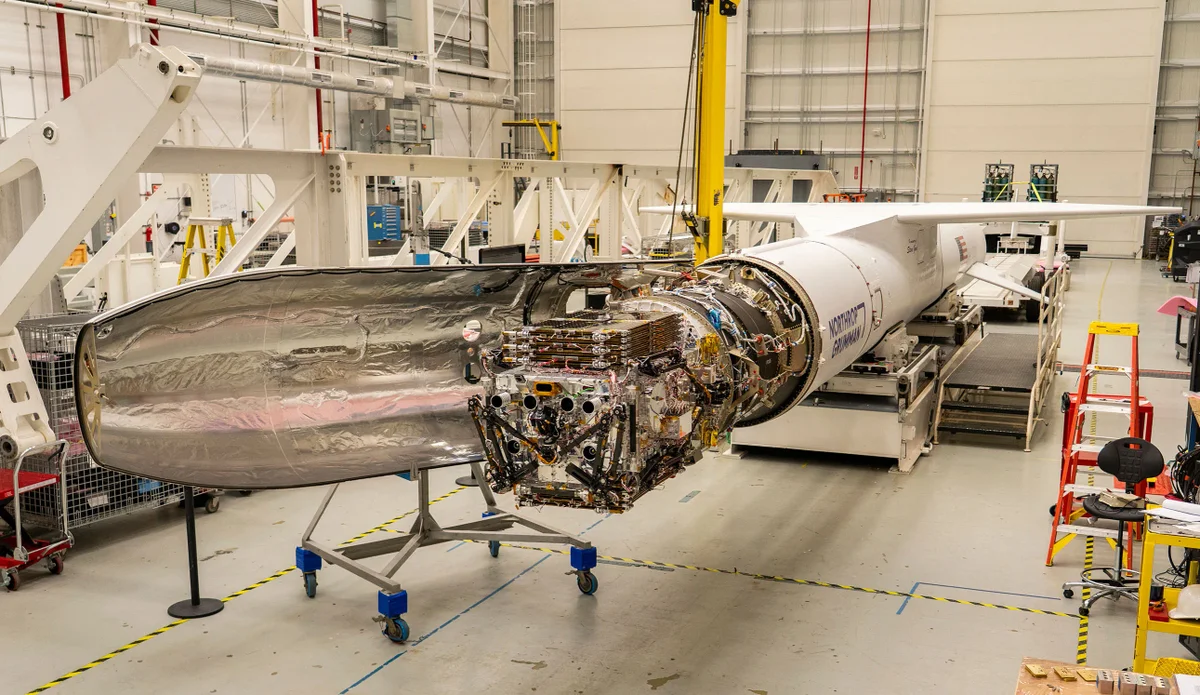
On Tuesday, an L-1011 Stargazer aircraft will take off from the Marshall Islands, 2,300 miles southwest of Hawaii. A rocket will drop from the plane, then ascend to deliver a spacecraft called LINK to low-Earth orbit. LINK’s mission is to rescue one of the most scientifically productive astronomical facilities in operation: NASA’s Neil Gehrels Swift Observatory, which astronomers call “Swift.”
Swift is sinking. The satellite has orbited Earth about once every hour and a half for more than two decades, and over time, friction with particles in the upper atmosphere has caused its orbit to decay. Unusually intense solar activity in recent years accelerated the decline. If nothing is done, the spacecraft and the three telescopes on board will burn up in the atmosphere within months.
To save Swift, NASA hired the Arizona-based company Katalyst Space Technologies to build LINK. Katalyst had just nine months to design, construct, test and launch a satellite to do something that has never been done: grab a spacecraft that was not designed to be serviced (the “capture” stage of the mission), then carry it back to its original orbit (the “boost”). If it’s successful, the mission will demonstrate an important capability for the commercial space industry and give Swift decades more life at a much lower cost, in much less time, than it would have taken to build a new space observatory.
On supporting science journalism
If you’re enjoying this article, consider supporting our award-winning journalism by subscribing. By purchasing a subscription you are helping to ensure the future of impactful stories about the discoveries and ideas shaping our world today.
The stakes for my own research became all too clear one day in February. As an astronomer, I did what I have done almost 100 times before: I filled out a short web form, called a “target of opportunity” (ToO) request, to ask Swift to swivel and point at a particular part of the sky. My colleagues and I had discovered a supernova in a distant galaxy there, and we urgently needed x-ray and ultraviolet data—the star had exploded only a few days before, and the glow from the debris would potentially soon be too faint to study. As usual, we turned to Swift, which is named for an agile, insect-chasing bird: despite being as long as a pickup truck, Swift can point toward anywhere in space within minutes. I expected a response within 24 hours, so when I didn’t hear anything for a day, I contacted a member of the operations team, who told me that Swift had stopped taking ToO requests in order to point in whatever direction minimized orbital drag. I had known Swift was in danger, but that was when it fully dawned on me that without it, I couldn’t get the data I needed.
The capture is the riskiest stage of LINK’s mission. The tentative plan is for the spacecraft’s robotic arms to grasp solid metal panels on the corners of Swift. But the observatory is covered in something like aluminum foil for thermal insulation, and no one knows what state this layer is in because no one has seen Swift up close for 20 years.
Engineers from Katalyst Space Technologies in Flagstaff, Ariz., stabilize their LINK robotic servicing spacecraft as it moves into a vibration chamber at NASA’s Goddard Space Flight Center in Greenbelt, Md., on April 15, 2026. The vibration chamber simulated the intense shaking LINK will experience during launch.
When LINK arrives in orbit, it will first do a photoshoot, imaging Swift in different orientations and lighting conditions to figure out which part it should try to grasp. The boost phase of the mission is less risky than the capture, but it is also complicated. After LINK grabs hold of Swift, LINK will use its ion propulsion thrusters to push the pair to higher and higher orbits over several months. During that time, LINK must follow numerous rules about which direction the spacecraft can face in order to charge their solar panels and protect Swift’s mirrors and instruments. When they reach an altitude close to Swift’s original orbit, LINK will let go. At this point, astronomers will take over to return the observatory to its role as one of the most important tools for transient astronomy.
Transient astronomy is the study of cosmic phenomena that come and go on human timescales, most famously the explosions of stars as supernovae. Swift was originally designed to study a rare type of transient called gamma-ray bursts—seconds-long flashes of gamma-ray light that arise from the most energetic explosions in the universe. Swift has discovered almost 2,000 gamma-ray bursts and revolutionized our understanding of their origins, helping establish that they can come from merging neutron stars in addition to the explosions of single stars, and it has even found bursts from the earliest generations of stars in the universe.
Swift has also helped discover new and unexpected phenomena, driven by its users: any astronomer anywhere in the world can submit a ToO request on short notice. For example, in 2018 a ground-based optical facility called ATLAS (Asteroid Terrestrial-Impact Last Alert System) discovered a transient that was evolving so quickly and was so bright that astronomers all thought it must be some kind of foreground source in the Milky Way. Liliana Rivera Sandoval, now an assistant professor at the University of Texas Rio Grande Valley, submitted a ToO request to Swift, which to everyone’s surprise revealed bright x-rays—a sure sign it was much farther away and therefore much, much more energetic than something in our own galaxy. That event, AT2018cow (“the Cow”), turned out to be one of the most exciting objects I studied when I was a doctoral student and became the prototype of a fascinating new class of transients: today the menagerie includes events we nicknamed the Camel, the Tasmanian Devil and the Whippet. Without Swift, it would probably have taken weeks instead of days to convince ourselves that the source was interesting.
No other existing or planned telescope can observe through multiple ranges of the electromagnetic spectrum simultaneously on such short notice. Plus, Swift has the capacity to take risks. In 2023, 87 percent of Swift’s time was spent on ToO observations: an average of five requests are received each day, and a small operations team evaluates the requests scientifically (“Is this interesting?”) and practically (“Is this doable?”). Swift receives more annual observing requests than any NASA facility except the James Webb Space Telescope, and its scientific portfolio is broad, extending to comets and planets in other solar systems.
Swift’s capabilities are only becoming more important. So far transient astronomers have catalogued about 200,000 cosmic explosions, most discovered by optical telescopes when they are days or weeks old. Now the discovery landscape is transforming. Because of new facilities coming online soon, we’re about to discover huge numbers of transients in unexplored parts of the electromagnetic spectrum. For example, Israel’s ULTRASAT (Ultraviolet Transient Astronomy Satellite), launching in 2027, and NASA’s UVEX (Ultraviolet Explorer), set to go up in 2030, will be the first transient space telescopes dedicated to the high-energy ultraviolet part of the spectrum. And the Rubin Observatory in Chile, which opened last year, is predicted to discover 10 times more transients than previous optical telescopes. Gravitational-wave detectors should find merging black holes and neutron stars from even the most distant parts of the universe. And it will become much more common to discover explosions when they are just a few minutes old, thanks to facilities such as the Argus Array, under development in Texas.
Discovering tens of millions of possible transients per night is not enough, however. We need Swift in order to measure their basic properties such as temperature and the size of the explosion. Swift will also help us figure out where exactly these explosions are taking place, enabling other telescopes to point there, too, and make decisions about which ones are unusual and therefore worth pursuing in more detail. If the LINK mission succeeds, it will give Swift a new lease on life at just the right time for us to answer longstanding questions about the most powerful explosions known in nature.
