

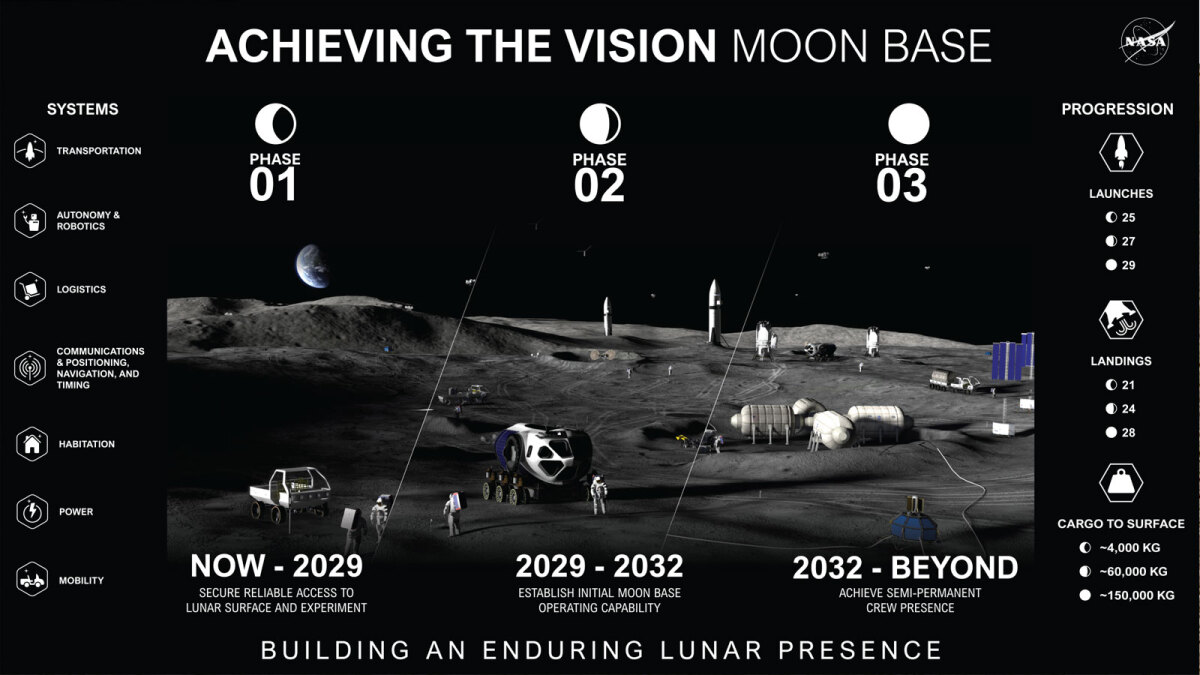
After much talk, NASA has begun laying the groundwork for a permanent American Moon base. This week, it handed out contracts to a handful of developers responsible for building key underlying hardware for the job. That includes drone development and cargo hauling, with NASA itself developing future drone projects to expand the facilities’ scope.
The first contracts were awarded to Astrolab and Lunar Outpost to develop two autonomous and manned rovers, with plans to get them to the lunar surface in 2028. Astrolab will receive $219 million for a CLV-1 rover design, while Lunar Outpost will receive $220 million to develop its Pegasus rover. Both designs will need to have a minimum range of 125 miles.
The other contract to go out this week was to Blue Origin to take both the drones there. This marks a significant investment in Blue Origin’s Blue Moon Mark 1 lander, which is currently being considered for the Artemis IV mission to take astronauts to the Moon before 2030.
Blue Origin was also selected to manage several uncrewed missions to the Moon this year, enabling it to drop off critical scientific equipment and materials for future lunar base construction. This will be key to understanding the lunar surface and what astronauts might need to develop a semi-permanent facility in the early 2030s. The first launch will take place this year, with Blue Origin receiving $230 million from NASA and funding the rest itself.
“What we are embarking upon is extremely challenging,” NASA Administrator Jared Isaacman said during a news conference on Tuesday (via Ars Technica). “We know so little from what is a combined 80 hours of lunar astronaut EVA time across the Apollo missions, and that was more than a half century ago.”
To that end, construction of the Moon base will begin with drone-based exploration. NASA plans to develop a “perimeter” around its potential base using three or four drones. This would potentially tie in to the existing Outer Space Treaty and effectively position America as the operator within a specific area. They can’t own it, but they can occupy it and then request that other nations not interfere. Until more in-depth space-based legislation can be agreed upon, this may have to suffice for now.
It’s also a major reason China and the US are racing back to the surface. For now, “finders keepers” is very much in effect.
NASA is planning to develop those drones itself in its Jet Propulsion Laboratory, which could soon change hands for the first time. Each drone will be about a meter tall, weigh 225kg, and be delivered to the Moon by Firefly Aerospace by around 2028, ahead of the Artemis IV mission to the surface.
