



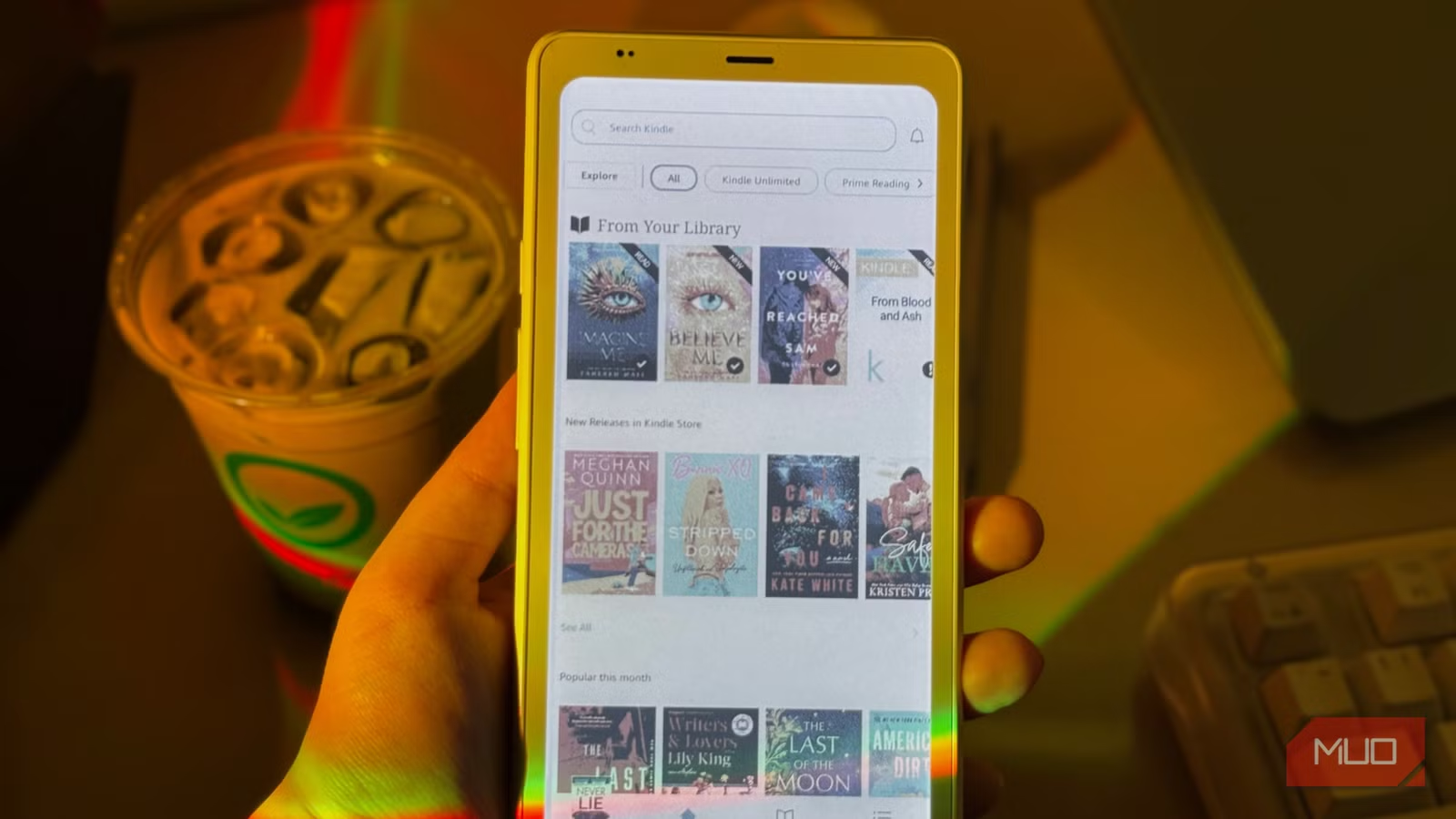
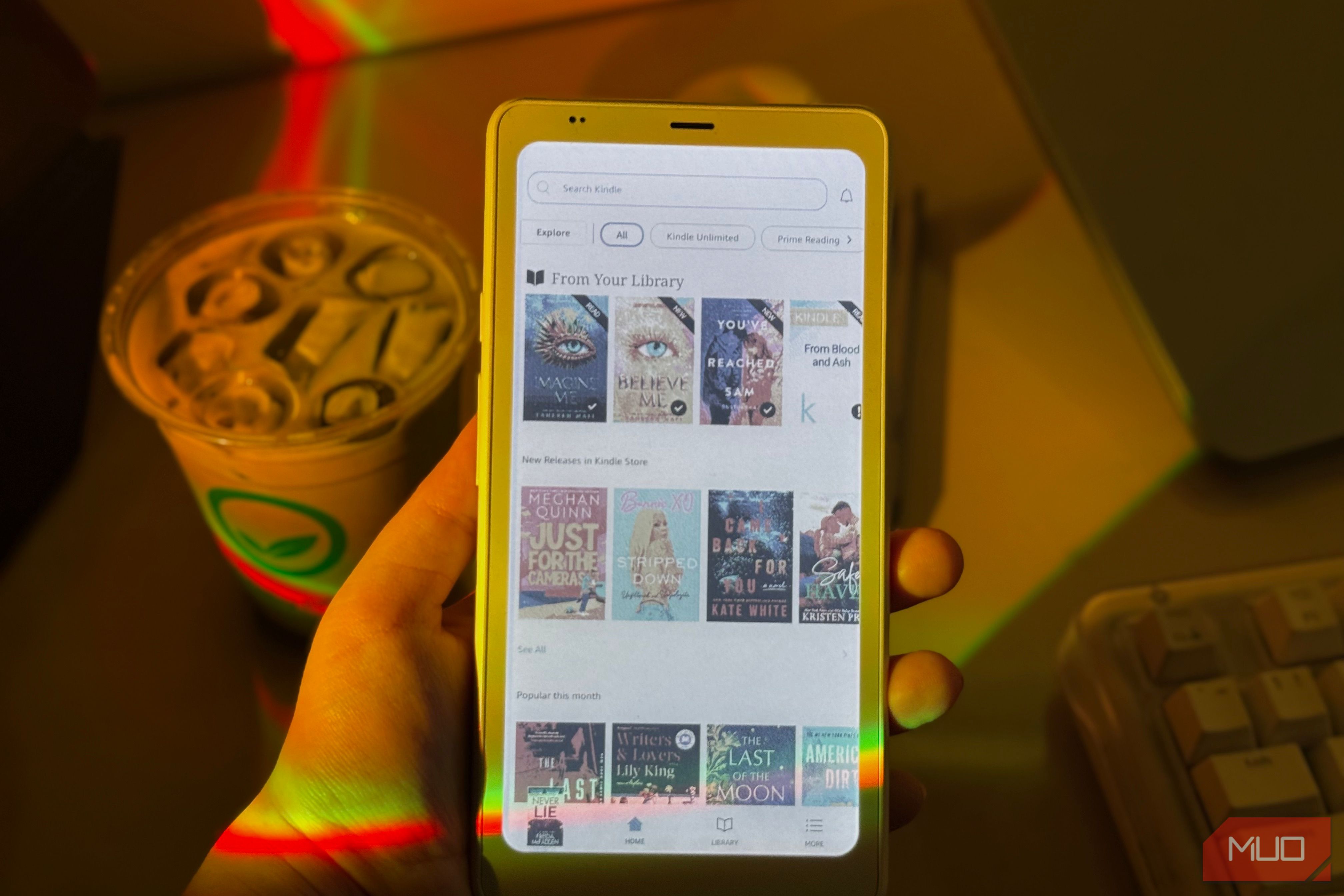

For most people, “eReader” is just a synonym for Kindle. Both terms have been interchangeable for so long that people automatically default to getting a Kindle the moment they decide they want to read digitally. My first eReader was a Kindle Paperwhite too, so I get the reflex and have absolutely lived it.
That said, I now can’t imagine buying another Kindle, and I’m convinced that any eReader I get from this point on won’t have Amazon anywhere near it. What I didn’t expect, however, was how surprising the shortlist would turn out to be.
Boox devices are the easiest recommendation I can make
The only reader that doesn’t pick sides
To preface this section, Boox is the one brand I can 100% vouch for. My current eReader is a Boox Go 10.3 (Gen II), and if I were to get another eReader tomorrow, the top of my list would be another Boox device. The biggest reason is the fact that Boox devices run Android. Currently, the latest Boox devices run Android 15, so in addition to being eReaders, they double as full-fledged Android tablets. The devices come pre-installed with the Google Play Store, and you have the freedom to install anything and everything you typically would on any other Android tablet.
Despite these devices coming with their own reading app and note-taking software, you’re never locked into Boox’s ecosystem. Want to read your Kindle library? Install the Kindle app. Prefer Kobo, or borrowing from your local library through Libby? Those work too. The native apps are there if you want them, but they’re simply a starting point, and you aren’t obliged to use them.
Boox devices are also available in all sorts of form factors. At the time of writing, the lineup spans everything from the pocket-sized Palma to compact 6- and 7-inch readers, right up to the large 10.3-inch slates like the Go 10.3 (Gen II) and the Note Air 5C. So whether you want a pocketable phone-sized reader for the commute or a larger slate for reading and note-taking, there’s a Boox that fits.
Kobo is the closest thing to a Kindle, without the Amazon
Familiar by design, open by choice
Now, I wouldn’t recommend a Boox to everyone. As much as I love the flexibility it offers, that flexibility is also exactly what makes Boox feel like too much for some people. If you just want to buy a book, open it, and read without thinking about Android settings, app stores, refresh modes, Kobo is probably the cleaner recommendation. With a Boox, you’re getting a full-fledged Android tablet that you can use for tasks beyond reading. This also means the cost you’re paying only makes sense if you actually need that extra functionality. If all you want is a simple, dedicated eReader that feels familiar without being tied to Amazon, Kobo is the safer bet.
With Kobo’s models, you get a dedicated reading device, a built-in bookstore, long battery life, waterproof models, audiobook support, and a clean interface that does not ask you to turn reading into a whole project. In that sense, it is very Kindle-like. The difference is that Kobo gives you a little more room to move. The current lineup covers the basics well, too. There is the Clara BW if you want a simple black-and-white reader, the Clara Colour if you want a compact color model, and the Libra Colour if you want a 7-inch color screen with physical page-turn buttons and stylus support.
The bigger reason Kobo belongs on this list, though, is the ecosystem. It is still an ecosystem, to be clear. This is not Boox, and you are not installing the Kindle app or turning it into a tiny Android tablet. But Kobo supports EPUB natively, works with library borrowing through Libby in supported regions, and generally feels less hostile to books that did not come from its own store. If you buy books directly from publishers, use Project Gutenberg, read comics, or borrow heavily from your library, Kobo starts making a lot of sense.
Related
I No Longer Use My Old iPad or Kindle for Reading—Here’s What I Use Instead
I use a device that’s basically the iPad and Kindle rolled into one.
It also has one newer trick that makes it feel especially reader-focused: StoryGraph integration. Kobo announced native StoryGraph syncing for its eReaders in 2026, which means reading progress can sync to StoryGraph without needing to manually update everything yourself. Considering StoryGraph is the Goodreads alternative many readers moved to specifically because it is not Amazon-owned, that pairing feels extremely on-theme here.
Bigme is basically budget Boox
For better and worse
Credit: Bigme
A brand I’m hoping to get my hands on very soon is Bigme. I haven’t used a Bigme device yet, so this is not me vouching for it the way I can vouch for Boox. But on paper, Bigme is probably the most interesting wildcard on this list, mostly because it looks like the closest thing to budget Boox.
The comparison is hard to avoid. Bigme has several compact eReaders in its lineup, including the Bigme Read, which starts at $149, and multiple versions of the B6, including color and black-and-white models running Android 14. The higher-end B6 Color model gets you a 6-inch Kaleido 3 color screen, 4GB of RAM, 64GB of storage, Google Play access, and the same basic promise that makes Boox appealing: you are not locked into one bookstore.
That means you can install the Kindle app, Kobo, Libby, or whatever reading app you already use, instead of having to move your entire library into one company’s ecosystem. The catch is that Bigme also seems to come with more obvious tradeoffs. Its lineup is cheaper than a lot of Boox’s larger devices, but it is not automatically cheaper across the board — the B6 Color sits close enough to the Boox Go 6 (Gen II) that the comparison becomes less about price alone and more about what kind of compromise you are willing to make. From the reviews I’ve seen, the hardware and flexibility are compelling, but the native reading software and overall polish do not sound quite as refined as what Boox offers.
That is why I would not put Bigme ahead of Boox on my own list, at least not without trying one first. But I also cannot ignore it! If the whole point of this search is to find an eReader that keeps Amazon out of the hardware while still giving me app freedom, Bigme deserves a spot in the conversation.
Your next eReader doesn’t have to be a Kindle
Kindles are popular for a reason, and I still understand why most people default to them. But once you start looking past Amazon, the eReader market gets a lot more interesting. In fact, I’d argue that the best eReader for you might not be a Kindle at all!


