

Microsoft
Follow ZDNET: Add us as a preferred source on Google.
ZDNET’s key takeaways
- PC-DOS 1.00 would lead to Microsoft becoming computing’s top dog
- Microsoft continues to embrace open source.
- The source code and annotations provide insight into the operating system’s earliest days.
Before “Micro Soft” became Microsoft, Bill Gates wrote BASIC interpreters. Microsoft’s first shipping operating system was a Unix distro called Xenix. Then, in 1980, Microsoft got its shot at the big time: IBM needed an operating system for its planned IBM PC and asked Gates if he could deliver one. You betcha! The rest is history.
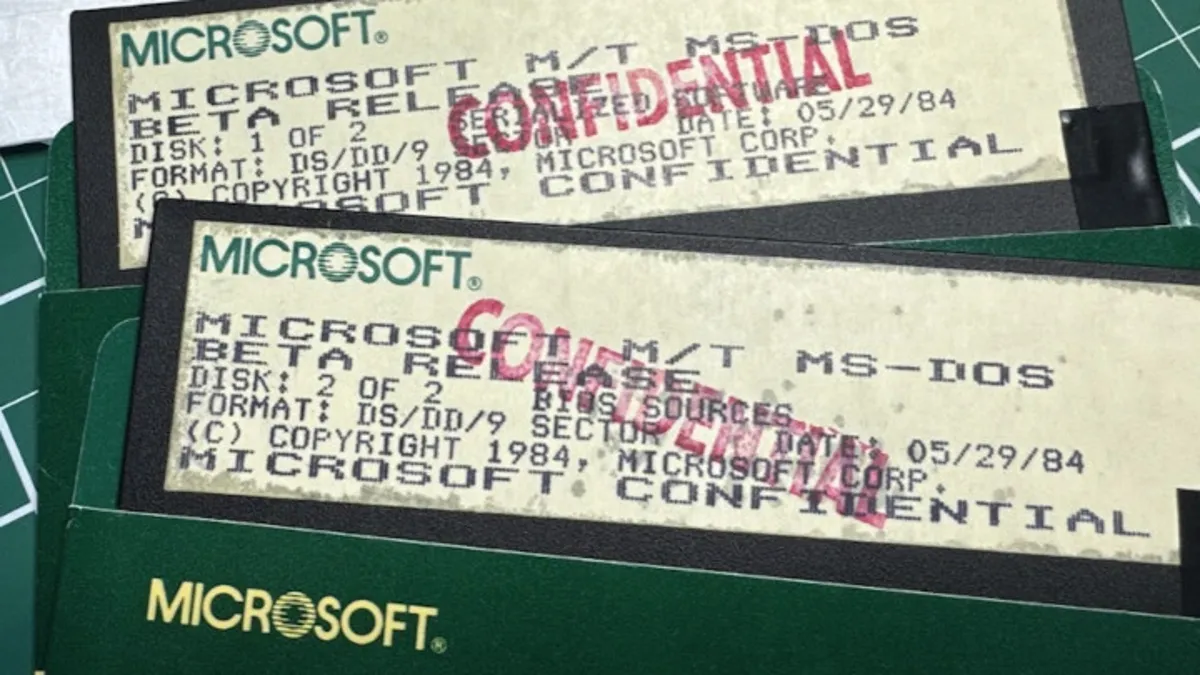
Now, Microsoft has released the source code and notes for PC-DOS 1.00, the first DOS release for the IBM PC.
Also: Microsoft’s incredible rise, 15 lost years, and stunning comeback – in 4 charts
Microsoft’s AT&T Unix license didn’t give the company the leeway to port Xenix to the x86 IBM PC. That would have led to a very different world with Unix as the top desktop operating system from then until today. In another reality, Linus Torvalds could have been Microsoft Unix CTO.
Microsoft buys 86‑DOS for $100,000
In the real world, Gates and company had to whip up an operating system as quickly as possible. They didn’t have time to develop their own, so they bought 86‑DOS, aka QDOS, from Seattle Computer Products and its inventor, Tim Patterson, for just under $100,000. What a steal! DOS would become the program that put Microsoft on the road to being one of the tech industry’s top companies for the next 50 years and beyond.
IBM had wanted a CP/M‑like operating system, but Digital Research, CP/M’s owner, faltered, so Big Blue turned to Microsoft. Microsoft adapted 86-DOS, which had CP/M‑style application programming interfaces (APIs), into what IBM would ship as PC‑DOS 1.0 in August 1981. Microsoft retained the right to sell it as MS‑DOS if there were other PC‑compatible manufacturers. This would set the stage for Microsoft’s post‑1981 dominance.
Also: Microsoft announces sweeping Windows changes – but no apologies
At the time, though, that was quite a bet. That first release was extremely limited by modern standards. It ran from 160KB floppy disks but offered no subdirectories or hard‑disk support. Even so, it became the foundation of the MS‑DOS line that would dominate PC operating systems through the 1980s and early 1990s.
Until now, the earliest DOS sources widely accessible to developers were MS‑DOS 1.25 and 2.0, which Microsoft originally released via the Computer History Museum in 2014 and then republished on GitHub in 2018. Those GitHub releases, along with the more recent publication of the joint Microsoft–IBM MS‑DOS 4.00 sources, signaled that Microsoft was increasingly comfortable treating its once‑proprietary DOS code as an educational and historical resource.
When Microsoft and the Computer History Museum first published an early MS‑DOS source in 2014, it came under a tightly constrained license that allowed only “non‑commercial research, experimentation, and educational purposes” and explicitly barred reuse in other projects. That approach made the code readable but not truly usable. The later GitHub re‑release of MS‑DOS 1.25 and 2.0 under the MIT license changed that, adopting a permissive license that the Free Software Foundation describes as GPL‑compatible and allowing almost unrestricted reuse, modification, and redistribution.
Putting DOS 1.0 into that same license completes the story from the very beginning of the PC era. Instead of being trapped in an archive, the code is now a browsable Git tree. With this code, systems programmers, educators, and retrocomputing fans can clone, build, and experiment with using contemporary toolchains.
Also: Sick of Microsoft and Google? This new European office suite is a private, open-source alternative
It’s not just DOS’s source code that Microsoft is sharing. Microsoft explained, “These materials aren’t just operating system releases in the traditional sense. In several cases, the listings represent point‑in‑time working states and hand-written notes, preserved by Tim Paterson himself. Think of them as a printed commit history of a Git repository.”
How operating system development was done
No one’s going to be using these releases for real work. However, they’re still remarkably instructive for anyone who wants to understand how operating systems were structured on first‑generation 8086 hardware. DOS 1.0’s small size and feature limitations make it a comprehensible codebase that can be understood almost end‑to‑end, especially compared to today’s sprawling operating systems.
As Microsoft stated, “The listings include sources to the 86-DOS 1.00 kernel, several development snapshots of the PC-DOS 1.00 kernel, and some well-known utilities such as CHKDSK. Not only were these assembler listings, but there were also listings of the assembler itself! This work offers rare insight into how MS-DOS/PC-DOS came to be, and how operating system development was done at the time, not as it was later reconstructed.”
Also: Canonical’s approach to AI is refreshingly thoughtful – Microsoft should take note
Open-sourcing also helps clarify long‑standing versioning questions. There was never any MS‑DOS 1.0 product sold under that exact name, and historians have had to reconcile IBM’s PC‑DOS 1.0, internal Microsoft version numbers, and OEM releases like MS‑DOS 1.25. Having a clearly labeled DOS 1.0 code drop that ties back to the original IBM PC era gives researchers a concrete reference point for that tangle of early DOS builds.
So, if you want a blast from the past, give the code a try. If nothing else, it will help you realize what a long, strange trip it’s been from the early days of the PC to today’s world, where you have more computing power in your pocket than Gates and crew had in the entire company.
