
Close Menu
Tech Nova Mindset – Empower Innovation and Forward Thinking

    Subscribe to Updates

    Get the latest creative news from FooBar about art, design and business.

    What's Hot

    IEEE Publishing Ethics Team Upholds Research Integrity

    July 30, 2026

    Why a Tiny Social Media Post Has Mathematicians Rethinking AI

    July 30, 2026

    Nvidia’s Open Source Alliance Snubs OpenAI and Anthropic

    July 30, 2026
    Facebook X (Twitter) Instagram
    Trending
    • IEEE Publishing Ethics Team Upholds Research Integrity
    • Why a Tiny Social Media Post Has Mathematicians Rethinking AI
    • Nvidia’s Open Source Alliance Snubs OpenAI and Anthropic
    • Montana’s plan to become an experimental medical hub just pushed forward
    • Detect the Signature of Dark Matter With a DIY Antenna
    • OpenAI’s Hacking Debacle Was a Human Mistake
    • The Download: tricking LLMs, and reviving geothermal plants
    • I Got a Free Meal From a Private Chef—Who Filmed It All to Train Robots
    Tech Nova Mindset – Empower Innovation and Forward Thinking
    • Home
    • Gadgets
    • Reviews
    • Tech News
    • Future Tech
    • AI & Robotics
    • How-To Guides
    • More
      • Cybersecurity
      • Startups & Innovation
    Tech Nova Mindset – Empower Innovation and Forward Thinking
    Home»Future Tech»Meet Intel’s 18A-Based Starfire Orbital Chip Design
    Future Tech

    Meet Intel’s 18A-Based Starfire Orbital Chip Design

    kirklandc008@gmail.comBy kirklandc008@gmail.comJuly 13, 2026No Comments3 Mins Read
    Facebook Twitter Pinterest LinkedIn Tumblr Email
    Meet Intel's 18A-Based Starfire Orbital Chip Design
    Share
    Facebook Twitter LinkedIn Pinterest Email

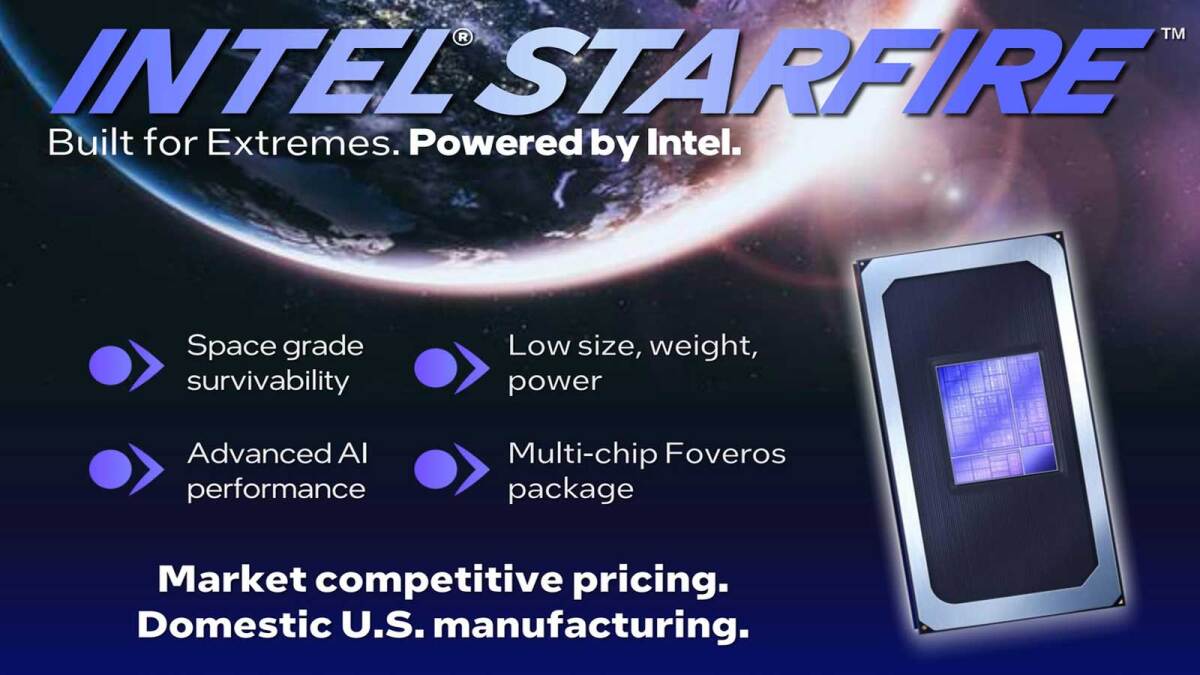
    In space, no one can hear you churn out AI calculations, but you need the chips to do the job. Intel’s new Starfire is a pitch to be the company behind a new wave of potential orbital AI data centers, per company documentation spotted by a user on X. The chips are based on Intel’s new 18A process and support high operating temperatures and anti-radiation protection, but performance may be limited.

    The big pitch for AI data centers in space from proponents like Elon Musk is that they can enjoy consistent solar power and don’t need to worry about noise levels, local pollution, or building permits. But they face other concerns instead: How do you cool data centers in space? How do you make them fast enough to compete with ground-based alternatives? And how do you make them even remotely cost-effective?

    If building a data center on the ground takes tens of billions of dollars, building one in space, where every launch costs tens to hundreds of millions of dollars, seems unlikely to offer much return on investment. Not to mention the maintenance costs.

    Still, if these projects do get off the ground, Intel wants xAI et al to use its chips. Starfire comes in two flavors: Low Power and Performance. Each has a mix of four Performance cores and four LP Efficiency cores, but the clock speeds are vastly different: 1GHz and 850 MHz for the LowPower version, and 3.1GHz and 2.1GHz for the Performance version.


    Credit: Intel

    They each have a three-tile NPU and three-tile GPU, clocked at 800MHz-1GHz and 2GHz, respectively. This results in the Low Power chip delivering up to 45 TOPS of AI compute on a 10W TDP, with the Performance chip delivering 75 TOPS of AI power for 35W.

    The chips are rated to perform between -55 and 125 degrees Celsius and use LPDDR5 or DDR5 memory. They’ll last 10 years or more, apparently. Intel appended its slide on the new chips with “Domestic US manufacturing,” which is useful for potential buyers. It also feels targeted at a very specific audience.

    All of this is impressive for a chip in space, but compared to anything on Earth? It’s pedestrian. A single Blackwell GPU can deliver over 1,000 TOPS on its own, and data centers include tens of thousands of them. These orbital projects might have a long-term use, but not until the hardware is vastly more powerful and efficient—and someone figures out how to cool them effectively.

    18ABased chip design Intels Meet Orbital Starfire
    Share. Facebook Twitter Pinterest LinkedIn Tumblr Email
    kirklandc008@gmail.com
    • Website

    Related Posts

    The Download: a chip talent battle, and deflating AI hype

    July 29, 2026

    Samsung’s chip workers are jumping ship to rival SK Hynix 

    July 28, 2026

    How AI helps scientists design the next generation of medicines

    July 24, 2026
    Leave A Reply Cancel Reply

    Top Posts

    Nothing CEO says phone prices are going to keep going up

    June 12, 20267 Views

    Google DeepMind Plans to Track AGI Progress With These 10 Traits of General Intelligence

    March 21, 20263 Views

    The AirPods 4 and Lego’s brick-ified Grogu are our favorite deals this week

    October 12, 20253 Views
    Stay In Touch
    • Facebook
    • YouTube
    • TikTok
    • WhatsApp
    • Twitter
    • Instagram
    Latest Reviews

    Subscribe to Updates

    Get the latest tech news from FooBar about tech, design and biz.

    Recent Posts
    • IEEE Publishing Ethics Team Upholds Research Integrity
    • Why a Tiny Social Media Post Has Mathematicians Rethinking AI
    • Nvidia’s Open Source Alliance Snubs OpenAI and Anthropic
    • Montana’s plan to become an experimental medical hub just pushed forward
    • Detect the Signature of Dark Matter With a DIY Antenna

    IEEE Publishing Ethics Team Upholds Research Integrity

    July 30, 2026

    Why a Tiny Social Media Post Has Mathematicians Rethinking AI

    July 30, 2026

    Nvidia’s Open Source Alliance Snubs OpenAI and Anthropic

    July 30, 2026

    Montana’s plan to become an experimental medical hub just pushed forward

    July 30, 2026
    Facebook X (Twitter) Instagram Pinterest
    • About Us
    • Contact Us
    • Privacy Policy
    • Terms and Conditions
    • Disclaimer
    © 2026 TechNovaMindset. Designed by By Pro.

    Type above and press Enter to search. Press Esc to cancel.