

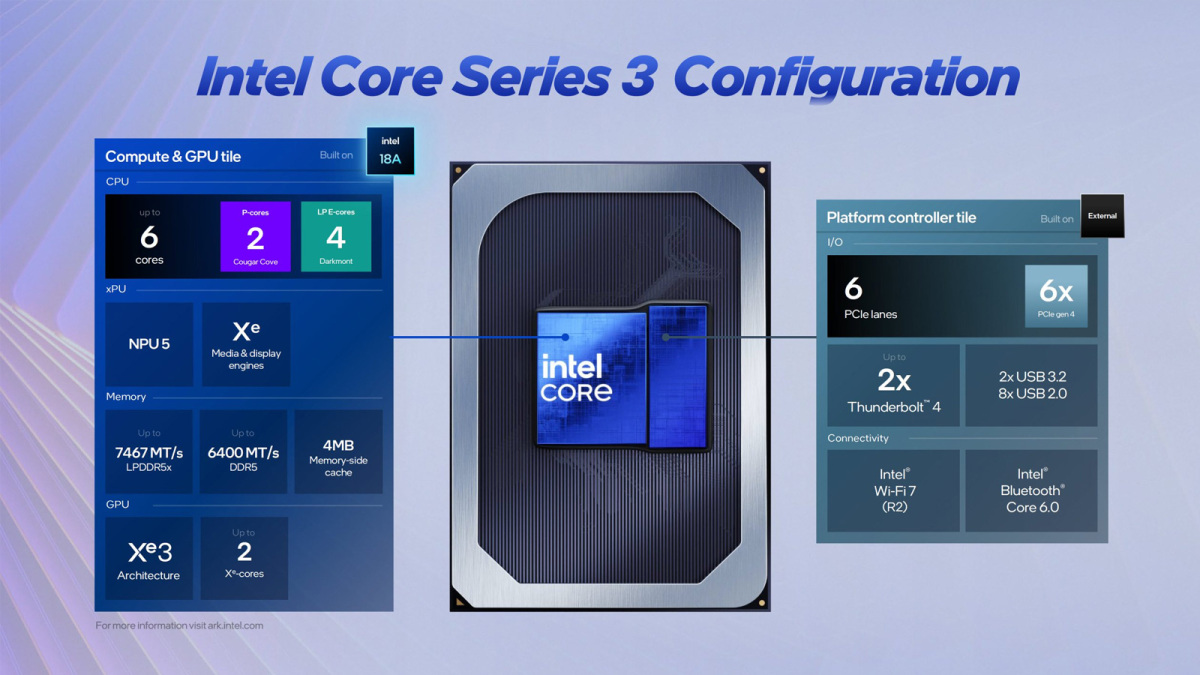
Hot on the heels of its successful rollout of impressive Panther Lake laptops, Intel has introduced a new range of entry-level mobile CPUs known as Wildcat Lake. As WCCFTech reports, these new chips are Intel Core Series 3, similar to Panther Lake, but they ditch the “Ultra” branding and come with a maximum of six CPU cores. But with impressive efficiency, access to Xe GPU graphics, and support for fast memory, they could be nippy little chips for more affordable systems.
With the budget laptop market reeling from the dual-pronged attack of Apple’s MacBook Neo and international sanctions and AI buildouts driving price spikes on everyday products, Intel’s Wildcat Lake chips could be the saving grace that affordable computing needs right now. Split across Intel Core 3, 5, and 7 ranges, the chips all come with six cores (bar the base 304 model, which has five), and sub-5GHz clock speeds. But the overall offering is intriguing, given that they’re targeting the Chromebook and low-cost laptop markets.
The chips mix twin Performance cores for strong single-threaded performance and burst workloads, and four LP-E cores, helping to extend battery life dramatically. They should last up to 18.5 hours for streaming 1080p video and over 12 hours for general work.
Credit: Intel
Intel made a number of other intriguing choices with the design of its new chip platforms. Memory speed is up to LPDDR5X 7467 MT/s or DDR5 6,400 MT/s, with support for up to 48GB of the former and 64GB of the latter. Despite those high specs, though, these Wildcat Lake platforms will be limited to just a single memory channel, cutting memory bandwidth dramatically. It will also cut costs, though.
The same goes for storage: These chips are designed to work with both cheap UFS storage and low-cost PCIe 4 SSDs. They also use a lower-cost Type-3 6-layer motherboard design and a more cost-effective 2-chip multi-chip package design.
All in all, Wildcat Lake seems uniquely designed to help bring down CPU costs. While memory and storage make up a larger share of the bill of materials in 2026, this could help some brands compete with the MacBook Neo for more low-cost, capable laptop designs.
Look out for new laptops sporting these designs later this year.
