


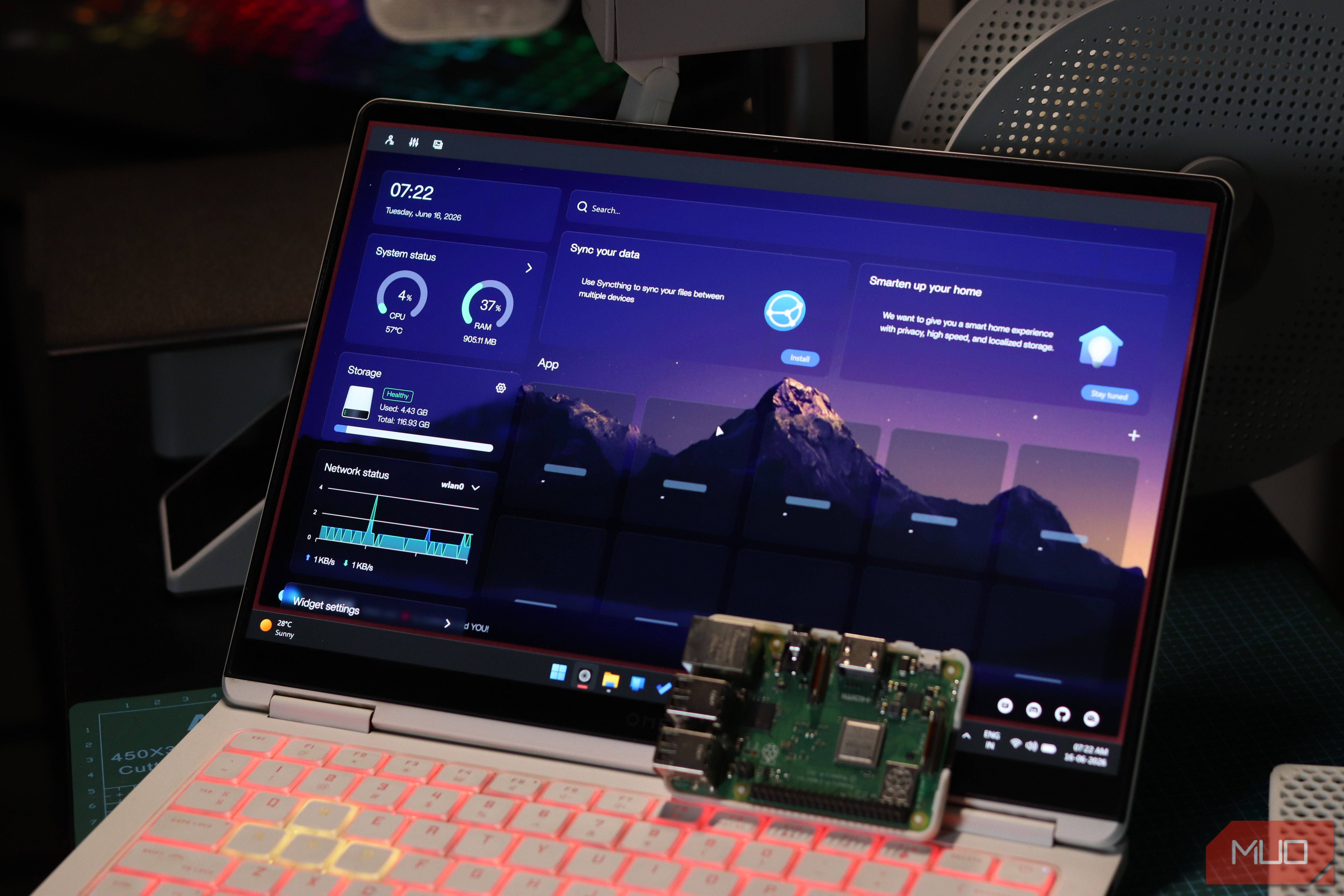
Raspberry Pis are by far the most popular single-board computers (SBCs) in the world, and are extremely capable devices that can run a ton of services. That is, if you’re buying the Raspberry Pi 4 or Pi 5 with their more powerful ARM processors and tons of memory.
But if you’ve got an old Raspberry Pi 3B+ sitting around collecting dust, it’s not yet lost to aging hardware. It’s not the most powerful Raspberry Pi you can buy anymore, but it is significantly cheaper, and with CasaOS, it can be quite the home server. So if you’re looking to self-host on a budget, the Raspberry Pi everyone stopped talking about is still worth buying.
Related
5 Raspberry Pi alternatives that are cheaper and work just as well
The Pi tax is getting harder to justify.
The easiest way to build a home server
What CasaOS is and why it removes most of the usual pain
Despite the name, CasaOS isn’t really a standalone OS in the traditional sense. It’s a software layer you install on top of an existing Linux distro like Debian, Ubuntu, or, in this case, Raspberry Pi OS. It can turn your device into a personal cloud appliance with a polished web dashboard with a level of finish I’m yet to see in most open-source projects.
Under the hood, every app you install runs in its own Docker container. But instead of writing Docker Compose files by hand or digging through environment variables, CasaOS handles all of that for you with a clean, user-friendly interface.
The dashboard looks more like a smart TV launcher than a server management panel, and that’s the point. You get real-time system stats including CPU, RAM, storage, and network, along with app tiles, a built-in file manager, SSH access to the base OS, and a storage manager that makes mounting drives as simple as plugging in a USB stick. It’s the kind of UI that makes self-hosting accessible even to those who have never done it before.
OS
Linux
Developer
IceWhale Technology.
Price model
Free, Open-source
CasaOS is a user-friendly, open-source home server platform that simplifies self-hosting through a web-based app store and management dashboard.
The Raspberry Pi 3B+ still has life left in it
Why older hardware is more than enough for many self-hosting tasks
CasaOS officially supports ARMV7 architecture, which is exactly what the Raspberry Pi 3B+ runs. That might sound like a minor detail, but it’s actually what makes this whole project possible. A lot of home server platforms, including even more polished CasaOS alternatives like UmbrelOS, have dropped support for older ARM devices, which locks out older Pi hardware entirely. CasaOS hasn’t done that yet and supports the Pi 3B+ out of the box, no workarounds needed.
The 3B+ packs a 1.4GHz 64-bit quad-core ARM Cortex A-53 and 1 GB of LPDDR2 memory. It’s modest by today’s standards but more than enough for a focused home server workload, the keyword being focused. You won’t be running a dozen services simultaneously, but for two or three well-chosen apps, the board is powerful enough. This $50 board can replace your entire smart home hub and do a lot more if you use it right.
Just try to swap out your microSD card for a USB 3.0 drive if you can manage it. Alternatively, you can use endurance-grade microSD cards for storage. These cards are typically used in action cameras and have better read/write endurance, but can cost a pretty penny.
Brand
Raspberry Pi
Memory
1 GB
Raspberry Pi 3B+ is a compact single-board computer featuring a quad-core ARM processor, Gigabit Ethernet, dual-band Wi-Fi, and Bluetooth, making it ideal for DIY, IoT, and home server projects.
You’ll be up and running surprisingly quickly
Turning a dusty Pi into a usable server in an afternoon
Screenshot by Yadullah Abidi | No Attribution Required.
The setup process only requires a single terminal command. Start by flashing a fresh copy of Raspberry Pi OS Lite to your USB drive or memory card using Raspberry Pi Imager. Enable SSH during the flash and set up Wi-Fi to avoid having to plug your Raspberry Pi into the router via Ethernet. Once it boots up, access the terminal over SSH and enter this command to run your usual update cycle:
sudo apt update && sudo apt upgrade -y
Once done, you can install CasaOS with a single command:
curl -fsSL https://get.casaos.io | sudo bash
That’s it. The script automatically detects your hardware architecture, pulls down everything it needs, and configures Docker automatically. When it’s done setting everything up, it’ll show you the IP address you need to access the dashboard. Punch it in into a web browser on any device in your network, create your admin account, and you’re ready to go. The entire process took under 15 minutes on my Raspberry Pi 3B+ with a Samsung Evo Plus microSD card.
Not every service needs a Pi 5
The apps and workloads that run perfectly on a 3B+
Screenshot by Yadullah Abidi | No Attribution Required.
With only 1GB of RAM, you have to be selective about your app stack. The good news is that CasaOS’s built-in app store covers all the lightweight essentials, and you can expand it with third-party stores to access hundreds of apps. It’s also fully compatible with the Docker ecosystem.
AdGuard Home is a good first install. It runs effortlessly on the 3B+ and gives you network-wide ad and tracker blocking for every device on your Wi-Fi. Pi-hole is also a good alternative if you’re looking for ad/tracker blocking and DNS tools. You can also build your own password cloud server with Vaultwarden, the self-hosted Bitwarden-compatible password manager. You can also use Syncthing for continuous file synchronization across devices without putting any noticeable load on the system.
Services like Nextcloud or AFFiNE are also good for basic use, like documents, notes, and calendar syncing. Jellyfin can also be installed, in theory, but don’t expect the Pi 3B+ to transcode video in real time. For media streaming to work well, or to install more apps, it’s best if you upgrade to a Pi 4 or 5 or even a dedicated mini PC if you can.
The best server is the one you already own
Why repurposing old hardware beats chasing specifications
What makes CasaOS compelling isn’t just the interface; it’s also the ease of use. Your data stays on your hardware, there’s no account required to use it, and there’s no subscription standing between you and your own data. The Pi 3B+ running CasaOS barely draws any power, and any regular USB phone charger is enough to keep it powered.
Related
5 things you shouldn’t self-host, even though you technically can
Some things are better left to professionals.
There’s also incredible community support. Third-party app stores add hundreds of additional containers, the documentation is solid, and because CasaOS runs on standard Docker Compose files, any app you can find on Docker Hub can technically be added, even if it isn’t an official store. So if you’ve got a Pi 3B+ sitting in a drawer collecting dust, or the newer Pis are just too expensive, this is one of the easiest ways to start tinkering and self-hosting your own software stack.
