

One of many reasons for escaping Windows (as I assume is for a majority of us as well) was to get rid of unnecessary pre-installed packages. This is especially true for laptops, which come with a lot of junk.
Even then, Windows just seems to never stop getting in your way. Be it forced updates, interrupting adverts or a general push to annoy the user in the most trivial way possible, there’s a lot that Microsoft could learn from the open-source community.
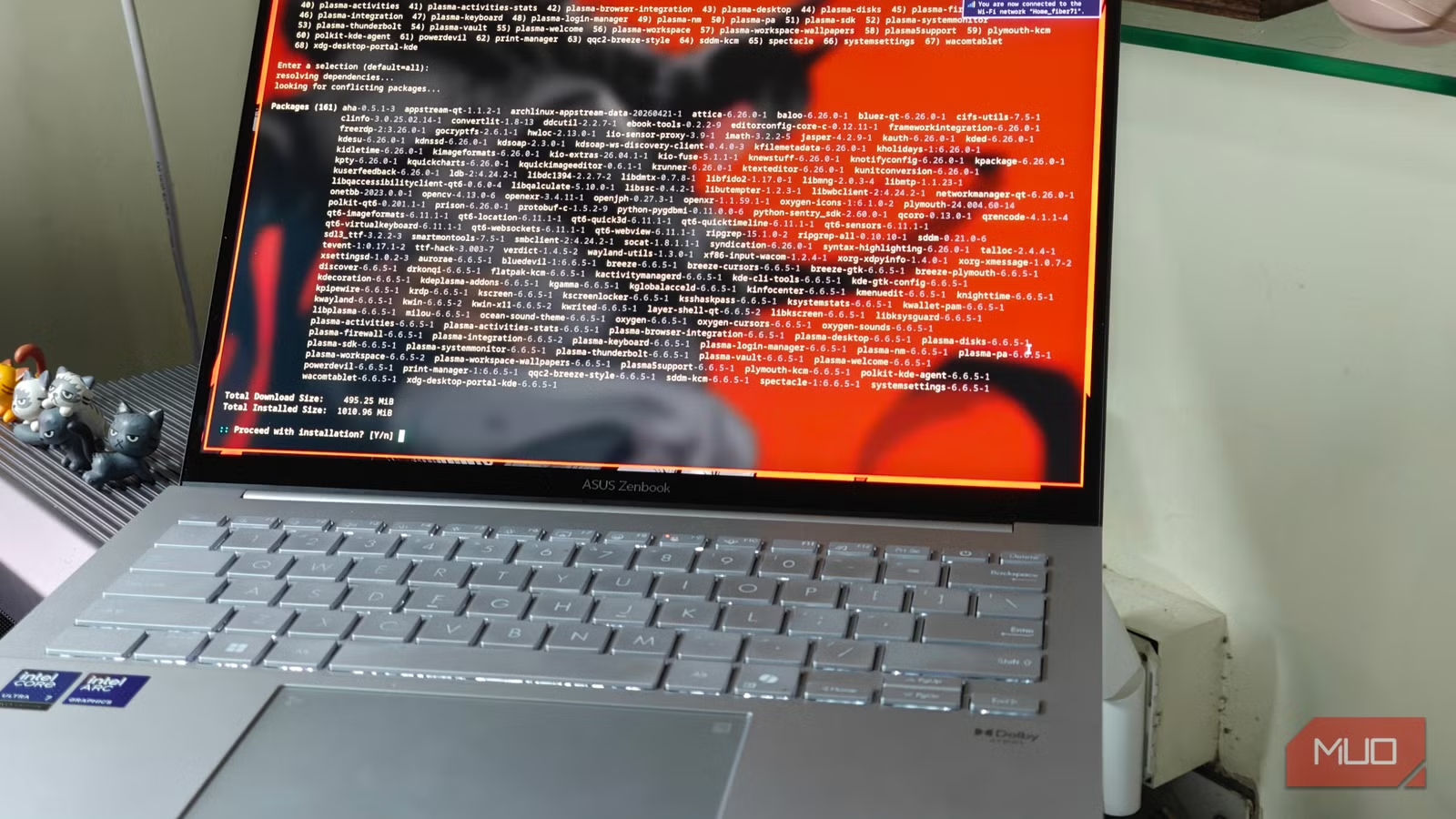
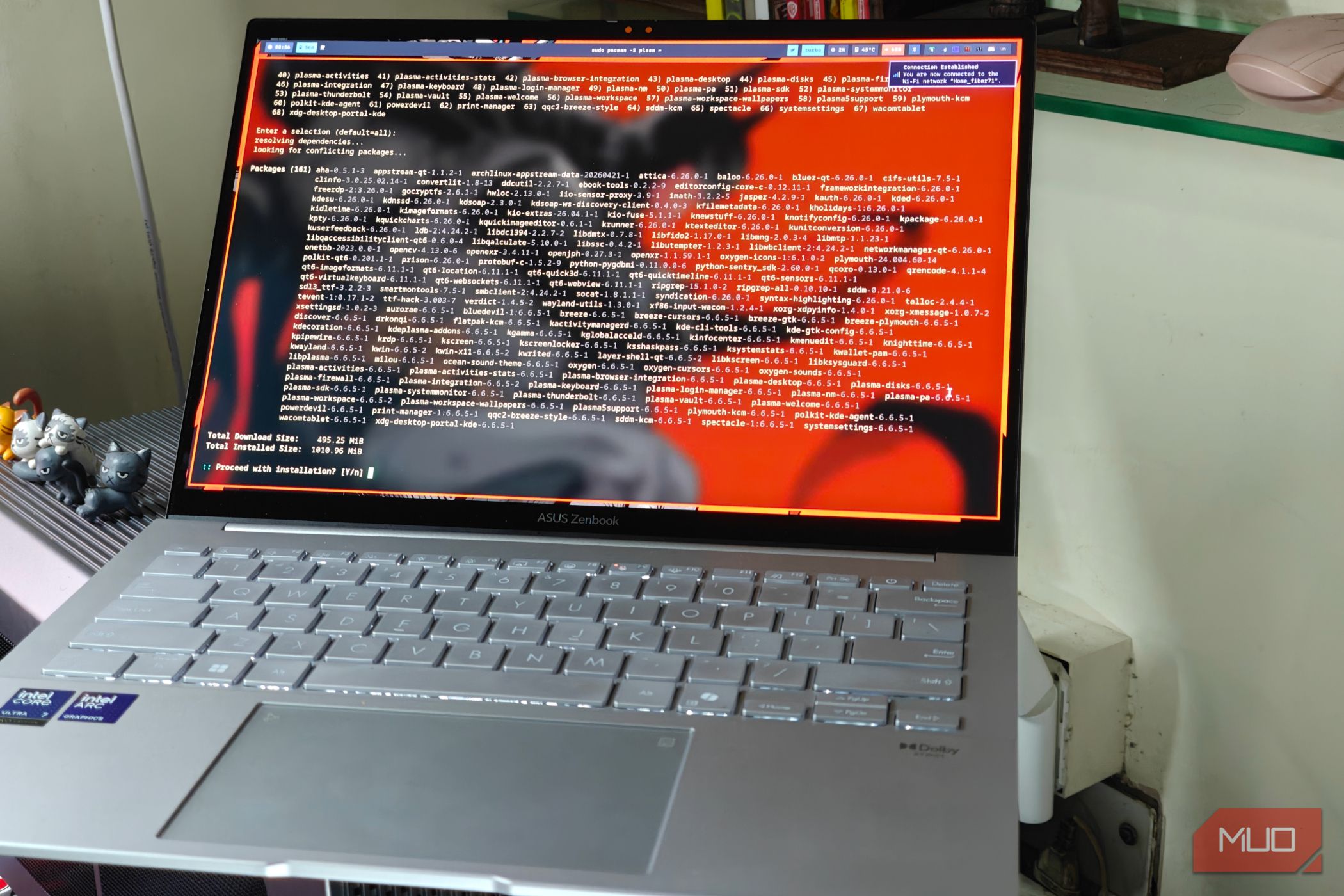
Using KDE as my desktop environment had so far been a breeze on CachyOS, or so I thought. Don’t get me wrong — I love KDE, but I also seemed to notice that it pulled in a ton of dependencies along the way. For me, this pet peeve was enough to grind my gears.
Related
5 programs you need to know about as a Linux user
Linux is more than a backup OS, and these programs prove it.
Exploring the “bloat” within Linux
KDE is a pretty bad offender
If you’ve ever carefully looked at a standard Linux installation, you’ll notice that downloading a package usually brings in some dependencies, which isn’t all that unusual. However, not all packages are treated the same.
Some draw in more dependencies than others, effectively pushing more “bloat” into the system. Traditional desktop environments are the worst offenders here, with both KDE and GNOME being pretty terrible in this regard.
And there’s not much else to do about it either — yes, there are alternatives, but they’re all pretty fragmented compared to KDE’s own app suite. Installing a single KDE package also pulls in a ton of other packages, many of which are entirely unnecessary, more so if you use something like a tiling window manager.
Just going through an installation of KDE Connect on my Arch-based system was enough to draw in a dozen or so odd packages, which I most certainly did not appreciate.
Go minimal
Unfortunately, just about every pre-configured installation medium out there is filled to the brim with excessive apps and pre-configured defaults, some of which might not align with your tastes.
Bazzite and CachyOS, for example, both come with multiple apps right out of the box, and you’ll often come across a few that you do not need. While you could easily remove these apps, it is a lot more difficult to do so on Linux.
The only way forward, (or so it would seem) is to double down. Minimal, customizable distributions have the advantage in letting you cherry-pick packages. Arch and Gentoo are excellent examples of the same.
Still, it’s certainly not for everyone. Manual installations warrant a massive time sink, and not everyone would want to do that. Which is why distributions like CachyOS exist and remain popular for a reason.
Tiling window managers to the rescue…or not?
A compromise
The whole thing gets a bit out of hand when you go for something that pre-configures things for you. A distribution such as Bazzite, for example. More often than not, these distros package in all KDE-specific apps (along with a few “goodies”), none of which ever happen to be exactly mandatory to get a system up and running.
It kind of makes sense though. Bootstrapping a user into a desktop environment wherein essential components such as a terminal and web browser aren’t present can be disastrous, and a literal nightmare to navigate through.
And thus, we have come to accept bloat in the name of convenience.
There is still a lot we can do to trim down the excess, so to speak. Switching to something a lot simpler, like a tiling window manager, for example. Tiling WMs bring with them a minimal set of dependencies (Hyprland being an exception to this in having a whole suite of its own apps) which makes them a lot more lightweight as opposed to a desktop environment.
Unfortunately, they are not easy to set up. Almost all tiling window managers come with their own set of config files which must be manually tuned to theme out your desktop interface. While you do get a template to base your work on, there really isn’t a friendly GUI to change things quickly from.
Quickshell-based alternatives such as DMS (Dank Material Shell) and Noctalia Shell do bring back some of that functionality, but that’s jumping into yet more dependency hell. This is exactly why I switched back to something a lot simpler, like Waybar and Mako for my current desktop.
Bloat within Linux is, at least, functional
The apps we term as “bloat” in Linux are rarely so, at least when taking functionality into account. Even KDEware has a ton of uses, and when integrated with the Plasma desktop, it makes for a very smooth experience.
Yes, these apps are still technically bloat, in the sense that they are unwanted — but calling them functionally useless would be untrue. More importantly, they do not come baked in with adverts or unprompted telemetry.
Still, I do find myself chasing minimalism and cutting down on packages as a whole from time to time, even if it really doesn’t matter in the grand scheme of things.
