

January 29, 2026
2 min read
Add Us On GoogleAdd SciAm
Heathrow dropped its 100-ml liquids rule. This scanner tech made it possible
New CT scanners can build a 3D model of your carry-on, helping airport staff spot risks without making you unpack or decant liquids into tiny bottles
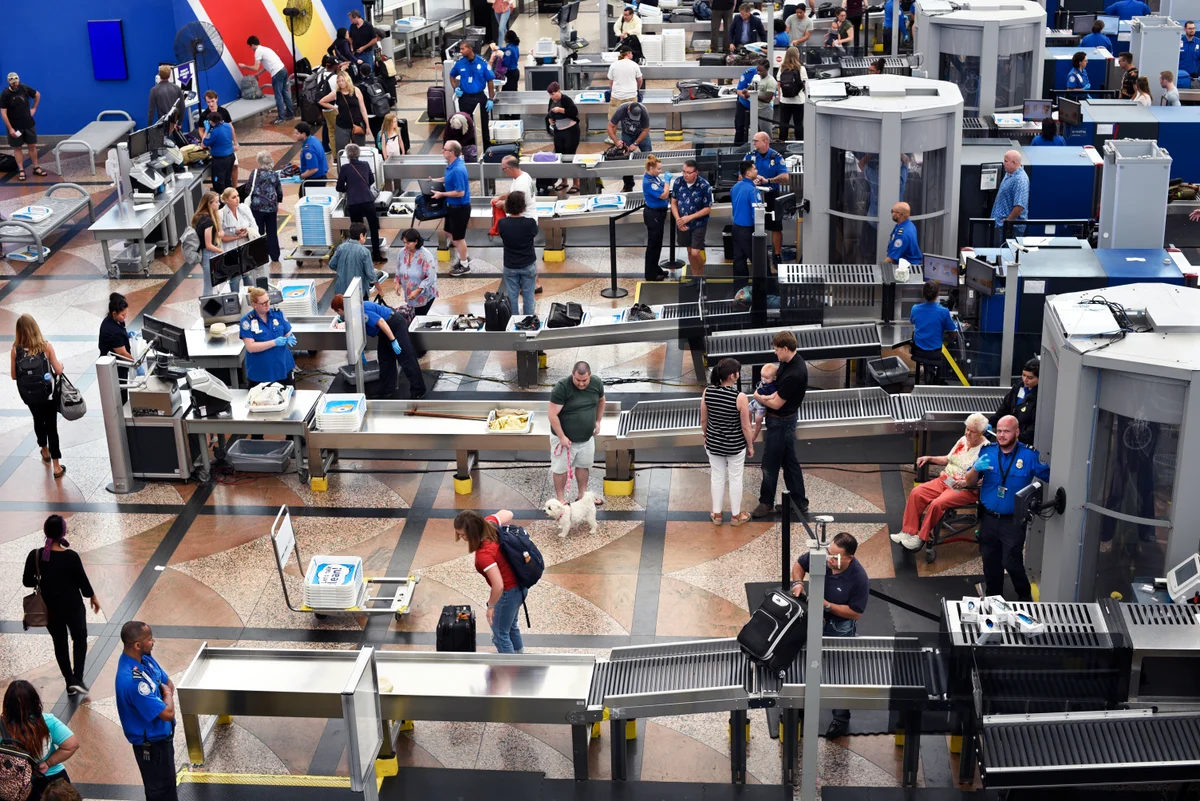
Airplane passengers proceed through a TSA security checkpoint at Denver International Airport.
Robert Alexander/Getty Images
If you’ve traveled by plane in the past 20 years, you know the checkpoint choreography: tiny bottles of liquids in a clear bag, laptop out, shoes off, pockets empty. It’s the most universal travel ritual since pretending the middle seat has plenty of legroom. But things are starting to change: at London’s Heathrow Airport, one of the world’s busiest airports, the dance is starting to fade.
Last week Heathrow completed a massive security upgrade that allows travelers to keep their electronics in their bags and to carry liquids in containers with a volume of up to two liters, far more than the long standard limit of 100 milliliters. Thank technology: better imaging and software have pushed checkpoints from two-dimensional x-rays to computed tomography (CT) scanners that build a three-dimensional model of your bag.
Why limit liquids on planes anyway?
On supporting science journalism
If you’re enjoying this article, consider supporting our award-winning journalism by subscribing. By purchasing a subscription you are helping to ensure the future of impactful stories about the discoveries and ideas shaping our world today.
The 100-ml (3.4-ounce) maximum for carry-on liquids began in 2006 as a blunt response to a foiled transatlantic liquid explosives plot. At that time, checkpoint scanners were effectively digital shadow puppets. They produced 2D images in which a bottle of shampoo and a dangerous substance could be hard to tell apart, especially when such an object was buried under a tangle of charging cables and power bricks. The solution was a work-around: shrink the liquids to 100 ml until the machines could cope.
The new class of hardware is checkpoint CT. Heathrow’s rollout includes systems such as Smiths Detection’s HI-SCAN 6040 CTiX, which captures more than just one or two static angles. The CT scanner rotates an x-ray source around the bag, capturing an image roughly every half-degree. That’s about 720 images per rotation.
The system then reconstructs these slices into a high-resolution 3D model of the carry-on. Security officers can then scroll through the visualized dataset—and can rotate the bag, zoom past a laptop, and inspect the carry-on for density and composition cues that a flat image tends to blur.
The real upgrade is the algorithm
The real innovation in the new scanners, however, is the move to automated algorithms. The systems carry C3 certification, a European standard that means the system meets a higher bar for spotting potential threats, including liquids, without forcing passengers to unpack everything.
In many setups, this enables screeners to stop hunting for every bottle of sunscreen in a bag and instead focus on whatever the system flags. The machine is less likely to be confused by all the clutter we all carry, which has convinced regulators to start relaxing rules in select places.
A word of caution: don’t toss your Ziploc bags just yet. While Heathrow upgraded its security checkpoints, other airports are lagging. So even if you fly out of Heathrow with a Costco-size bottle of sunscreen, your return airport will likely put you through the old routine.
The same goes in the U.S. The Transportation Security Administration is aggressively installing CT scanners at airports, but changing its policy is another matter—and any rule change will likely lag until CT is widespread enough to avoid patchwork protocols. So for now, on this side of the pond, American travelers are still stuck with a measly 3.4 ounces.
It’s Time to Stand Up for Science
If you enjoyed this article, I’d like to ask for your support. Scientific American has served as an advocate for science and industry for 180 years, and right now may be the most critical moment in that two-century history.
I’ve been a Scientific American subscriber since I was 12 years old, and it helped shape the way I look at the world. SciAm always educates and delights me, and inspires a sense of awe for our vast, beautiful universe. I hope it does that for you, too.
If you subscribe to Scientific American, you help ensure that our coverage is centered on meaningful research and discovery; that we have the resources to report on the decisions that threaten labs across the U.S.; and that we support both budding and working scientists at a time when the value of science itself too often goes unrecognized.
In return, you get essential news, captivating podcasts, brilliant infographics, can’t-miss newsletters, must-watch videos, challenging games, and the science world’s best writing and reporting. You can even gift someone a subscription.
There has never been a more important time for us to stand up and show why science matters. I hope you’ll support us in that mission.
