

May 29, 2026
5 min read
Add Us On GoogleAdd SciAm
What’s the biggest galaxy in the universe?
Deep surveys of the sky have turned up galaxies vastly larger than our own. Are there even bigger ones yet to be seen?
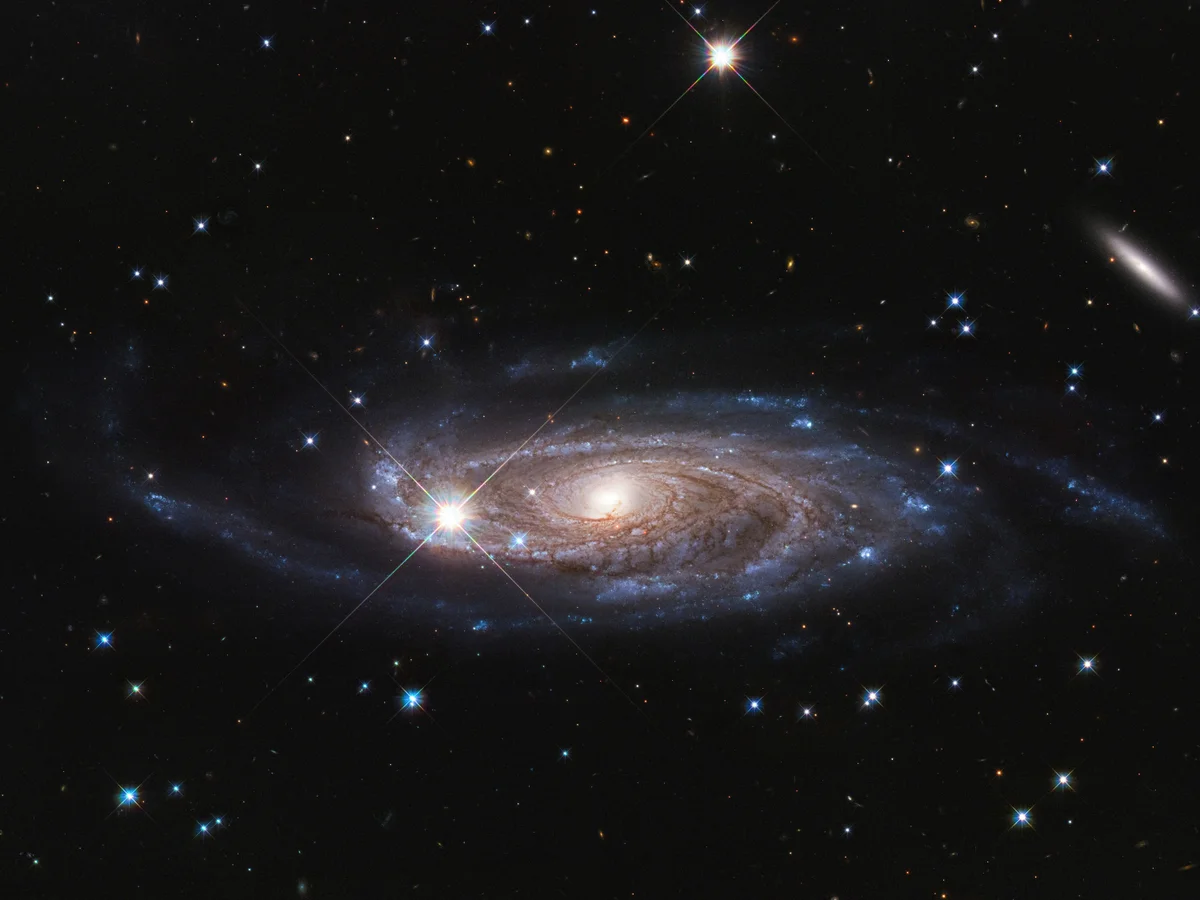
This image from the Hubble Space Telescope shows UGC 2885, also known as Rubin’s galaxy, which is one of the largest known spiral galaxies. It is 2.5 times wider than our Milky Way and contains 10 times as many stars—yet it’s still far smaller than many elliptical galaxies.
NASA, ESA, and B. Holwerda (University of Louisville)
Galaxies, like so many other astronomical objects, are surprisingly difficult to define.
Here’s a hand-wavy attempt: a galaxy is a collection of stars, gas, dust and dark matter all held together by mutual gravity. That works for most galaxies but starts to get shaky when you look more closely. Some galaxies don’t have much dark matter. Some have little or no gas and dust. Others barely have any stars!
Perhaps worse, this definition is vague about size. At the lower end of the scale, some very small galaxies could be mistaken for globular clusters—agglomerations of up to a few million stars that form alongside galaxies. The globular cluster Omega Centauri, for example, may have started out as a small galaxy before being stripped of many stars by an encounter with our own large spiral galaxy, the Milky Way.
On supporting science journalism
If you’re enjoying this article, consider supporting our award-winning journalism by subscribing. By purchasing a subscription you are helping to ensure the future of impactful stories about the discoveries and ideas shaping our world today.
But what about the upper end of the scale? How big can a galaxy get?
The maddening answer is that no one really knows. The Milky Way is pretty big as these objects go, with a starry disk at least 100,000 light-years across. Our galaxy, like most others we can examine in close detail, also has a much larger surrounding halo of hot, diffuse gas that’s sprinkled with stars. But we’ll leave halos out of this discussion because they’re so hard to detect beyond our nearest galactic neighbors; instead, for determining width, let’s stick to a galaxy’s more luminous and star-rich regions.
But even then it’s difficult. Galaxies lack distinct edges like those of rocky planets or moons. Instead a galaxy’s distribution of stars thins out farther from the center. That attenuation makes for fuzzy boundaries—all the more so because as a galaxy’s stars get less numerous with distance, they blend into the foreground of stars we gaze through from our position within the Milky Way. This effect is strongest for elliptical galaxies, which look like fluffy cosmic cotton balls, but it’s a problem for gauging the size of spiral or disk galaxies, too.
Astronomers have adopted somewhat arbitrary standard units to address this issue. For example, they sometimes calibrate using a galaxy’s “surface brightness,” a measure of how much light from the galaxy falls within a small square on the sky (usually one square arcsecond). Observers can then estimate the boundaries of a galaxy’s main body as where this surface brightness blends into the brightness of the background sky.
A final complicating factor is that a galaxy’s apparent size is a function of its actual dimensions plus its distance from us in space; a galaxy might be physically huge but so fantastically far away that it appears small on the sky. We can measure a galaxy’s redshift to clarify its true size—although at sufficiently large separations (many billions of light-years), uncertainties about the expansion history of the universe itself complicate things, so some care must be taken.
Still, even with all these impediments, we can reliably measure the sizes of many galaxies to see just how big they can get.
I have a couple of favorites. Malin 1 is about a billion light-years from Earth, an immense distance. At first it looks like a rather normal, even boring, face-on spiral galaxy some 30,000 light-years wide. But extremely long-exposure images reveal that Malin 1’s spiral arms include very dim and intricate extensions that span a staggering 650,000 light-years, making this galaxy approximately six times wider than the Milky Way! That makes Malin 1 among the largest spiral galaxies known, and the first such “giant low surface brightness” galaxy ever discovered. Several are now cataloged, but because these galaxies are so faint and hard to find, many more probably lurk out there, as yet unseen.
It’s unclear how they get so big. If they grew by galactic mergers, you’d expect their large-scale structures to be disturbed, but that doesn’t seem to be the case with Malin 1’s delicate spiral arms. There also seems to be a dearth of other nearby galaxies on which it could feed. But maybe that’s a clue: perhaps Malin 1 lacks many smaller neighbors because it already merged with them, so gently or so long ago that its majestic spirals now lack obvious distortions.
Another huge spiral is UGC 2885, or Rubin’s galaxy. It’s a little over 230 million light-years distant, and is nearly 450,000 light-years wide. Like Malin 1 it seems to be relatively isolated from other galaxies, so again, its overgrown size is something of a mystery.
There are other very large spirals, such as the Tadpole galaxy or the Condor galaxy, that are clearly undergoing a collision with another big companion. Galactic collisions can stretch spiral arms out into long tidal tails, boosting a galaxy’s size. But because these effects are relatively temporary, such cosmic train wrecks should be seen more as exceptions rather than the rule when it comes to establishing an upper limit on galaxy sizes.
Ellipticals can grow huge, as well—much bigger than any known spiral or disk galaxy. And, a bit like the colliding spirals we just discussed, an elliptical can have a different size depending on when you’re seeing it. The biggest tend to be at the centers of huge clusters of galaxies, some with many hundreds of members. This is no coincidence; galactic mergers are more likely at the cluster’s gravitational center, and astronomers think the chaos of such collisions helps give ellipticals their characteristic spheroidal shape. ESO 383-76 sits in the center of the cluster Abell 3571 and is an elongated elliptical about 1.8 million light-years wide, making it far larger than the Milky Way. Astronomers have also spotted some enormous ellipticals that are conspicuously alone—ESO 306-17, for example, is more than a million light-years across but has no other galaxies nearby. It may be the end result of a small cluster’s worth of galaxies merging together over time, so that eventually all form a single gigantic elliptical.
I have to wonder, though, if even larger galaxies still await us somewhere out in the universe, avoiding discovery so far by virtue of being so diffuse and dim. New telescopes such as the Vera C. Rubin Observatory or the soon-to-be-launched Nancy Grace Roman Space Telescope may yet find more, with their wide fields of view and capability to see extremely faint objects.
We may not know how all giant galaxies grow so large, but the best way to figure it out is to find as many as possible and study them. Stay tuned. Not everything in the cosmos can hide from us forever.
It’s Time to Stand Up for Science
If you enjoyed this article, I’d like to ask for your support. Scientific American has served as an advocate for science and industry for 180 years, and right now may be the most critical moment in that two-century history.
I’ve been a Scientific American subscriber since I was 12 years old, and it helped shape the way I look at the world. SciAm always educates and delights me, and inspires a sense of awe for our vast, beautiful universe. I hope it does that for you, too.
If you subscribe to Scientific American, you help ensure that our coverage is centered on meaningful research and discovery; that we have the resources to report on the decisions that threaten labs across the U.S.; and that we support both budding and working scientists at a time when the value of science itself too often goes unrecognized.
In return, you get essential news, captivating podcasts, brilliant infographics, can’t-miss newsletters, must-watch videos, challenging games, and the science world’s best writing and reporting. You can even gift someone a subscription.
There has never been a more important time for us to stand up and show why science matters. I hope you’ll support us in that mission.
