

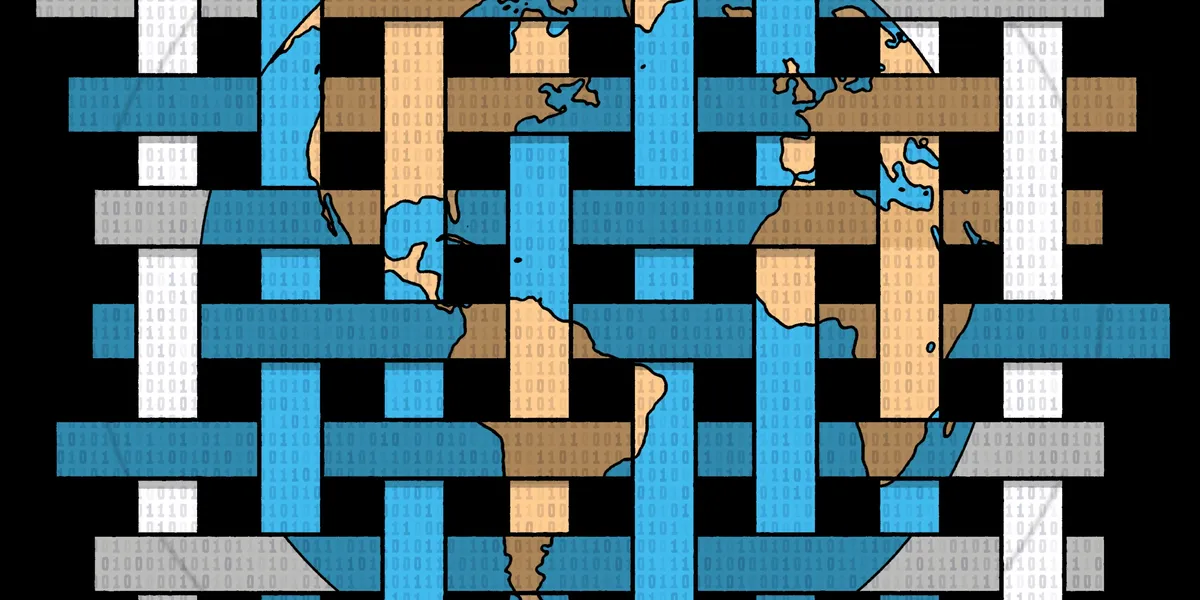

The Internet, born as an experiment meant to connect teams of researchers, has grown into a planetary-scale infrastructure that has reshaped society. Over the course of six decades, it has advanced through—by our count—three phases: first connecting computers, then mobile devices, and later all devices. But that’s just the start. Because just ahead comes new frontiers of connected intelligence and then, later, perception. Last, we suggest, represents a kind of global or ubiquitous connectedness, and finally connectedness even down to the quantum scale.
Through every phase, connectivity has been the unifying principle, although with every successive phase also comes new forms of connection. The story begins with connected packets of data across fixed networks of big machines. Then comes mobility, along with broadly connecting all manner of machines—not just mobile and fixed computing devices. Having already progressed through the first three Phases of the Internet (and having now entered the fourth), the world today has seen the steady expansion of human potential, while unlocking new industries, and reshaping how everyone connected to the Internet lives and works.
With a nod to Shakespeare’s As You Like It, what follows is our sketch of the Internet’s 7 Phases. However, unlike the Bard’s “7 ages of man,” each of the Internet’s eras do not come to an end when the next one starts. The Internet’s 7 Phases, in other words, are not sequential but rather additive. Each phase builds on and extends the previous, in the process setting the foundation for what is still to come.
Phase 1: The Internet
The original Internet was conceived in the 1970s to interconnect computer networks. Its groundbreaking aspect lay not only in its architecture but also in the principle of openness. By adopting common protocols, diverse networks could connect regardless of their location. The Internet has transformed isolated systems into a “network of networks,” enabling unprecedented collaboration across institutions and borders. Early applications such as email and file transfer demonstrated that connectivity could democratize access to information.
In the early 1990s, the World Wide Web introduced a unifying framework: URLs as addresses, HTTP for communication, HTML as a common language, and the browser as a universal interface. Between 1991 and ‘93, the Web transformed the Internet from a research network into a global platform for information exchange, paving the way for broader adoption.
The next big leap involved mobility. In the early to mid-2000s, as mobile Internet devices spread and smartphones matured, connectivity turned portable. The Internet was no longer tethered to desktops; it traveled in pockets, purses, and messenger bags.
The Internet’s newfound portability connected billions of people around the world for the first time, reshaping communication, commerce, and entertainment. Social networks flourished, mobile payments reached those without access to traditional banking, and services like ridesharing and food delivery became everyday conveniences. Connectivity had transformed from being deskbound and centered around one’s PC to becoming an always-on, portable, digital resource network woven into daily life. The app economy soon followed, where any service or application could be accessed instantly at our fingertips.
Connectivity expanded beyond PCs and mobile devices to all digital devices with any networking capability, creating today’s Internet of Things (IoT). Sensors, appliances, and other devices in homes, factories, cars, and cities stream telemetry data around the clock, turning the Internet into an invisible nervous system linking the physical and digital worlds. The IoT has opened new possibilities in healthcare, manufacturing, logistics, and agriculture such as connected tractors and soil sensors that enable smart farming, boosting yields while conserving resources.
Phase 4: The Internet of AI Agents
The most profound shift now underway is the rise of AI agents. Unlike IoT devices that merely transmit data, agents can perceive, reason, act, and collaborate. They are no longer passive endpoints but rather independent actors shaping digital and physical economies.
Two dimensions define this phase:
- Digital AI agents: This category includes software-based entities such as coding copilots, digital assistants, workflow orchestrators, and trading algorithms. They live in the digital world but shape economies and services. Consider, for instance, a coding copilot that assists developers and collaborates with other agents to debug, refactor, and optimize software in real time.
- Physical AI agents: By contrast, physical AI agents are systems that operate across both digital and physical environments such as autonomous vehicles, drones, industrial robots, and medical devices. A self-driving car that fuses lidar, radar, and ISAC (Integrated Sensing and Communications) is one increasingly prominent type of physical AI agent today. This agent detects its environment, avoids collisions, and coordinates with nearby vehicles and traffic systems. ISAC functions here as part of the vehicle, supplying the instant-by-instant environmental awareness that allows the car to navigate without human control.
We call Phase 4 not just the era of AI agents but rather the “Internet of AI Agents.” This is because value arises not from isolated intelligence but from networked intelligence. Agents will communicate, collaborate, and coordinate in real time across networks on Earth and in the oceans and skies and beyond, creating new forms of productivity, trust, and resilience.
Phase 5: The Internet of Senses
If Phase 4 brought intelligence through agents, the next step of Internet integration is perception. The Internet of Senses extends connectivity from exchanging information to exchanging experiences.
Two dimensions define this phase:
- Multisensory communication expands the network’s palate beyond just text, audio, and video. In the age of the Internet of Senses, networks will carry signals that convey the modalities of touch, taste, and smell. Advances in haptic wearables, digital olfaction, and brain-computer interfaces (BCI) will allow a shopper to “feel” the texture of clothing online or “smell” perfume before buying. In healthcare, doctors will remotely examine patients using haptic gloves that transmit the sense of feeling. Meanwhile, education will become more immersive, enabling students to explore history or science through tactile and sensory experiences.
- ISAC at the network level: Unlike the era of AI agents, where intelligence came embedded with its own sensing and communications systems, here the network is the thing doing the perceiving. Programmable surfaces and meta-materials will shape signals, enabling motion detection, distance measurement, and localization as part of system communications. Smart cities, for instance, will detect traffic flow and crowd movement in real time, feeding its own “senses” of the environment directly into its network.
The Internet of Senses will make connectivity immersive and context-aware, enriching how humans and machines interact and laying the foundation for embodied intelligence in the physical world.
Phase 6: The Ubiquitous Internet
As billions of devices and AI agents come online, the importance of seamless coverage ramps up. Phase 6, the Ubiquitous Internet, addresses this network-level need by integrating terrestrial and non-terrestrial infrastructures like cellular networks, Wi-Fi, Ethernet, local area networks, fiber, satellites, and high-altitude platforms into one unified global network.
Ultimately, a Ubiquitous Internet will ensure connectivity everywhere across remote villages, open oceans, skies, orbit, cislunar space, and beyond. This wide-scale network will underpin the next advances in autonomy, perception, and intelligence, enabling AI agents and human users alike to operate without borders.
The final frontier in connectivity will be the Quantum Internet, where quantum communication, networking, sensing, and computing converge. Unlike the classical Internet, which transmits bits, the Quantum Internet distributes qubits through entanglement and teleportation, enabling capabilities beyond anything conventional systems can achieve. Early demonstrations are already showing the Quantum Internet’s potential. Entangled qubits transmitted over optical fibers and satellites will one day create ultra-secure communication channels, resistant to interception, while quantum sensors achieve unprecedented precision in measuring time, motion, and the environment. These innovations will together open possibilities such as navigation without GPS and ultra-sensitive environmental monitoring.
Greater still is the promise of quantum networking, which will interconnect distributed quantum processors into one planetary-scale connected computer system. AI systems will run across multiple quantum computers at once, working together on the same sets of problems. Expect integrated quantum AI systems, for example, to speed up the creation of new medicines and to optimize routes for complicated supply and delivery chains.
The Quantum Internet will not replace the classical Internet but augment it, overlaying quantum signals with classical bits. Just as the Internet of Agents put intelligence in motion, the Quantum Internet will supercharge that intelligence by embedding it with the laws of physics at the smallest scales: weaving together sensing, security, computation, and AI into a single global system of connectivity.
Comparing the Internet’s 7 Phases
Taken together, the 7 Phases of the Internet above tell how connectivity has expanded from workstations and mainframes to mobile devices to people and the physical world. We have drawn lessons from the first three phases to forecast several new phases ahead: involving networked integration of AI agents, senses, everything in the classical world, and finally down into the quantum realm as well. To highlight how each phase is built on the last, what follows is a side-by-side view of the Internet’s 7 Phases:
As the above illustrates, the Internet’s evolution has been both vertical and horizontal. Vertically, each phase has added new layers of capability from hosts to people to devices to agents, building on the shared foundation of connectivity. Horizontally, new paradigms have often run in parallel with existing ones: fixed and mobile networks coexisted, IoT expanded alongside human communication. And in the future, quantum channels will share the same fiber as classical signals on different wavelengths.
The combination of layering and parallel expansion has made the Internet resilient, scalable, and continuously transformative. Meanwhile, at every stage, connectivity has adapted to new demands—enabling the Internet to be not just a network of endpoints but a fabric of fabrics, supporting diversity while fostering integration.
Each phase of the Internet—from networks to people to things to agents to senses to ubiquity to the quantum world—has extended and will continue to extend the foundation of connectivity. Each of the Internet’s 7 Phases overcomes the limits of the previous phase, while also opening new frontiers.
Even as the Internet enters into Phase 4, long gone is its limited mandate of merely moving data packets. The Internet is today and over its future phases becoming the intelligent, resilient, and universal fabric upon which the world’s digital future rests. And in the age of AI, connectivity is not merely the foundation. It is increasingly intelligence itself.
From Your Site Articles
Related Articles Around the Web
