

April 22, 2026
3 min read
Add Us On GoogleAdd SciAm
How did humans evolve language? It may be far more ancient than scientists realized
A new study links genetic regions that predate the divergence of modern humans and Neanderthals to language
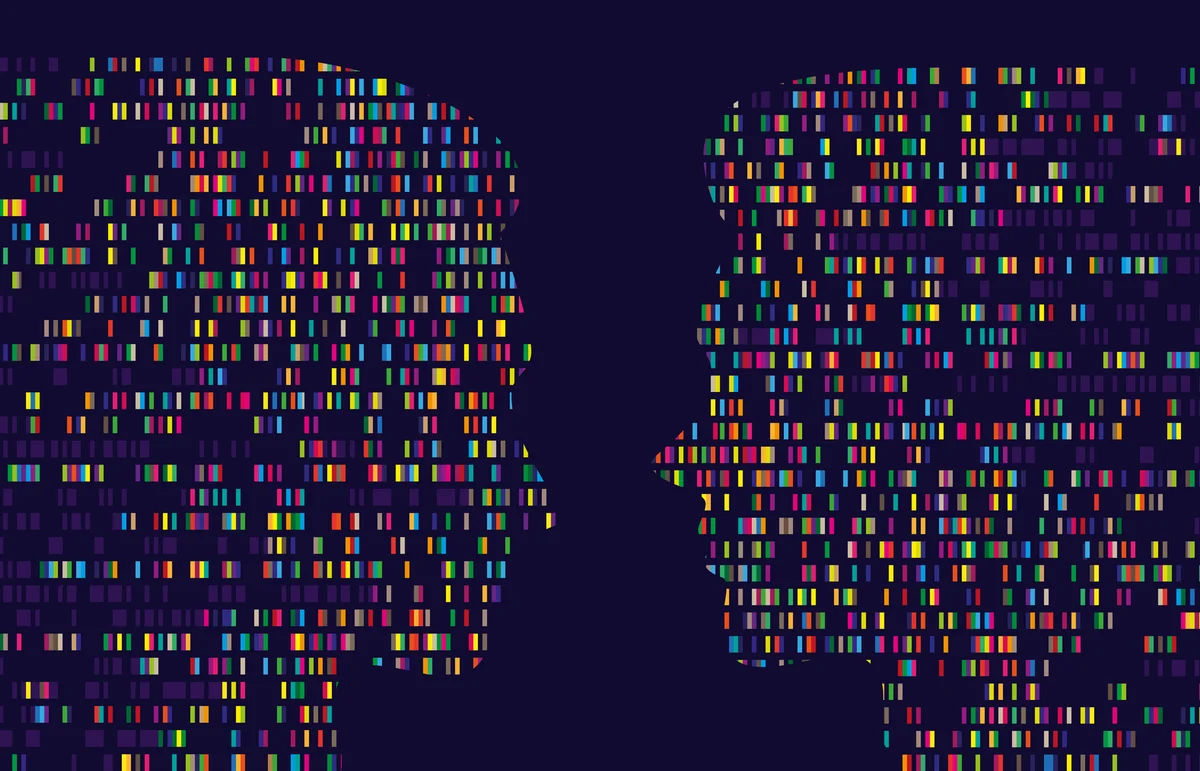
Veronika Oliinyk/Getty Images
In 2001 scientists studying human language made a breakthrough: by looking at the DNA of a family with a rare speech disability, they found that a mutation in a single gene called FOXP2 were responsible for the condition. At the time, scientists thought the gene could be the key to how humans evolved language.
“That was the gene that launched 1,000 ships,” says Jacob Michaelson, a professor of psychiatry at the University of Iowa. Since then the picture has blurred: across the population, FOXP2 doesn’t seem to be single-handedly driving our language abilities. Something else must be going on.
And now new research from Michaelson and his colleagues adds a piece to the puzzle: some regions of our genome that are influenced by the activity of genes like FOXP2 may be much more ancient than scientists realized.
On supporting science journalism
If you’re enjoying this article, consider supporting our award-winning journalism by subscribing. By purchasing a subscription you are helping to ensure the future of impactful stories about the discoveries and ideas shaping our world today.
In a study published in Science Advances on Wednesday, Michaelson and his team grouped regions of the human genome by age and looked for which groups tracked closest to language ability. They found that the regions that “pack the most punch,” according to Michaelson, are among the most ancient parts of our genome—having evolved before modern humans split from Neanderthals. Scientists call these genetic regions “human ancestor quickly evolved regions” (HAQERs).
“It’s not very much of the genome,” Michaelson says, explaining that these regions account for around a tenth of a percent of our DNA. “But we found that a huge amount of the genetic variation that explains individual [language] differences was in there.”
The researchers analyzed the genomes of 350 elementary school students in Iowa who took 17 language ability tests at various times between kindergarten and fourth grade. A trend emerged: the ancient HAQERs tracked with a person’s language ability. They found the same trend among more than 100,000 individuals enrolled in other studies, such as the UK Biobank health study and SPARK (Simons Powering Autism Research), a large study on autism.
HAQERs aren’t genes. They’re regions of the genome that act like “volume knobs” or “dials” that fine-tune how and when genes are expressed, Michaelson explains. “Individually, these don’t have a huge effect, and so they’re often very hard to study. But collectively, they can have a big effect.” Proteins made by genes like FOXP2, meanwhile, act as “hands” on the dials throughout the genome.
Together, these “dials” and “hands” appear to influence human language development, according to the findings. “It’s the collective effect of variation across all these different sites that seems to be the major explainer of individual differences in language,” Michaelson says. “There’s no single gene for language.”
Importantly, HAQERs are just one of many factors that could play a role in how modern humans evolved speech, and it’s unclear what Neanderthals’ “language” might have looked like. But Michaelson says that his team’s findings suggest that “they certainly had the biological hardware and the propensity to have language.” More research is needed to explain what role HAQERs played in Neanderthals, however.
“The authors may have identified genetic sequences associated with variation in language ability in modern humans, but we cannot know with certainty if these sequences arose in our ancient past because they granted language abilities in our ancestors,” says Mark Pagel, a professor of evolutionary biology at the University of Reading in England, who was not involved in the study. “They evolved during a time of rapid expansion of the hominin brain, and so their origin might lie in promoting that evolutionary brain growth.”
On a more philosophical level, Michaelson says, the findings are a reminder that that our desire to engage in face-to-face communication—and to be understood by others—has ancient evolutionary roots.
Human language “resonates with the code that is within us,” Michaelson says. “Through eons of evolution, our species has been optimized for this.”
It’s Time to Stand Up for Science
If you enjoyed this article, I’d like to ask for your support. Scientific American has served as an advocate for science and industry for 180 years, and right now may be the most critical moment in that two-century history.
I’ve been a Scientific American subscriber since I was 12 years old, and it helped shape the way I look at the world. SciAm always educates and delights me, and inspires a sense of awe for our vast, beautiful universe. I hope it does that for you, too.
If you subscribe to Scientific American, you help ensure that our coverage is centered on meaningful research and discovery; that we have the resources to report on the decisions that threaten labs across the U.S.; and that we support both budding and working scientists at a time when the value of science itself too often goes unrecognized.
In return, you get essential news, captivating podcasts, brilliant infographics, can’t-miss newsletters, must-watch videos, challenging games, and the science world’s best writing and reporting. You can even gift someone a subscription.
There has never been a more important time for us to stand up and show why science matters. I hope you’ll support us in that mission.
