

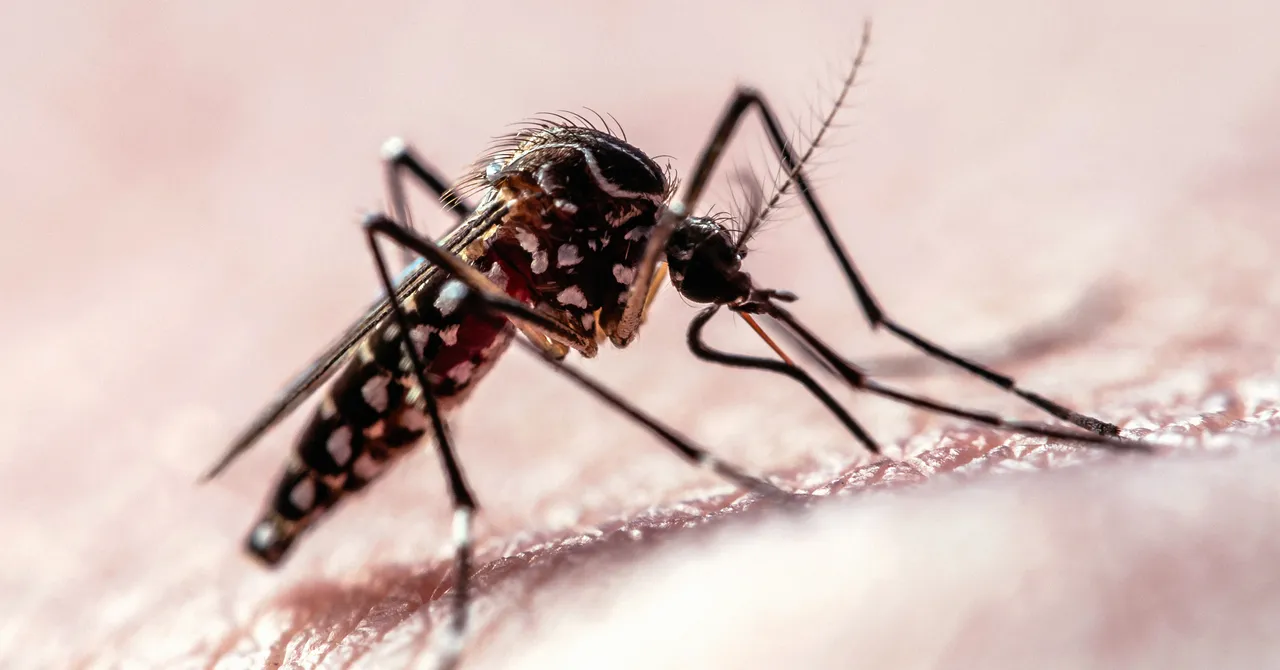
Infectious diseases borne by mosquitoes—such as malaria, dengue fever, and Zika fever—claim more than 770,000 lives worldwide each year. Understanding how mosquitoes find humans has long been a challenge in controlling the spread of these diseases. However, little has been known about how mosquitoes integrate multiple cues, including visual information and carbon dioxide, to approach their targets.
In this context, a research team led by the Georgia Institute of Technology and Massachusetts Institute of Technology has succeeded in automatically deriving a dynamic model governing mosquito flight by applying Bayesian inference statistical methods to a vast amount of data recording mosquito movements.
Bayesian inference is a statistical technique that probabilistically determines the most plausible model parameters from observed data. Using this method, the researchers were able to construct a mathematical model that could reproduce experimental results with high accuracy while compressing mosquito behavior to fewer than 30 parameters.
“The big question was, how do mosquitoes find a human target?” explains Cheng-Yi Fei, a postdoctoral researcher at MIT. “There were previous experimental studies on what kind of cues might be important. But nothing has been especially quantitative.”
Mosquitoes Have Two Modes of Flight
The research team released two female Aedes aegypti mosquitoes into a sealed experimental space and recorded their flight paths in 0.01-second increments using two infrared cameras. The data obtained from a total of 20 experiments exceeds 53 million points, with more than 400,000 flight paths recorded. This represents the largest dataset ever collected for a study quantitatively measuring mosquito flight.
The experiment began by photographing mosquitoes flying around human subjects, who were dressed in dark-colored clothing. This observation revealed that Aedes aegypti mosquitoes were concentrating their approach on human heads. This was a fundamental discovery that served as the starting point for the entire study.
Next, the researchers experimented with subjects dressed in black on one side and white on the other. They found that although carbon dioxide and body odor were emitted equally from both sides of the body, the mosquitoes’ flight trajectories were concentrated only on the black side. Although strange at first glance, this result vividly demonstrated that visual stimuli play an important role in the search for targets in a windless environment.
Furthermore, a detailed analysis of mosquitoes flying in a stimulant-free environment revealed that their flight patterns could be broadly classified into two types. One was the active state, in which they actively explored the space while maintaining a speed of approximately 0.7 meter per second. The other was the idle state, in which they flew almost without using thrust. The idle state is thought to be a preparation stage for landing and was observed more frequently near the ceiling of the experimental space.
Analysis of mosquito responses to visual stimuli revealed that mosquitoes are attracted to dark objects and slow down when they get within about 40 centimeters. However, without additional cues such as body odor, humidity, or heat, mosquitoes often flew away even after approaching their target. This suggests that visual stimuli alone are insufficient to induce landing and blood-sucking.
The response to carbon dioxide sources was entirely different. Mosquitoes that entered within a radius of about 40 centimeters of the carbon dioxide source suddenly slowed to 0.2 m/s and began flying erratically, swaying without a clear direction. Numerical simulations also showed that mosquitoes can detect carbon dioxide concentrations as low as 0.1 percent and that their detection range extends to approximately 50 centimeters from the source.
Furthermore, the mosquito response changed even more dramatically when visual stimuli and carbon dioxide were presented simultaneously. The mosquitoes began to circle around the target, and significantly more mosquitoes concentrated near the target than when either stimulus was used on its own.
