

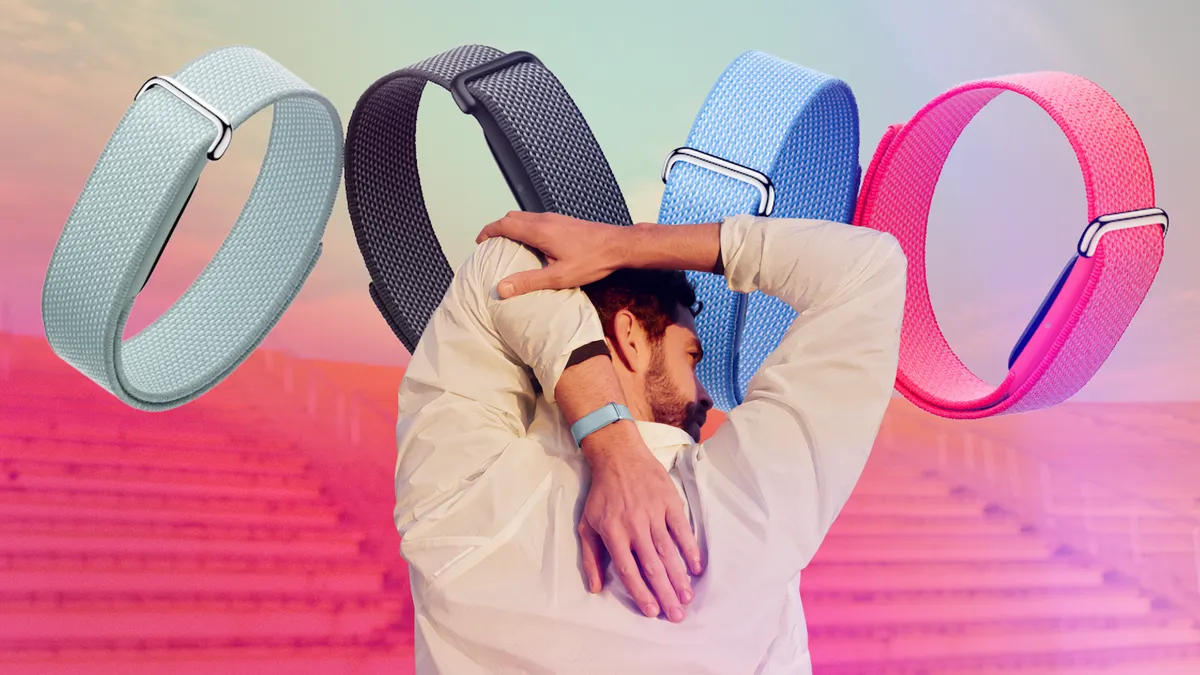
Google is ditching the screen on its latest wearable and betting hard on its AI health coach. The new Fitbit Air is a slim, screenless band with a removable sensor with the sole job of collecting health data in the background, removing the distractions of notifications, apps and stats.
Read more: Fitbit Air, Redesigned App and an AI Coach: Google Is Overhauling Its Health Ecosystem
This back-to-basics move echoes the earliest Fitbit devices, but with a very different end game. Where those first bands only counted steps, the Fitbit Air feeds a much broader stream of biometric data into Google’s evolving health ecosystem that seems to be increasingly centered on AI.
At $99, the band is just the ticket to get you in the door. The main event is Google’s recently launched Health Coach, part of the Google Health Premium (formerly Fitbit Premium) service. The premium service will run $10 a month or $100 a year when you purchase an annual subscription.
Health Coach is an AI-powered chatbot built on Gemini that translates raw data into personalized guidance, adaptive workout plans and recovery recommendations.
The strategy also extends beyond Android. Because the Fitbit Air and its companion app support both iOS and Android, Google is using the device as a Trojan horse of sorts to bring its AI health coach to iPhone.
News of the launch comes alongside a broader rebrand, as Google phases out the Fitbit name in its app in favor of Google Health — part of a push to unify its wearables, services and AI. The Fitbit branding sticks around on hardware for now, but the finish line for the Fitbit name is in sight.
It’s also a strategic bet on where the market is headed. Screenless devices like the Whoop band and Oura Ring have carved out a growing category of wearables focused on continuous wear, sleep tracking and long-term health trends rather than the in-the-moment functionality of a smartwatch. The fact that the Fitbit Air can be paired with a device like the Pixel Watch further suggests Google sees the two as complementary, not competitive.
The Fitbit Air has a removable sensor below the band.
What does it track?
The Fitbit Air covers the core health metrics you’d expect, including 24/7 heart rate monitoring, heart rate variability, SpO2 (blood oxygen level), temperature variation, sleep tracking and analysis, cardio load, training readiness, steps, distance and irregular heart rhythm notifications for atrial fibrillation detection. It also includes automatic activity tracking that you can confirm later in the app. The device is water-resistant up to 50 meters.
One caveat: The Fitbit Air uses an older sensor setup than the current Pixel Watch 4, which includes a multipath optical heart rate sensor and a far-field temperature sensor. The Air sticks with more traditional sensors, which could limit accuracy, especially in peak heart rate zones and for more advanced insights, like menstrual cycle tracking.
Google’s coaching superpowers
Google Health Coach, and the long-term health insights, are the main reason you’d buy this band. The coach pulls together fitness, sleep, heart rate and menstrual cycle data to build training plans that adapt to real-time performance and schedule. It sets weekly targets and can suggest workouts (which include video examples), adjust recommendations based on recovery and can use your own data to signal when to push and when to rest. This includes haptic Smart Wake alarms that use your sleep data dynamically to wake you at an optimal point in your sleep cycle.
Health Coach has been in beta since October of 2025 and is rolling out in a staggered launch alongside the Fitbit Air.
Three phone screens showing Google Health Coach nutrition and fitness logging.
Battery life
One of the clearest advantages of going screenless is battery life. Google says the Fitbit Air lasts up to a week on a single charge. (We’ll have to test to see how this holds up to our real-world testing.) And it can also charge from zero to 100% in 90 minutes.
That doesn’t quite match the Whoop band’s two-week battery life, but it’s a serious step up from the roughly 36-hour battery cap you’d get from its display-totting siblings, like the 41mm model of the Pixel Watch 4.
The Pixel Watch 4 (pictured) can be used alongside the Fitbit Air.
iOS and Android
Unlike the Android-only Pixel Watch, the Fitbit Air works with both Android and iOS, which is more in line with other Fitbit devices. That means you can get the Google Health Coach even if you have an iPhone, though it’s unclear if there are any advantages to using the Air on Android versus iOS.
Design and fit
I haven’t seen the Fitbit Air in person yet, but based on the specs, it follows a familiar screenless design. Like the Whoop band, the sensor module can be removed and swapped between different bands. Unlike Whoop, which offers alternate mounts such as a sports bra and even a Whoop thong, Fitbit is sticking to wrist-based accessories. That may change later based on feedback.
The Air supports a range of interchangeable bands in different materials. Options include the Performance Loop for everyday wear, the Active Band for workouts and the Elevated Modern Band for a more polished look. Bands start at $35 and come in four colors: Obsidian, Fog, Berry and Lavender. An orange and gray Stephen Curry Special Edition will also be available in limited quantities.
Fitbit Air Performance band in: Lavender, Obsidian, Berry and Fog.
The privacy dilemma
The shift toward Google Health branding is now prompting renewed scrutiny, particularly as the company explores letting users import medical records to the app. As part of its 2020 acquisition of Fitbit, Google agreed to keep Fitbit health data separate from its advertising business for 10 years.
Google says data collected by the Fitbit Air and other Fitbit devices will not be used for advertising, but experts have noted that even anonymized health data can often be traced back to individuals, and that once data is collected, how it’s used years down the line depends entirely on policies that can change. For anyone considering handing over their health data, it’s worth reading the fine print and keeping an eye on how those policies evolve over time.
The Fitbit Air detects workouts automatically and stores them in the Google Health App.
Fitbit Air pricing and availability
The Fitbit Air launches May 7 for $100 at Google.com and in the Google Store app, with in-store availability at physical retail locations beginning May 26. Accessory bands start at $35.
Three months of Google Health Premium are included with purchase, after which the subscription automatically renews at $10 a month.
CNET will be testing the Google Fitbit Air over the coming weeks, so check back for our full review.
