



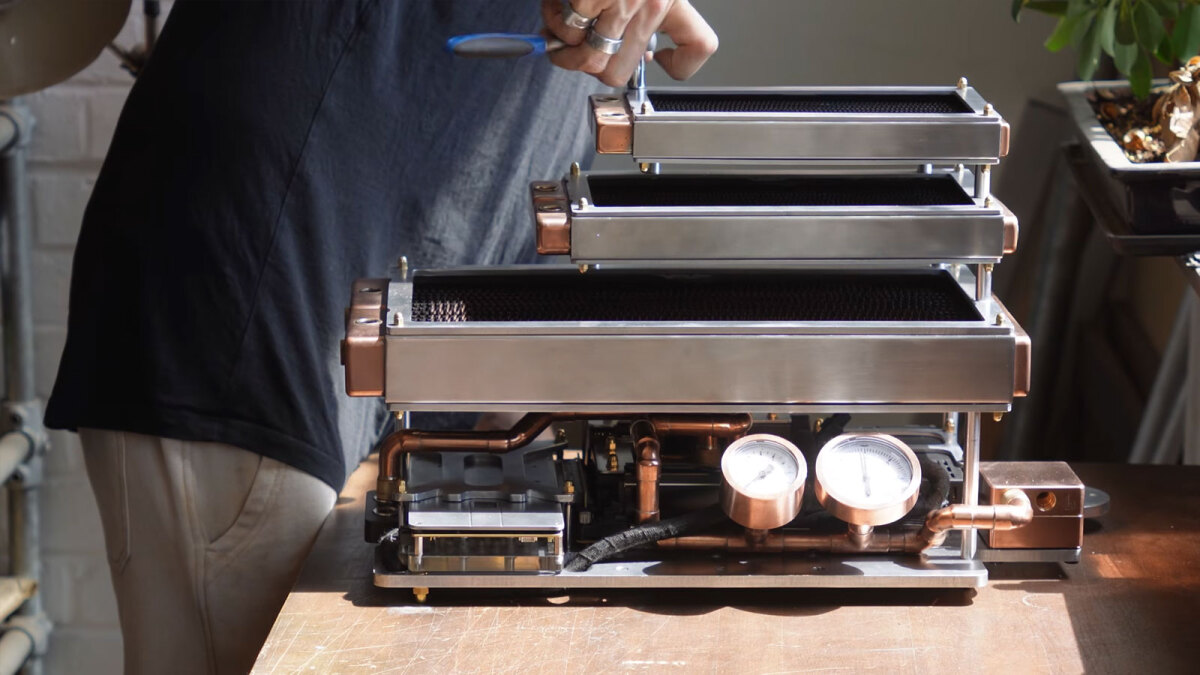
Fans might produce annoying noise, but they’re essential for cooling most PCs—especially high-end ones made for gaming. But Billet Labs has developed a fanless gaming system with an RTX 5080 and Ryzen 9800X3D, using a custom water-cooling loop with multiple fan-free radiators and extensive copper piping. The result is impressive, but keeping temperatures in check was almost impossible.
The RTX 5080 is a high-end graphics card with a 360W TDP and a recommended 750W PSU for power. In this case, Billet Labs used a mere 600W unit for the entire system and paired it with a CPU that pulls 120W at full load. Combined with a Gigabyte Aorus Pro B850 motherboard, 32GB of DDR5 memory, and 2TB of NVMe storage, it’s a powerful gaming system, and one that Billet somehow managed to cool without fans—albeit only just.
The cooling system uses a trio of vertically stacked water-cooling radiators, with convection providing natural airflow over them. These measure 120 × 240mm, 140 × 280mm and 200 × 400mm, with the largest at the bottom. The CPU and GPU were both connected to this custom water loop, while the motherboard was mounted on an aluminum plate. Thick thermal pads sent heat into the plate, passively cooling the chipset.
The end result was a PC that was almost completely silent at idle and full load, with only minor pump noise giving away that it was powered on. The cooling effect was plenty for idle, with the internal coolant temperature sitting at around 28 degrees C. However, after running Cinebench for 30 minutes, the coolant temperature reached 39 degrees, and the CPU reached 90 degrees.
In gaming, bringing the GPU into the equation, the coolant reached 56 degrees C. Though the RTX 5080 didn’t throttle, the coolant temperature was reaching uncomfortably high levels, and it’s likely that continued operation would have caused throttling. Unfortunately, this isn’t a setup that can withstand hours upon hours of gaming.
The conclusion for Billet Labs is that the project shows promise, but needs further refinement. Perhaps larger radiators for greater surface area? A more powerful pump? A longer loop?
Consider me interested in whatever Billet Labs does next.


