

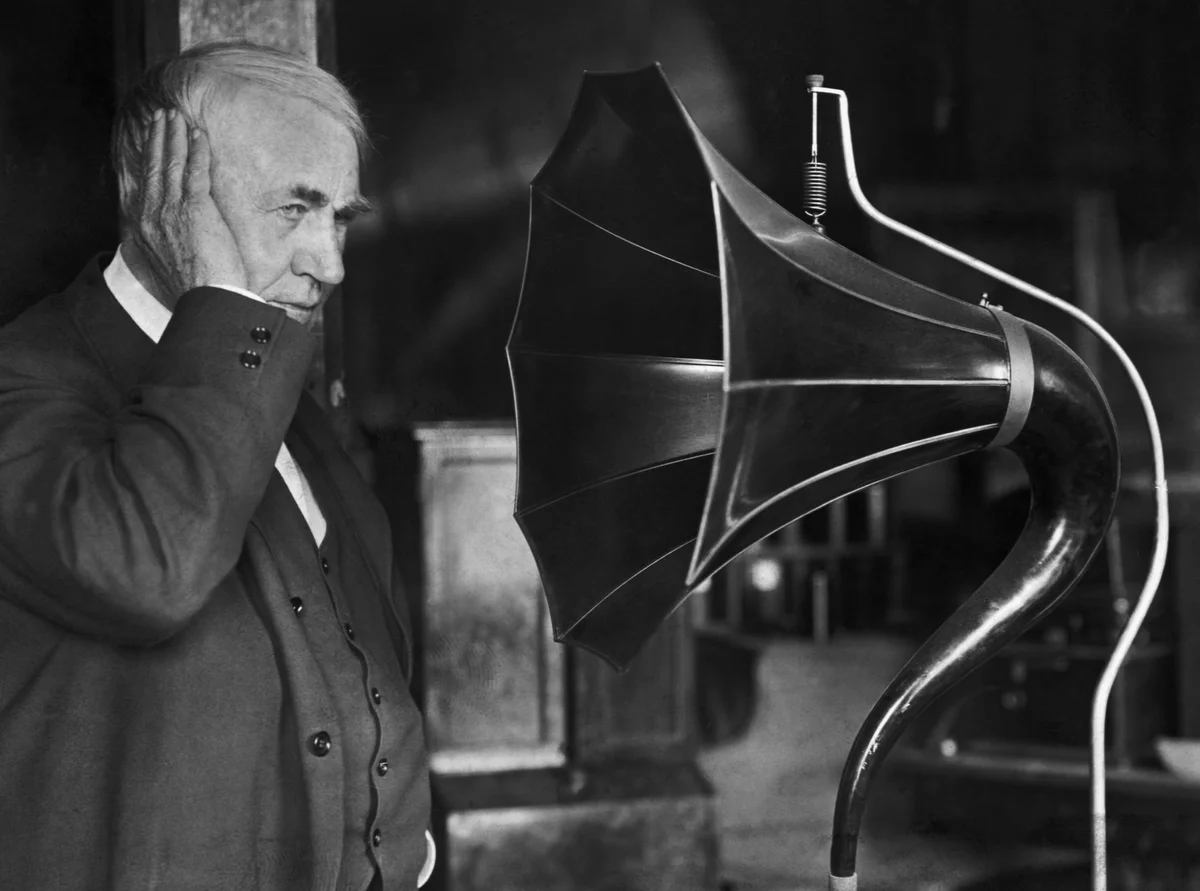
On December 7, 1877, Thomas Edison walked into the offices of Scientific American in New York City and placed a metal device on a desk. With a turn of a crank, Edison astonished the dozen or so staffers who had gathered around the contraption.
The machine spoke. “Good morning,” it said in Edison’s voice. “How do you do?”
SciAm’s editors described the demonstration in the December 22, 1877, issue. “There can be no doubt,” they wrote, “but that the inflections are those of nothing else than the human voice.” Accompanying the report was a detailed sketch of Edison’s device, which the inventor called a phonograph.Virtually overnight, the article catapulted Edison to fame and established the phonograph as the first machine to record and reproduce human speech.
On supporting science journalism
If you’re enjoying this article, consider supporting our award-winning journalism by subscribing. By purchasing a subscription you are helping to ensure the future of impactful stories about the discoveries and ideas shaping our world today.
But was it?
On May 15, 2026, at the annual meeting of the Association for Recorded Sound Collections in Memphis, audio historian Patrick Feaster proposed another candidate for the title—a recording machine that would have preceded Edison’s by nearly a century.
Feaster, a tenacious researcher with a photographic mind for everything phonographic, began investigating this possibility more than 20 years earlier, when he came across a German article from the early 1900s surveying mechanical devices that synthesized (but did not record) some of the sounds of human speech. The article mentioned a man identified only by his last name, Müller, who had exhibited some kind of talking machine in the 1780s. Although the article’s author branded Müller’s machine an obvious hoax, Feaster was intrigued.
His occasional investigations over the following two decades uncovered additional references to Müller and his “speaking machine,” including a book describing the device from 1788—the same year the machine was exhibited in Erlangen, Germany.
Feaster found two eyewitness accounts that agreed on the details. The speaking machine was apparently about 3.5 feet wide and 2.5 feet high, deep and flanked by two life-size human figures—one male and one female. Each figure rested a hand on top of a cabinet that featured 34 “speech mechanisms” resembling organ pipes, along with levers, rollers, cylinders, clockwork mechanisms and 10 bellows. But Feaster also found other accounts that described Müller’s device as a puppet that conversed with audiences.
An artist’s impression of a talking device exhibited in the 1780s by Georg Theodor Jacob Müller. According to eyewitness accounts, sounds came out of the two figures’ mouths.
Patrick Feaster/Maria Amador
In January Feaster made a startling discovery: there were two Müllers, and both demonstrated speaking machines in Germany in the 1780s. (Neither device has survived.)
One of them, Laurentius Müller, did indeed employ a speaking puppet, and it was documented as a hoax. The other Müller, Georg Theodor Jacob Müller, was a devotee of medicine and mechanical sciences. Feaster says he was impressed by several contemporaneous accounts of Georg Theodor Jacob Müller’s machine, including a testimonial by physicist Johann Tobias Mayer.
According to Mayer’s account, sounds passed from the top of the machine through tubes that carried the vibrations up through the arms of the two figures and into their mouths, producing distinct male and female voices. “No one will be convinced that the human voice has been achieved perfectly,” Mayer noted, but if the figures were removed and listeners pressed their ears directly on the hole at the top of the cabinet, the speech became clearer.
The machine’s repertoire included answers to 12 riddles, passages from books, and laughing, crying and kissing sounds, as well as arias sung in both male and female voices—all feats that Edison’s phonograph would one day be able to accomplish by recording and playing back the human voice.
Like his contemporaries, however, Mayer took for granted that the device was a fake. “Everyone assumed that no machine could really do what Müller’s was supposedly doing,” Feaster says.
Two features, however, lend credence to the idea that the device wasn’t a hoax. Müller mentioned that his machine used an artificial ear, a mechanism simulating the human eardrum that gathered sound from the air and was employed during the 1780s as a hearing aid. An artificial ear could have been part of a recording device.
The second notable feature involved an echo. When audience members spoke three or four words into the ear of one of the figures, they heard what appeared to be those same three or four words in their own voices after a delay. A natural echo with a delay long enough for those words to be enunciated clearly would require a bigger volume of space than the interior of Müller’s cabinet. So if the repeated words weren’t an echo, Müller might have employed some kind of mechanical technology to record and play them back.
“Even if Müller was a fraud,” says Jacob Smith, a media historian at Northwestern University, “Patrick [Feaster] has given us a richer picture of the horizon of imagination surrounding talking machines long before Edison.”
Feaster has already helped rewrite the history of artificial ears. In 2008 he and several of his sound historian colleagues established that an invention of the late 1850s was likely the first to capture sounds on paper. The phonautograph, a device invented by a French typesetter, channeled sound vibrations from an artificial ear to a stylus that transcribed those vibrations on soot-coated paper in the form of seismographlike tracings. Feaster and his collaborators even managed to use digital technology to transform those soot tracings into an audio recording: breaths that once actually passed through human lips.
The invention that Edison brought into the offices of Scientific American also used sound vibrations to make a needle vibrate—in his case, by digging grooves into a strip of tinfoil or paper that was embossed with wax. When he ran the grooves back though a stylus, it reproduced the sound that had been recorded.
“In my class on the history of recorded sound,” Smith says, “the students are always surprised at how ‘low tech’ [the phonograph] is and that, technically speaking, it could have been invented much earlier.”
Maybe it was.
For now, Feaster says, the evidence that Georg Theodor Jacob Müller created some version of a phonograph remains intriguing, inconclusive—and elusive. That doesn’t mean he’s giving up. This week Feaster is in Germany to hunt for more clues.
