

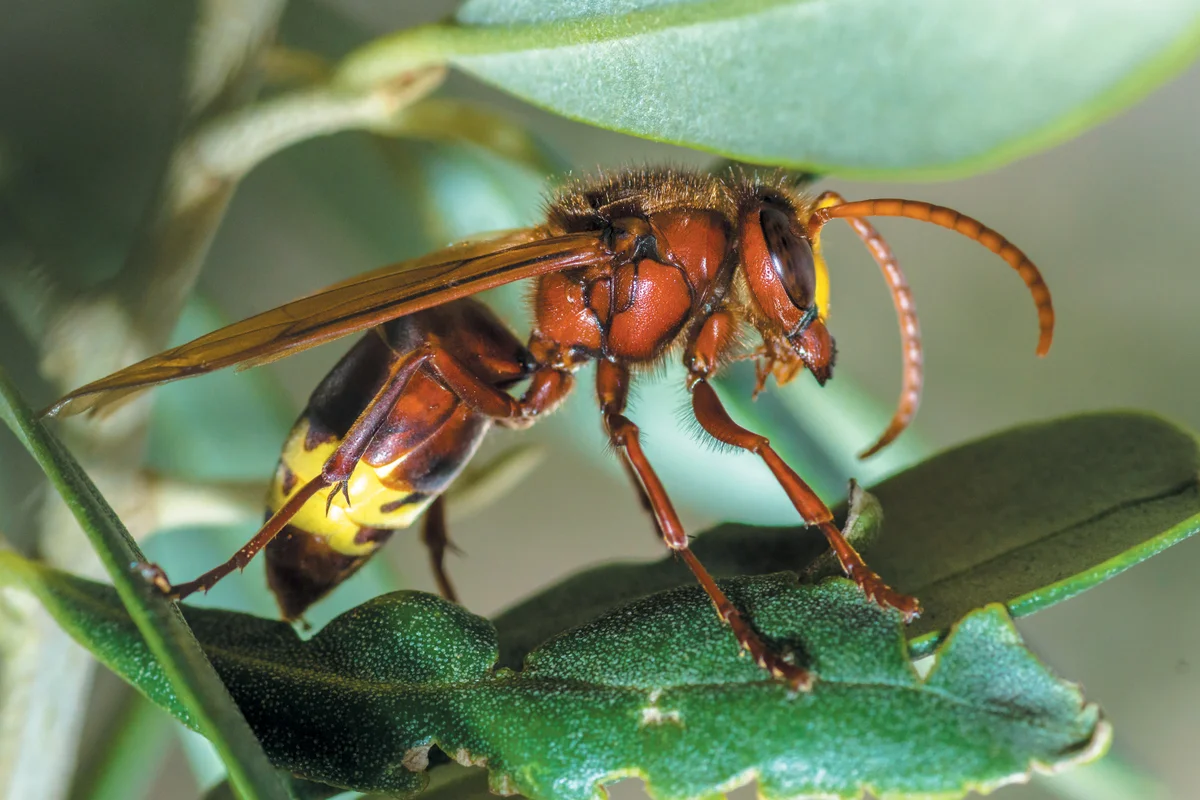
Earth has a dizzying diversity of insects, with beetles alone making up 25 percent of all named animal species. But a new analysis suggests there’s even more variety than we thought: as many as 20 million unique insect species, more than triple the 6 million figure that’s been taxonomist’s touchstone for years. And so far, we’ve described just a paltry 1.5 million of those species, says study co-author Laura Melissa Guzman, an entomologist at Cornell University.
The new calculations, detailed in a study published on Monday in Proceedings of the National Academy of Sciences, are “a game changer,” says Nigel Stork, an entomologist at Griffith University in Australia and one of the scientists behind earlier, lower estimates of species diversity. “It’s amazing work.”
But how can scientists count the critters we don’t know about? It took decades of hunting parasitoid wasps in the cloud forests of Costa Rica, lessons learned from outbreaks of hepatitis A in colleges in Taiwan and a quest to map every tree species on Earth.
On supporting science journalism
If you’re enjoying this article, consider supporting our award-winning journalism by subscribing. By purchasing a subscription you are helping to ensure the future of impactful stories about the discoveries and ideas shaping our world today.
First, the parasitoid wasps—these winged insects have a flair for a dramatic entrance, hatching from eggs inside other creatures to burst out, Alien-style, from their living flesh. Guzman and her colleagues looked to three long-running projects that tracked these insects. Two were networks of Malaise traps, tent-shaped nets that intercept flying bugs and funnel them into a liquid reservoir for preservation and collection. In the third, coauthors Dan Janssen and Winnie Hallwachs spent more than 40 years collecting caterpillars in the forest and rearing them with the express purpose of seeing which parasitoid wasps tore their way out.
In total, these three operations detected 1,414 species of parasitoid wasps. But there was remarkably little overlap and nearly 30 percent of the species present were known only from a single observation. That’s how researchers know they aren’t even close to capturing the full diversity in a system, says lead author Robert Colwell, an entomologist and statistician at the University of Colorado Museum of Natural History.
To estimate how many parasitoid wasp species in the Costa Rican national park have evaded detection, the researchers took cues from infectious disease tracking. In 2015, one of the new study’s coauthor Anne Chao looked at cases of hepatitis B identified by blood serum, reported by doctors and local hospitals, and student questionnaires to see where they did and didn’t overlap to estimate the true size of an outbreak—this same technique led them to ballpark the true number of parasitoid wasp species in the park at about 3,400.
To convert that to an estimate of total species in the park, they turned back to the bug “soup” of the Malaise traps, which contained more than 1.6 million insects. A genetic analysis technique called DNA barcoding identified nearly 54,000 species among them. Applying the same ratio of observed to ‘missed’ wasps to the other species gave the researchers a ballpark estimate of about 333,000 insect species in the Costa Rican park.
But to apply that figure worldwide, the researchers needed help from trees. “One of the most consistent patterns [in biodiversity] is called latitudinal richness,” Guzman explains. “The number of species is higher in the tropics than in the polar areas” across all the kingdoms of life, and scientists can use a better-understood class of creatures—in this case, trees—as an anchor value for a region’s local biodiversity. Based on a study that surveyed trees across a gridded map of every piece of land on the planet, the researchers calculated an “upscaling factor” to go from the estimated number of tree species in the Costa Rican forest (between 1,200 and 1,500) and species worldwide (about 73,300).
These creative calculations suggest a grand total of about 20 million species of insects, many of them with behaviors and physical adaptations and remarkable lives scientists today can only dream of discovering.
“It makes it obvious that we aren’t going to be able to do it by the traditional methods,” Colwell says. “There aren’t enough entomological taxonomists to even begin to chip away at that within our lifetimes.
“It’s really useful to know who we share our life on Earth with,” Guzman says, And with biodiversity under threat, this new estimate “gives us a baseline of how much we stand to lose.”
It’s Time to Stand Up for Science
If you enjoyed this article, I’d like to ask for your support. Scientific American has served as an advocate for science and industry for 180 years, and right now may be the most critical moment in that two-century history.
I’ve been a Scientific American subscriber since I was 12 years old, and it helped shape the way I look at the world. SciAm always educates and delights me, and inspires a sense of awe for our vast, beautiful universe. I hope it does that for you, too.
If you subscribe to Scientific American, you help ensure that our coverage is centered on meaningful research and discovery; that we have the resources to report on the decisions that threaten labs across the U.S.; and that we support both budding and working scientists at a time when the value of science itself too often goes unrecognized.
In return, you get essential news, captivating podcasts, brilliant infographics, can’t-miss newsletters, must-watch videos, challenging games, and the science world’s best writing and reporting. You can even gift someone a subscription.
There has never been a more important time for us to stand up and show why science matters. I hope you’ll support us in that mission.
