


David Temkin was driving south from San Francisco, down Highway 101, as billboard after billboard pitched AI in variations of dense word salad. One ad marketed “automated testing compliance done without command shift.” Another promised “safer schools with instant visitors screening.” All of them marketed tech companies, but to whom and for what was obscure—even for tech insiders like Temkin.
“It is absolutely absurd,” Temkin tells Fast Company. “Some of these are absolutely impenetrable. Like, what are they even talking about? It makes me wonder what the intention is.”
The Silicon Valley veteran has lived through plenty of change, watching firsthand as the tech world evolved from a niche for nerds into a cultural force with global influence both online and offline. Since arriving in the 1990s as a young software engineer, he’s founded several startups and worked within established tech players like Apple, Google, and AOL.
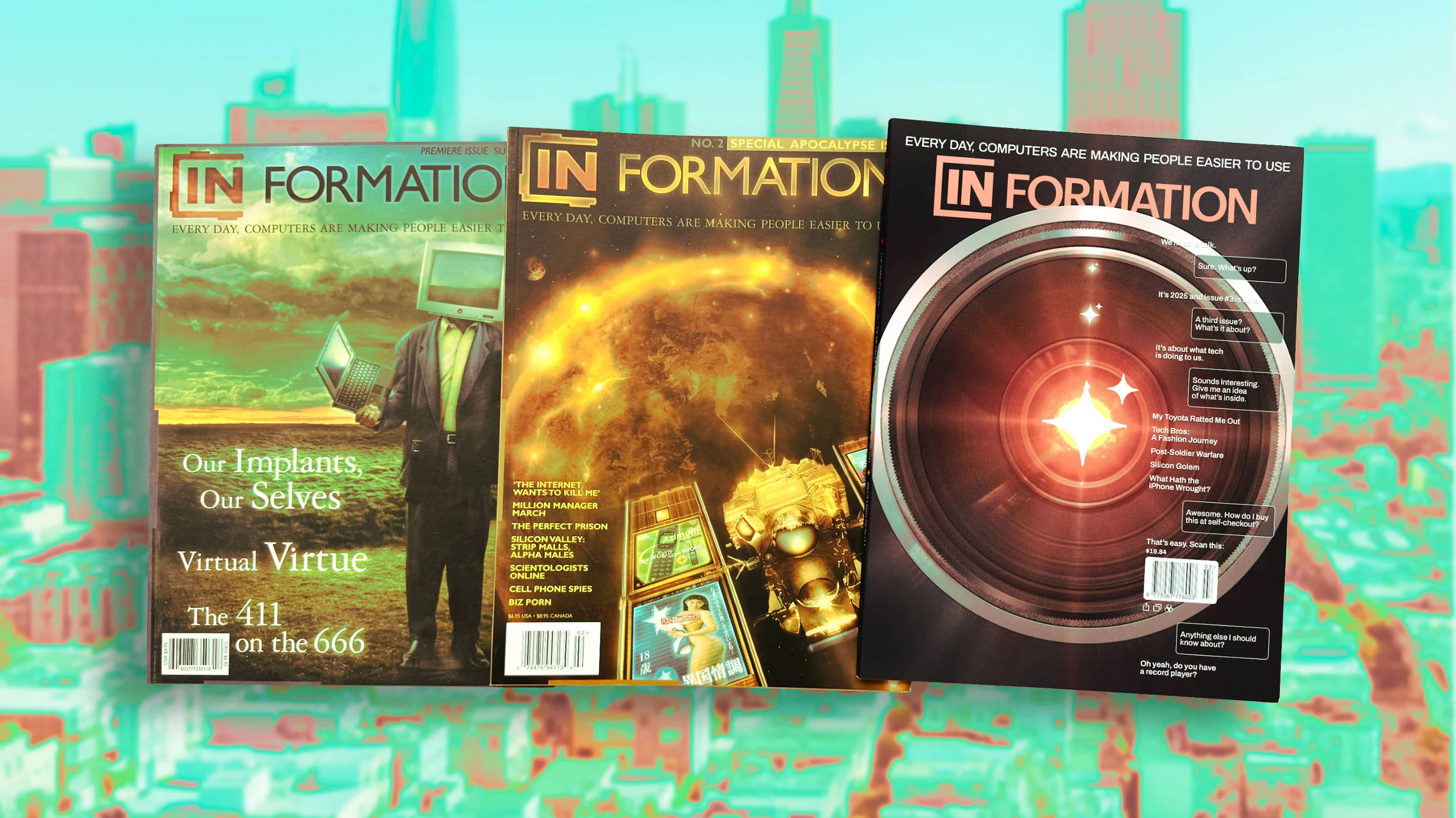
Temkin is refreshingly self-aware about the industry he’s helped build. He’s also the cofounder of In Formation, a satirical print magazine about Silicon Valley’s self-importance, which published its first two issues in 1998 and 2000. Now, a quarter-century later, it’s back with a familiar tone but an updated set of ideas about everything from data privacy and artificial intelligence to biotech. “We were looking at this and realized it just absolutely needed to be mocked, scrutinized, and kind of looked at in a sideways manner,” he says. “My own thinking was this is both actually hilarious and kind of slightly ominous at the same time.”
The third issue, published in August, has 150 pages of articles, essays, comics, jokes, and even fake ads. The magazine recently expanded distribution via a new deal with Barnes & Noble, selling for around $20 in more than 500 stores across the country.
In Formation’s tagline still reads like an evergreen epigram on the dark side of innovation: “Every day, computers are making people easier to use.” In the late ’90s, it was a clever twist on Silicon Valley’s UX obsession. Now, it feels eerily prescient, anticipating two decades of how digital design has shaped attention, beliefs, and behavior—from social media to today’s era of AI.
Full circle
The new nationwide bookstore rollout also represents something of a full-circle moment. In 1999, In Formation’s first issue was pulled from CompUSA’s shelves for reportedly failing to fit with the now-defunct retailer’s “corporate image,” according to a Wired magazine article from the dot-com era.
Tech has changed a lot since the 1990s. Back then, the industry was still a niche space for a “bunch of geeks making a bunch of products” they hoped would succeed. At the time, tech reporting was still relatively scant. The first two issues of In Formation turned out to be alarmingly accurate—including articles about internet cookies and tracking cellphones and browsers, and a 2000 piece joking about future cashless societies. Now, the question is, how true will this third issue ring in another 25 years. “We’re in a moment where tech is promising to change the deepest aspects of both what it means to be human and what is real,” Temkin says.
The magazine itself is split into four themed sections. “The Panopticon” covers various aspects of data privacy, content moderation, and tech regulations. “Peak Valley” provides cultural commentary—such as a piece about the evolution of tech bro fashion, Silicon Valley culture like crypto and biohacking, AI copyright debates, and even a lengthy short story comic. “Apocalypse Now-ish” delves into the existential angst of AI, such as hallucinations, consciousness, and AI-enabled healthcare. And “Receding Reality” explores the blurring reality between the digital and physical world—including the impact of the iPhone, AI rom-coms, and social media addiction.
(Not) drinking the Kool-Aid
Instead of selling ad space, In Formation filled its pages with parodies. An early page resembles the ubiquitous cookie-consent banner. One “ad” is for a smart speaker called The Problematic, which looks like an Amazon Echo and corrects “problematic language.” Another ad for Voyeur Vehicle Analytic Service appears adjacent to an article by a privacy expert detailing what he learned about all the data Toyota reportedly collects from his car. Another fake ad is for a CVS-branded “Self-Censorship Test Kit.” The only real ad is for Espolòn, a tequila brand, which appears on the back cover.
The ads were designed by Brian Maggi, a user-interface designer who worked on ’90s-era Apple products like the original iMac and Newton during the Steve Jobs era. Maggi said humor helps people see what’s wrong with parts of tech in a fresh way. “It might be good to know, too, that there are some of us on the inside that aren’t drinking the Kool-Aid,” says Maggi, who has co-founded several startups, adding that the magazine is also full of Easter eggs for insiders.
The print magazine’s design was influenced by digital UX pattern principles, patterns, and methods usually applied to organizing content in mobile apps—such as flow, discovery, and dwell time. Josh Kleiner, who led design for the issue, says the team wanted readers to get lost in the print magazine and be able to flip through it easily. They also added other quirks of digital design, like tracking sections based on the numbers of pages and words per page. “The joke was that we were doing such clean grids, you could code on them. And then we just messed with them,” Kleiner says. “We kept things weird, doing things you wouldn’t traditionally do in print, like overlapping text and images in a certain way.”
Despite the project’s tech-savvy staff, Temkin and others say the project, which started in 2023, didn’t use generative AI as much as one might expect—other than for some help editing or tweaking some of the images. One of the few instances of AI-generated text includes blurbs about the magazine from ChatGPT, Claude, and Gemini, after Temkin uploaded the magazine and instructed each chatbot to “create a smackdown in the form of a tweet.”
A frictionless world
Over the past 25 years, Temkin argues Silicon Valley’s mission has been overachieved to the point where technology has become so frictionless that it’s now addictive. While he notes that there are plenty of ways tech is helping people, he said today’s landscape presents a different kind of inflection point. He also notes that writing about tech’s harms is far too often either done in an “unsophisticated or reflexive way” or focused on AI’s “corporate horse race.”
One of the new writers for the issue is Jon Callas, a renowned cryptographer and privacy advocate who has led security efforts at Apple, the Electronic Frontier Foundation, and elsewhere. Callas, who wrote a piece about data privacy 25 years after the last issue, doesn’t think the future of tech will be as good as people claim, but also not as bad as some think.
“It’s difficult to have a real conversation about whether or not something is good or bad based upon either extreme,” he says. “It really is like the old saying about averages—where if you have one foot in a bucket of boiling water and one foot in a bucket of ice water, on average you’re comfortable.”
The extended deadline for Fast Company’s Most Innovative Companies Awards is tonight, October 14, at 11:59 p.m. PT. Apply today.
