



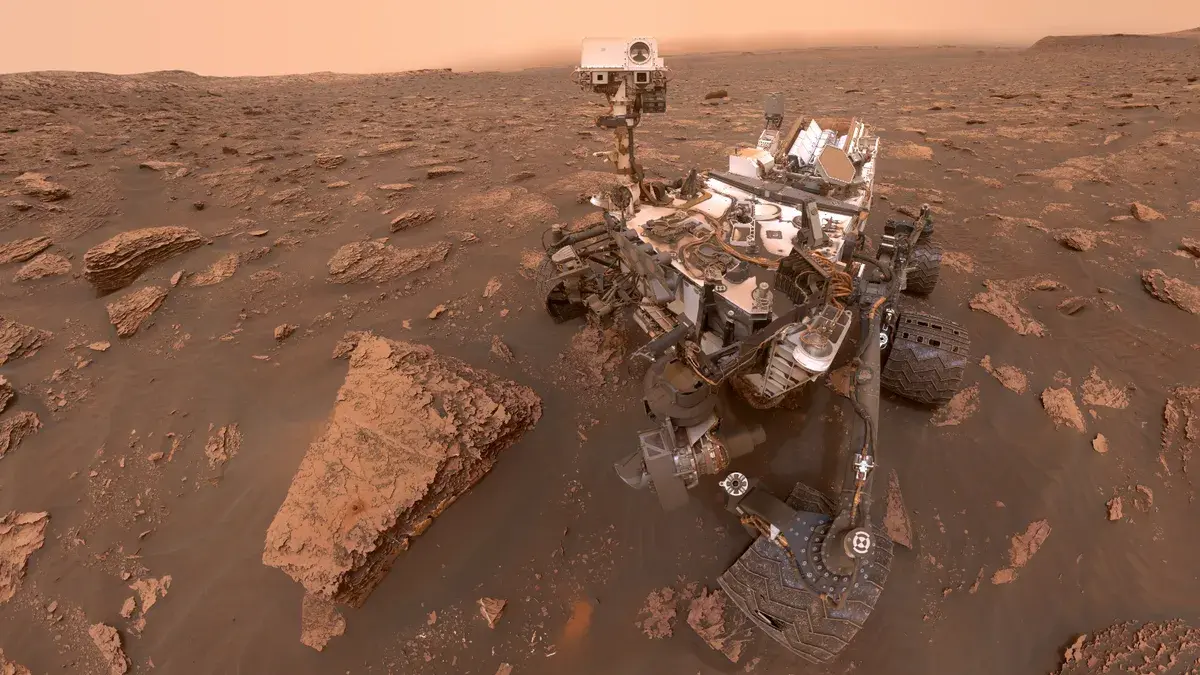
The discovery not only offers insight into the likelihood of life on early Mars, but hope that we could actually find signs of that life, today.
Credit: NASA
New findings published in the journal Nature Communications announce a treasure trove of organic molecules discovered by the Curiosity Mars rover, including seven previously unknown. It lends credence to the argument that early Mars could have supported life.
Remember, organic doesn’t mean alive; it means carbon-based. So, technically, geological and meteorological processes could form such molecules without the need for life. But the more diverse the set of organic compounds that can be catalogued, the lower the chance that they could all have formed abiotically.
The molecules were discovered using the Sample Analysis at Mars (SAM) mini-laboratory built into Curiosity’s belly. The rover can take a small rock sample and grind it into a powder, which can then be superheated to cause the sample’s components to vaporise. SAM’s instruments use spectroscopy to analyse these gases.
But SAM also has a much more rarified form of analysis, called “wet chemistry,” which uses a finite supply of liquid solvents for only the most important samples. Curiosity examined this recent sample by dropping it into a vessel containing tetramethylammonium hydroxide (TMAH, to its friends), becoming the first sample deemed vital enough to use in this way.
The sample in question came from the bore-hole labelled “Mary Anning 3.”
Credit: NASA/JPL-Caltech
Overall, the analysis revealed an enormous catalogue of organic compounds. Back on Earth, NASA scientists also performed TMAH analysis on a sample of the ancient Murchison meteorite, which has been well characterized and contains large organic molecules thought to have been seeded throughout the early solar system.
They found that the much larger organic compounds in the Murchison sample broke down in the presence of TMAH, forming many of the same smaller compounds Curiosity observed. This suggests that they could have been generated from the breakdown of such larger molecules, which have long been thought to be relevant to life.
In terms of specific compounds, the most exciting was nitrogen heterocycle, a molecule built around a nitrogen-containing ring of carbon atoms that is thought to be a likely precursor to DNA and RNA and so critical to abiogenesis. Benzothiophene, another new find, is also thought to be one of the critical chemicals seeded through the early solar system.
Curiosity is, of course, just one in a line of experiments aimed at surveying the surface of Mars. The ESA will soon operate the Rosalind Franklin Mars rover, which will use a mass spectrometer designed and supplied by NASA to look even more closely at the chemical makeup of samples collected.
Of course, we would all have liked to see the Mars Sample Return Mission come through and allow NASA chemists to do a full battery of tests, but alas, that won’t be happening. Until we see a much more robust mission to Mars, potentially even a crewed mission, we’ll have to make do with the mini-labs that can be fit on low-powered rovers and helicopter drones.


