

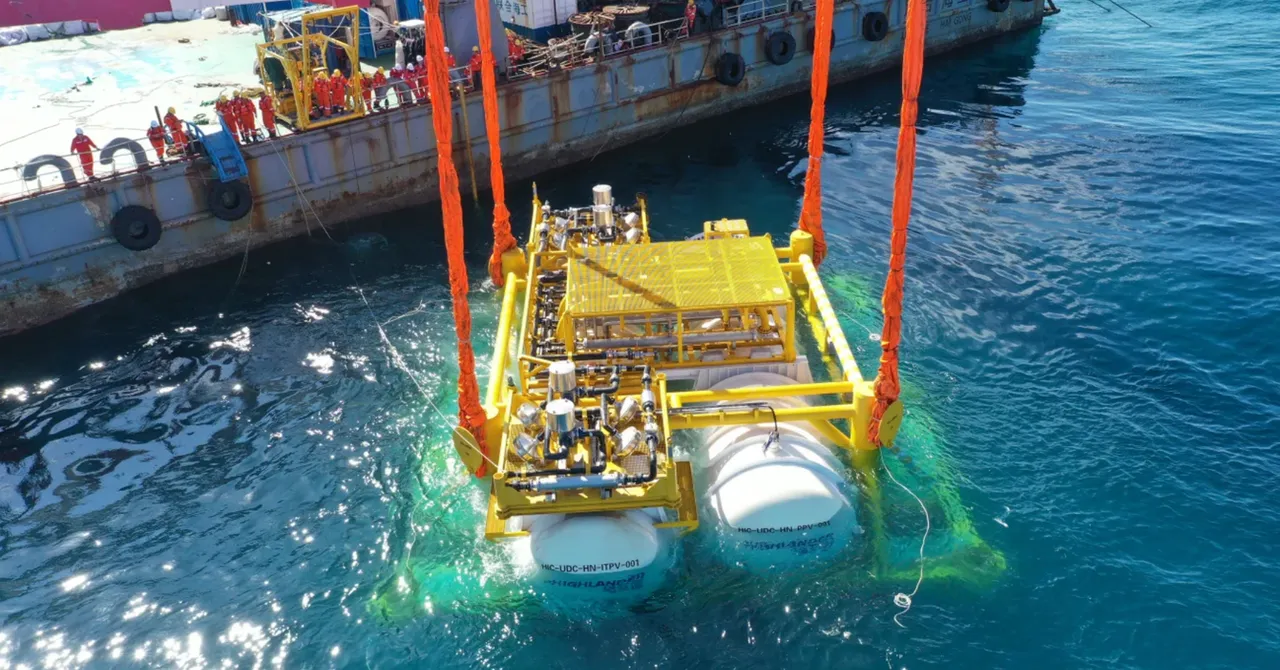
China has become the first country in the world to operate an underwater data center, or UDC, powered by wind. Located off the coast of Shanghai, the complex represents a significant advance in the country’s strategy to secure energy supplies in the face of the accelerated growth of artificial intelligence, reduce dependence on fossil fuels, and reduce the environmental impact of its technology infrastructure.
The initiative is the result of a collaboration between private company HiCloud Technology and state-owned China Communications Construction, which involved an investment of 1.6 billion yuan, equivalent to about $236 million.
With an initial capacity of 24 megawatts, the facility is submerged at a depth of 10 meters in the Lin-gang Special Zone, within the China Pilot Free Trade Zone in Shanghai. This location allows seawater to be used as a natural cooling system, reducing the proportion of energy used to cool the infrastructure to less than 10 percent.
This feature solves one of the main energy consumption challenges of conventional data centers, where air conditioning systems typically account for 40 to 50 percent of the total electricity required to operate.
The thermal efficiency of the UDC is directly reflected in its power-usage effectiveness, or PUE. This metric is used by the industry to evaluate the energy performance of a data center; 1.0 represents the maximum theoretical efficiency. In its first phase, the Lin-gang facility is designed to achieve a PUE of no more than 1.15, a figure considered state-of-the-art within the industry.
Under this same cooling principle, HiCloud opened the world’s first commercial underwater data center in 2023 in Hainan, an island located in southern China. However, the Shanghai complex marks a milestone as the first to operate using offshore wind power.
Construction of the UDC was completed in mid-October last year. According to the Chinese government, “compared to traditional onshore data centers, the project is designed to use more than 95 percent green electricity, reducing energy consumption by 22.8 percent, and water and land use by 100 percent and more than 90 percent, respectively.”
The opening of the complex is an important step in China’s efforts to optimize energy supply through renewable sources and, at the same time, sustain its leadership in computing capacity linked to AI development.
A report recently published by the UN points out that only 32 countries host data centers specialized in artificial intelligence. Of that global infrastructure, about 90 percent is concentrated in two nations: China and the United States.
Both powers have taken steps to secure the energy demanded by AI development, albeit through different approaches. While the United States has reduced investments and proposals related to the energy transition, China seeks to reduce its dependence on fossil fuels both to meet its climate goals and to reduce its vulnerability to external suppliers.
Beijing’s energy self-sufficiency strategy stands out in this context. As the world’s largest energy consumer, the country is exploring technologies ranging from the use of materials such as thorium and bismuth to the accelerated expansion of renewable energies and nuclear generation.
Last year, a new energy law came into force, which prioritizes the development of renewable sources and hydrogen in order to reduce dependence on fossil fuels and strengthen national energy security. The legislation also obliges the authorities to set minimum targets for consumption from clean sources.
In parallel, the country launched a profound reform of its electricity market. As of June 2025, all solar and wind energy is required to be traded through market mechanisms or auctions, gradually eliminating the old feed-in tariff schemes. These measures, accompanied by financial incentives and the phasing out of legacy subsidies, aim to boost investment in clean technologies and improve the efficiency of the energy system.
China’s energy transition is not only driven by environmental considerations. It is also part of a long-term economic and geopolitical strategy aimed at strengthening its technological and industrial autonomy. In this context, the launch of the UDC represents a significant step forward that strengthens the country’s position vis-à-vis the United States and the rest of the world in the race to build the infrastructure that will support the next generation of artificial intelligence and other technological advances.
This article originally appeared on WIRED en Español and has been translated from Spanish.
