

October 20, 2025
3 min read
Cells Have a Crystal Trigger That Makes Them Self-Destruct When Viruses Invade
A special class of immune proteins protect us from pathogens but also drive inflammation and cell death
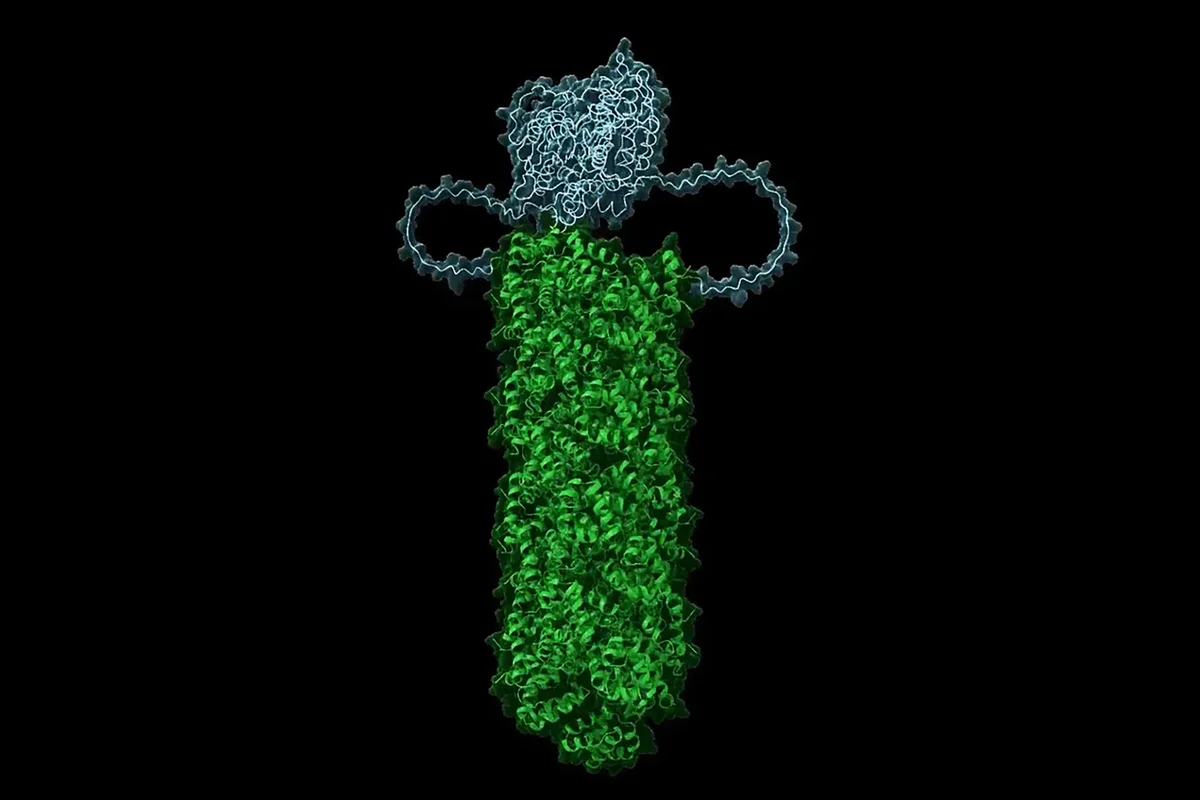
A model showing proteins called death fold domains (green) telling a caspase enzyme (blue) to kill the cell after it has been compromised by pathogens.
Stowers Institute for Medical Research/Tayla Miller
The immune system has a tough job: When a tiny virus invades one of our cells, that cell must detect it and, within minutes, decide what to do. If the cell quickly self-destructs, that will prevent the virus from spreading throughout the body. But such a response to a false alarm will mean the cell will die unnecessarily.
Now researchers have discovered that a special group of about 100 immune proteins hangs out inside every cell in the body, where these proteins do nothing but wait. Then, when a virus breaks in, it seeds a crystal, and the proteins instantly clump around it, forming a scaffold for enzymes known as caspases to activate and immediately initiate cell death. (The caspases must be brought together to kill the cell; it is their proximity to one another that activates them.) The kind of cell death caused by this mechanism is called pyroptosis, and unlike apoptosis (programmed cell death), it triggers inflammation.
“What we found, in essence, is that the cells are literally waiting to die all the time,” says Randal Halfmann, an associate investigator at the Stowers Institute for Medical Research. Halfmann oversaw the work, which was published in eLife in September.
On supporting science journalism
If you’re enjoying this article, consider supporting our award-winning journalism by subscribing. By purchasing a subscription you are helping to ensure the future of impactful stories about the discoveries and ideas shaping our world today.
Historically, scientists have studied proteins’ folded structures to understand their function individually. But “we’re in this explosion of discovery, realizing that these individual molecules that we’ve studied so well are coming together into larger structures that are not bound by membranes,” says D. Allan Drummond, a molecular biologist at the University of Chicago, who was not involved in the study. This new understanding has prompted “new kinds of ways of thinking about cellular function and decision-making by cells, new ways for them to store energy, and so on.”
The study, which was done in living yeast cells and human cell lines, illustrates how proteins act collectively by forming a crystal that gathers caspases together to activate the cell death program and enable the cell to make a rapid life-or-death decision. It also provides an example of how solid protein clumps, which are typically believed to be pathological (such as in Alzheimer’s disease), can be essential to function: “In order to be useful, their whole job is to be this irreversible, downhill, spontaneous reaction that allows the cell to make decisions that include killing the cell,” Drummond says. The rapidity of the decision is key: if the cell relies on more traditional signaling pathways that activate genes in response to an infection, an agile virus could take control of the cell’s protein-making machinery before the cell has a chance to respond.
Although structural biologists had studied this kind of protein behavior in test tubes, “what was really lacking was: ‘Does this really happen in the cell?’” says Bostjan Kobe, a protein structural biologist at the University of Queensland in Australia. “That’s why [Halfmann’s] work was really interesting—because it came at the problem from a completely different angle.”
Halfmann’s team observed that these immune proteins typically remain soluble but that, given enough time—over a lifespan—they will spontaneously crystallize, misfiring in a way that leads to cell death and inflammation. “What this means is that if you wait long enough, every cell will die via this mechanism because even if a virus doesn’t get into the cell, it will happen at some frequency spontaneously,” Halfmann says. (Of course, cells can die by other mechanisms, such as apoptosis, first.)
Halfmann’s team quantified the driving force for these proteins to crystallize in different human cell types and found that their concentration is correlated with the rate of cell turnover in our body. For example, some blood cells are replaced every few days, whereas neurons often last a lifetime. The faster cells normally turn over, the more of these immune proteins they tend to have, suggesting that this process of spontaneous activation might be responsible for killing them.
These results suggest that these immune proteins might be contributing to the low-grade inflammation that accompanies aging. Finding ways to keep the proteins from crystallizing could potentially extend cells’ lifespan and reduce aging-related inflammation, but the trade-off would be a weaker immune system, Halfmann says.
This feature of the immune system is very ancient. It is found in the earliest animals, such as sponges, and it even exists in bacteria, from which we likely inherited it. It is specifically found in some bacteria that live in tight-knit communities. “If you’re a single-celled organism, there’s no drive to kill yourself,” Halfmann says. “But when you’re part of a community and you’re compromised by a phage [a virus that kills bacteria], then it absolutely makes sense to kill yourself because you’re related to everybody around you, and that is where these proteins seem to have evolved.”
It’s Time to Stand Up for Science
If you enjoyed this article, I’d like to ask for your support. Scientific American has served as an advocate for science and industry for 180 years, and right now may be the most critical moment in that two-century history.
I’ve been a Scientific American subscriber since I was 12 years old, and it helped shape the way I look at the world. SciAm always educates and delights me, and inspires a sense of awe for our vast, beautiful universe. I hope it does that for you, too.
If you subscribe to Scientific American, you help ensure that our coverage is centered on meaningful research and discovery; that we have the resources to report on the decisions that threaten labs across the U.S.; and that we support both budding and working scientists at a time when the value of science itself too often goes unrecognized.
In return, you get essential news, captivating podcasts, brilliant infographics, can’t-miss newsletters, must-watch videos, challenging games, and the science world’s best writing and reporting. You can even gift someone a subscription.
There has never been a more important time for us to stand up and show why science matters. I hope you’ll support us in that mission.
