
Close Menu
Tech Nova Mindset – Empower Innovation and Forward Thinking

    Subscribe to Updates

    Get the latest creative news from FooBar about art, design and business.

    What's Hot

    Ads in Chatbots Have Arrived. Here’s What’s Working—and What’s Not

    November 5, 2026

    Your Brag Sheet Secret for How to Get a Promotion

    November 5, 2026

    Science Is Littered With AI Slop. A New Detector Could Filter It Out.

    November 5, 2026
    Facebook X (Twitter) Instagram
    Trending
    • Ads in Chatbots Have Arrived. Here’s What’s Working—and What’s Not
    • Your Brag Sheet Secret for How to Get a Promotion
    • Science Is Littered With AI Slop. A New Detector Could Filter It Out.
    • Reddit Founder Says Building Social Media Apps Is ‘Not Cool Anymore’
    • The Download: Texas’s fragile AI boom and energy policy shifts
    • Why the 2026 Solar Eclipse Will Reshape Corona Studies
    • Finding New Drugs Is Laborious. This AI Startup Is Skipping The Lab Work
    • A new bill could change how the US builds energy infrastructure 
    Tech Nova Mindset – Empower Innovation and Forward Thinking
    • Home
    • Gadgets
    • Reviews
    • Tech News
    • Future Tech
    • AI & Robotics
    • How-To Guides
    • More
      • Cybersecurity
      • Startups & Innovation
    Tech Nova Mindset – Empower Innovation and Forward Thinking
    Home»Future Tech»Can Orbital Data Centers Solve AI’s Power Crisis?
    Future Tech

    Can Orbital Data Centers Solve AI’s Power Crisis?

    kirklandc008@gmail.comBy kirklandc008@gmail.comMarch 1, 2026No Comments3 Mins Read
    Facebook Twitter Pinterest LinkedIn Tumblr Email
    Can Orbital Data Centers Solve AI’s Power Crisis?
    Share
    Facebook Twitter LinkedIn Pinterest Email

    What’s the difference between a stupid idea and a brilliant one? Sometimes, it just comes down to resources. Practically unlimited funds, like limitless thrust, can get even a mad idea off the ground.

    And so it might be for the concept of putting AI data centers in orbit. In a rare moment of unalloyed agreement, some of the richest and most powerful men in technology are staunchly backing the idea. The group includes Elon Musk, Jeff Bezos, Jensen Huang, Sam Altman, and Google CEO Sundar Pichai. In all likelihood, hundreds of people are now working on the concept of space data centers at the firms directly or indirectly controlled by these men—SpaceX, Starlink, Tesla, Amazon, Blue Origin, Nvidia, OpenAI, and Google, among others.

    Likely costs to design, build, and launch a 1-GW orbital datacenter, based on a network of some 4,300 satellites and including operating costs over a five-year period, would exceed US $50 billion. That’s about three times the cost of a 1-GW data center on Earth, including five years of operation.John MacNeill

    So how much would it cost to start training large language models in space? Probably the best accounting is one created by aerospace engineer Andrew McCalip. McCalip’s exhaustive, detailed analysis includes interactive sliders that let you compare costs for space-based and terrestrial data centers in the range of 1 to 100 gigawatts. One-gigawatt data centers are being built now on terra firma, and Meta has announced plans for a 5-GW facility, with anticipated completion some time after 2030.

    In an interview, McCalip says his initial rough calculations a few years ago suggested that data centers in space would cost in the range of 7 to 10 times more, per gigawatt of capacity, than their terrestrial counterparts. “It just wasn’t practical,” he says. “Not even close.” But when Elon Musk began publicly backing the idea, McCalip revisited the numbers using publicly available information about Starlink’s and Tesla’s technologies and capabilities.

    That changed the picture substantially. The figures in his online analysis assume an orbital network of data-center satellites that borrows heavily from Musk’s tech treasure chest—“essentially…you just start putting some radiation-resistant ASIC chips on the Starlink fleet and you start growing edge capacity organically on the Starlink fleet,” McCalip says. The network would rely on the kind of watt-efficient GPU architecture used in Teslas for self-driving, he adds. “You start dropping those onto the backs of Starlinks. You can slowly grow this out, and this would be approximately the performance that you would get.”

    Bottom line, with some solid but not necessarily heroic engineering, the cost of an orbital data center could be as low as three times that of the comparable terrestrial one. That differential, while still high, at least nudges the concept out of the instantly dismissible category. “I have my particular views, but I want the data to speak for itself,” McCalip says.

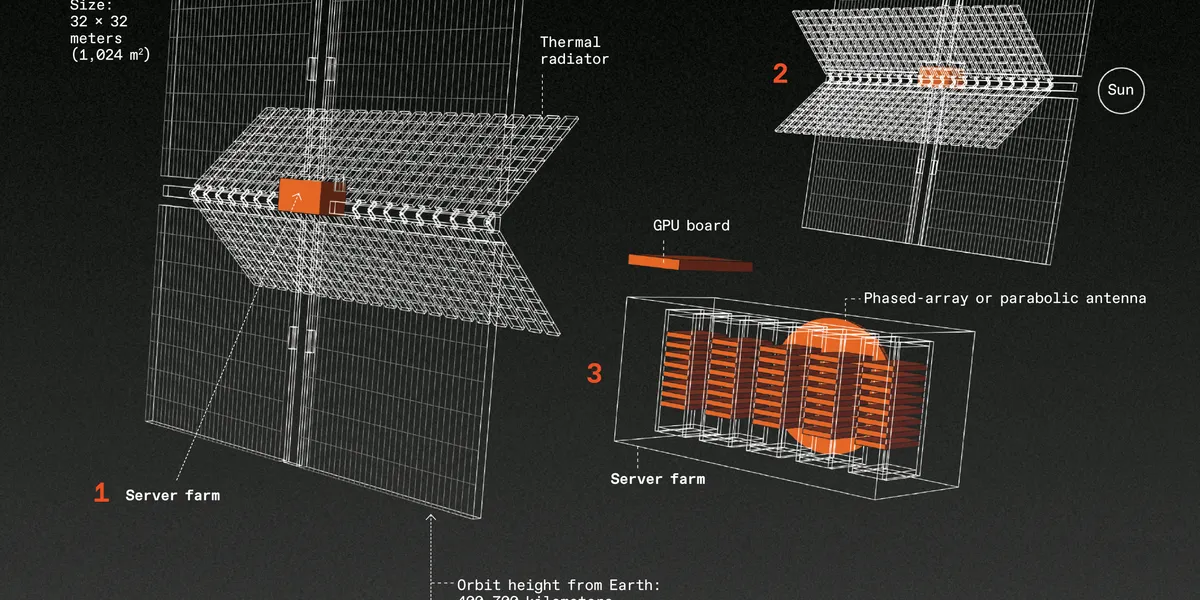
    For this illustration, we picked a configuration with an aggregate 1 GW of capacity. The network would consist of some 4,300 satellites, each of which would be outfitted with a 1,024-square-meter solar array that generates 250 kilowatts. The data center on that satellite, powered by the array, might have at least 175 GPUs; McCalip notes that a popular GPU rack, Nvidia’s NVL72, has 72 GPUs and requires 120 to 140 kW.

    The total cost of the satellite network would be around US $51 billion, including launch and five years of operational expenses; a comparable terrestrial system would cost about $16 billion over the same period.

    Stupid? Not stupid? You decide.

    From Your Site Articles

    Related Articles Around the Web

    AIs Centers Crisis data Orbital Power solve
    Share. Facebook Twitter Pinterest LinkedIn Tumblr Email
    kirklandc008@gmail.com
    • Website

    Related Posts

    Securing the agentic enterprise with data lineage

    November 5, 2026

    The Blue Wave Has Tech Bros Scrambling for Data Centers in Space

    November 5, 2026

    Texas was the new epicenter of the AI data center buildout. That might be kaput.

    November 4, 2026
    Leave A Reply Cancel Reply

    Top Posts

    Nothing CEO says phone prices are going to keep going up

    June 12, 20267 Views

    The best VPN routers of 2026: Expert tested and reviewed

    June 14, 20263 Views

    Google DeepMind Plans to Track AGI Progress With These 10 Traits of General Intelligence

    March 21, 20263 Views
    Stay In Touch
    • Facebook
    • YouTube
    • TikTok
    • WhatsApp
    • Twitter
    • Instagram
    Latest Reviews

    Subscribe to Updates

    Get the latest tech news from FooBar about tech, design and biz.

    Recent Posts
    • Ads in Chatbots Have Arrived. Here’s What’s Working—and What’s Not
    • Your Brag Sheet Secret for How to Get a Promotion
    • Science Is Littered With AI Slop. A New Detector Could Filter It Out.
    • Reddit Founder Says Building Social Media Apps Is ‘Not Cool Anymore’
    • The Download: Texas’s fragile AI boom and energy policy shifts

    Ads in Chatbots Have Arrived. Here’s What’s Working—and What’s Not

    November 5, 2026

    Your Brag Sheet Secret for How to Get a Promotion

    November 5, 2026

    Science Is Littered With AI Slop. A New Detector Could Filter It Out.

    November 5, 2026

    Reddit Founder Says Building Social Media Apps Is ‘Not Cool Anymore’

    November 5, 2026
    Facebook X (Twitter) Instagram Pinterest
    • About Us
    • Contact Us
    • Privacy Policy
    • Terms and Conditions
    • Disclaimer
    © 2026 TechNovaMindset. Designed by By Pro.

    Type above and press Enter to search. Press Esc to cancel.