

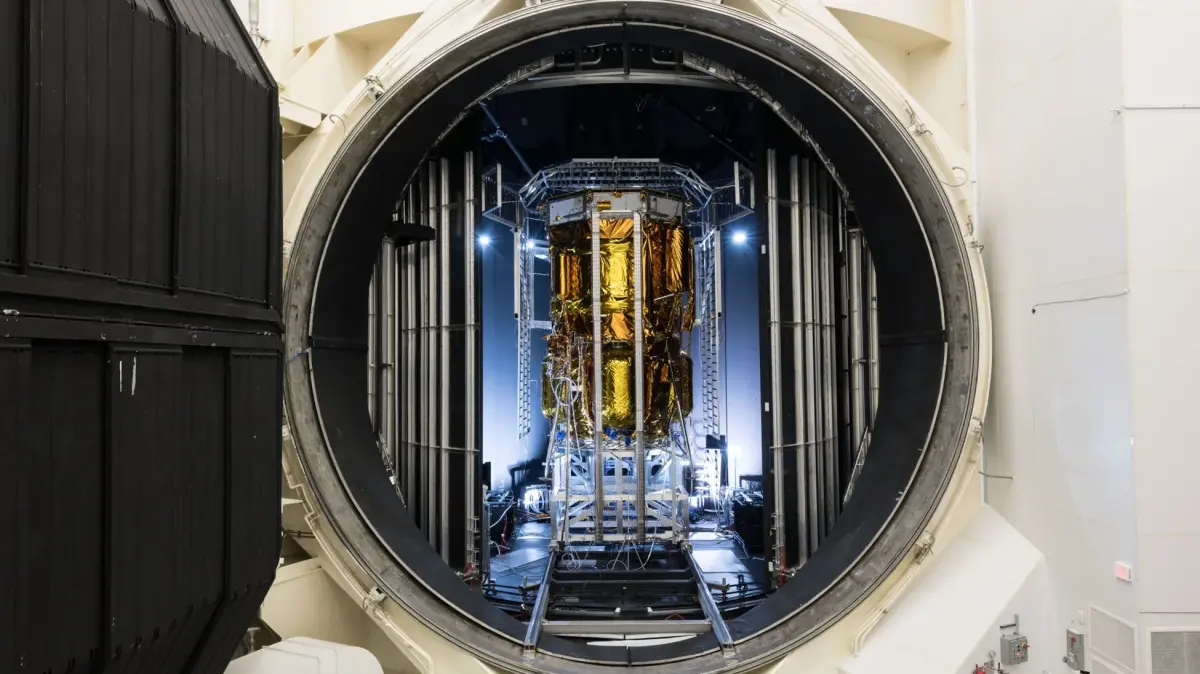
Endurance Mk1 is a cargo lander that could be the basis of the next crewed lunar landing vehicle.
Credit: NASA
It may be debatable whether the Jeff Bezos-founded aerospace company Blue Origin won the race to put a billionaire into space, but the perennial second runner of the private space industry could be on the trail of a much more lasting win.
This week, NASA announced that a Blue Origin-designed Moon lander had completed critical testing in the agency’s vacuum chamber, raising hopes that it could be the first to meet NASA’s specifications for a crewed lander. This one is only a cargo lander, but many of its design principles apply to both projects.
For reference, the NASA contract to make a manned lunar lander, or Human Landing System (HLS), originally went to Elon Musk’s SpaceX, based on some rather ambitious timelines for completion. Then the timelines started slipping, and NASA invoked a contract stipulation stating that the deal’s exclusivity depended on meeting those milestones.
As a result, NASA opened up the contract to more bidders, including Blue Origin. In the time since, we haven’t heard much in terms of direct progress from any party, other than a watchdog report that found the largely SpaceX-based plans could leave astronauts stranded on the Moon.
The report made it clear that SpaceX, by name, would not be able to support the crewed Artemis mission timelines.
A render of the SpaceX Human Landing System. Only a render, unfortunately.
Credit: NASA
These most recent tests of the Blue Origin cargo lander, dubbed Endurance Mk1, are meant to validate the crewed lander project, dubbed Blue Moon Mk2. The tests proved that the vehicle can withstand the vacuum of space and the extreme temperature swings caused by solar radiation spikes.
The tests help to prove that the lander is ready for the rigors of space and of the approach to the Moon. The official report didn’t specify the exact tolerances tested, but in the past, such tests have also examined shielding against radiation and even surface dust resistance on the Moon.
Eventually, it will head to space to demonstrate precision landing, cryogenic propulsion, and autonomous guidance, navigation, and control capabilities that will help advance the Human Landing System (HLS). By testing these mission-critical attributes in an uncrewed lander, the Blue Origin team advances HLS goals while developing a useful technology in its own right.
SpaceX has a big head start on this project, but it also has an enormous catalog of projects to develop and a track record of struggling with this particular program. Blue Origin is definitely coming from behind, but with strong momentum and a smart plan to start with a less ambitious project along the way.
One way or another, somebody is going to invest a whole lot of money and then go on to lose the contract. At least if it’s Blue Origin, it will still have its cargo lander to fall back on.
