

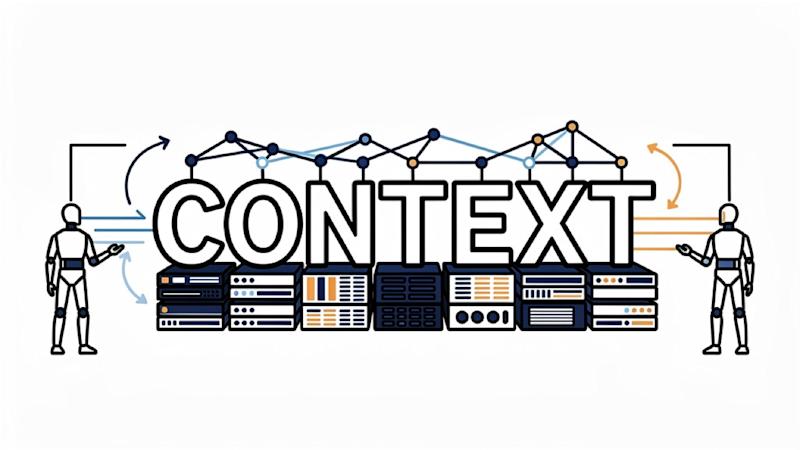

Building a context layer between enterprise data stores and AI agents is bespoke work, with no standard service to automate or maintain the graphs over time. Amazon is making a direct play to change that.
Amazon on Wednesday entered the space, announcing a series of three products it’s positioning as a context intelligence stack for AI agents. The centerpiece is AWS Context, a new knowledge graph service that gets smarter through agent usage over time. AWS also announced the general availability of Amazon S3 Annotations and a preview of skill assets in AWS Glue Data Catalog.
The context layer is now a contested architectural category with no shortage of options from different vendors. AWS is entering that market with a different architectural premise: that the graph should learn from how agents use it automatically, without human re-curation.
“Your agents now get smarter without you having to rebuild anything from scratch,” said Swami Sivasubramanian, vice president of Agentic AI at AWS, during his AWS Summit NYC keynote.
“This service automatically builds a knowledge graph from all your existing data,” he said. “This service infers relationships across your data sets, business rules, and domain knowledge, and makes all of it available to your agents and your organization at runtime.”
AWS Context builds a self-learning knowledge graph from existing data
It’s a problem AWS says it has seen repeatedly in customer deployments.
AWS Context maps relationships across existing data automatically: what tables exist, what columns mean, how sources relate and which sources are authoritative. It combines semantic search with graph-level reasoning and infers relationships across datasets, business rules and domain knowledge, making all of it available to agents at runtime.
“The knowledge graph improves itself over time as it learns which sources produce correct results and which parts get used,” Sivasubramanian said.
Data stewards manage the graph through the AWS Management Console, reviewing inferred relationships, promoting them to production and attaching business definitions and usage rules. Every query inherits the calling user’s IAM and Lake Formation permissions, making agent data access auditable by identity through controls enterprises already rely on.
All metadata is published in Apache Iceberg format to Amazon S3 Tables, queryable via Athena, Redshift, Spark or any Iceberg-compatible engine, with no proprietary APIs. Third-party catalog connections are supported, so context from systems outside AWS can be pulled into the same graph. Agents query through agentic search APIs and MCP tools across Bedrock AgentCore, EKS or any MCP-compatible framework.
Context is more than just a single service
Context is a complicated space and AWS is layering multiple services to help enterprises build context across the data stack.
Amazon S3 Annotations. This service enables users to attach rich business context at the storage layer, directly to individual S3 objects.
AWS Glue Data Catalog skill assets. Glue skill assets attach domain knowledge at the catalog layer, linking runbooks, query patterns and usage rules to data assets across the estate.
AWS Context then synthesizes both into the knowledge graph that agents query at runtime, combining semantic search with graph-level reasoning across structured and unstructured sources. Each layer feeds the next.
AWS is entering a highly competitive context space
Snowflake announced its context approach earlier this month with its Horizon Context and Cortex Sense services. Microsoft is providing context via its Fabric IQ platform that provides a semantic ontology for data. Redis has developed a context platform that optimizes data for retrieval. Vector database vendor Pinecone has its Nexus context offering that compiles enterprise data into task-specific artifacts before agents ever query them.
AWS’s structural argument is straightforward: for enterprises already running S3, Glue and Lake Formation, AWS Context extends an existing identity model with no data movement required. The pitch is zero-integration friction — not just cost consolidation.
“Context makes agents more powerful and as the whole world is building agents, every agentic platform vendor needs a context capability,” Holger Mueller, VP and Principal analyst at Constellation Research, told VentureBeat.
Mueller noted that AWS is no exception. “The concern — as with all context offerings — is going to be performance, especially for transactional data, we will see,” he said.
