

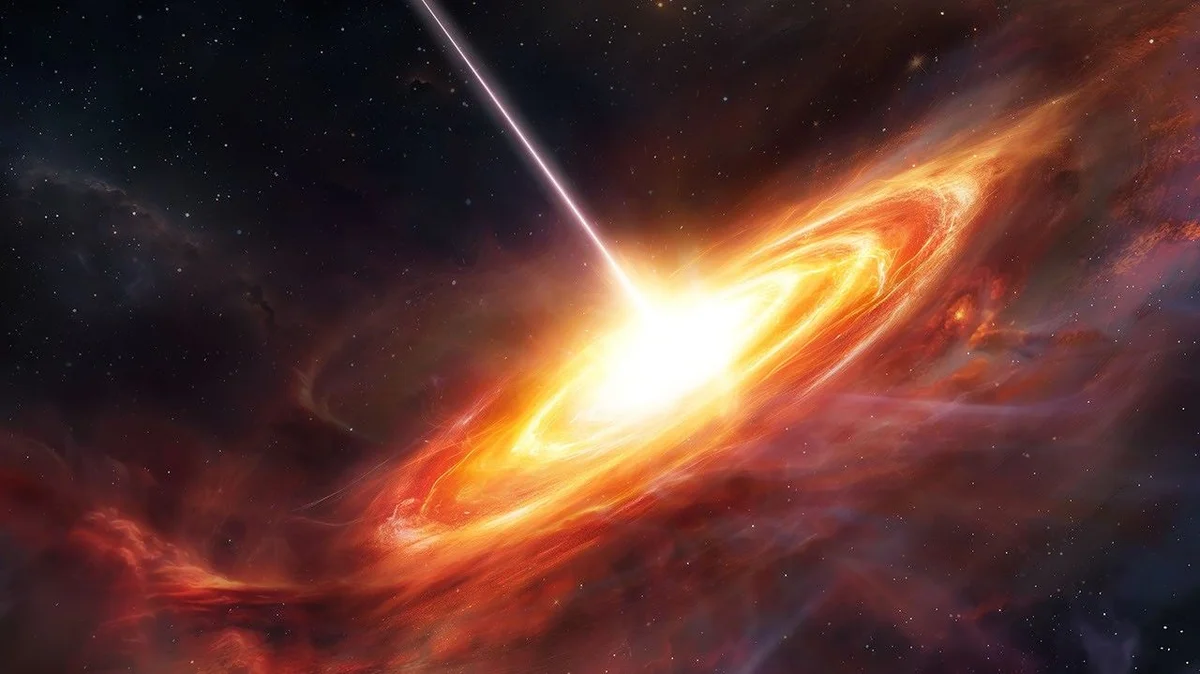
At the heart of many galaxies lie supermassive blackholes. These engines power quasars—active galactic nuclei that emit some of the brightest light astronomers can possibly see in the sky. How these extreme objects formed in the earliest years of the universe—when the cosmos was less than a billion years old—has long been something of a mystery.
But now, the European Space Agency’s Euclid Space Telescope has identified a clutch of primordial quasars, dating to some 13.4 billion years ago—putting them among the oldest of these objects ever found in the universe.
Ancient quasars offer glimpses into the universe in its chaotic infancy; but actually finding these primeval objects can be very difficult. Because they formed so long ago, they are extremely far away from Earth and their bright light can be mistaken for a signal of a more run-of-the-mill celestial object, like stars.
On supporting science journalism
If you’re enjoying this article, consider supporting our award-winning journalism by subscribing. By purchasing a subscription you are helping to ensure the future of impactful stories about the discoveries and ideas shaping our world today.
Quasars from the earliest era of the cosmos are among the rarest known objects in the universe, and emit light at a specific energy band that tends to elude ground-based telescopes.
From its vantage point in space more than a million miles from Earth, the Euclid telescope has a unique view, said Eduardo Bañados, an astronomer at Max Planck Institute for Astronomy and co-lead of the Euclid Quasar Work Package until 2025. He is also a co-author on a new study detailing the findings.
“Seeing Euclid deliver on its potential is immensely satisfying,” said Bańados in a statement. “But more than that, it marks a genuine shift: For the first time, we can study the typical early-universe quasar, not just exceptional outliers. We now have a real window onto how the bulk of the first black holes grew — and how they shaped the galaxies around them.”
Euclid is equipped with cameras that can see both visible light and light in the near-infrared range. Beginning in February 2024, the team began a six-year project called the Euclid Wide Survey, with the aim of mapping a swathe of extragalactic space. When it is complete, it will have mapped about a third of the sky. Just two years in, the survey has now revealed 31 ancient quasars from the dawn of the universe. The findings were published on Monday in Astronomy & Astrophysics.
Incredibly, 12 of the quasars Euclid has found date to the first 770 million years of the universe, while another two appear to have formed when the universe was just 670 million years old. That makes them almost as ancient as the oldest known galaxies.
There could be even older quasars still out there. In the new study, the team observe that both the Hubble and James Webb Space Telescope have equipment that’s sensitive enough to possibly detect even fainter emissions than Euclid.
“These objects provide the best clues for understanding how supermassive black holes form,” said study co-author Joseph Hennawi, a physics professor with joint appointments at the University of California, Santa Barbara and Leiden University in Germany, in a statement. Future research—and looking further into the universe’s past—could offer more clues, he added.
“Every step further back in time makes the puzzle more perplexing: How did the Universe produce supermassive black holes so quickly?” Hennawi said. “We’re finding black holes with hundreds of millions of times the mass of our sun at a time when the universe was barely getting started.”
It’s Time to Stand Up for Science
If you enjoyed this article, I’d like to ask for your support. Scientific American has served as an advocate for science and industry for 180 years, and right now may be the most critical moment in that two-century history.
I’ve been a Scientific American subscriber since I was 12 years old, and it helped shape the way I look at the world. SciAm always educates and delights me, and inspires a sense of awe for our vast, beautiful universe. I hope it does that for you, too.
If you subscribe to Scientific American, you help ensure that our coverage is centered on meaningful research and discovery; that we have the resources to report on the decisions that threaten labs across the U.S.; and that we support both budding and working scientists at a time when the value of science itself too often goes unrecognized.
In return, you get essential news, captivating podcasts, brilliant infographics, can’t-miss newsletters, must-watch videos, challenging games, and the science world’s best writing and reporting. You can even gift someone a subscription.
There has never been a more important time for us to stand up and show why science matters. I hope you’ll support us in that mission.
