

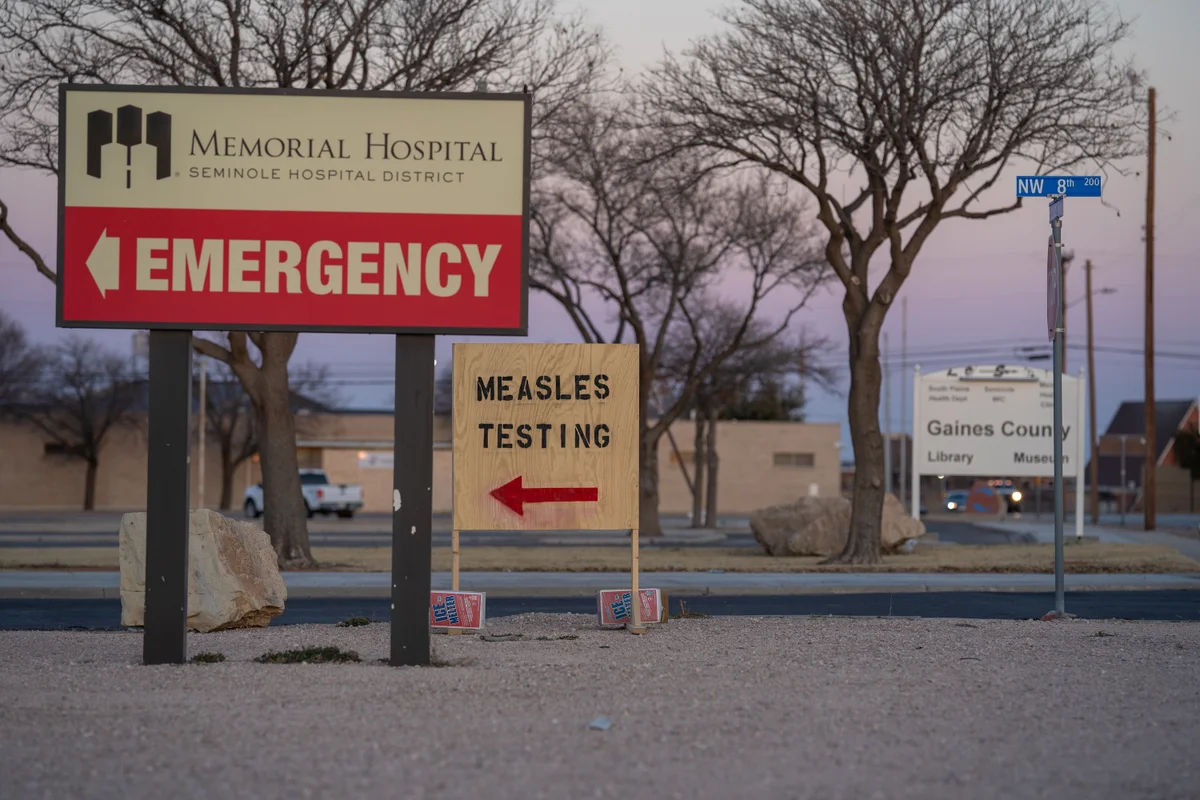
It has been a full year since one of the worst measles outbreaks in recent U.S. history began ripping through West Texas. The highly infectious disease has continued to burn across multiple U.S. states, Mexico and Canada since Texas reported an outbreak in children in January 2025. The U.S. had been virtually free of the disease for more than a quarter-century thanks to highly effective and safe vaccines, but now experts say we’re on track to losing that status if officials determine measles has spread continuously for a year.
“The U.S. is in the throes of the deadliest measles outbreak it has seen in decades,” says Jennifer Nuzzo, an epidemiologist and director of the Pandemic Center at Brown University. “Losing measles elimination status is an official acknowledgement that the country is on the wrong path.”
For measles, the Pan American Health Organization (PAHO) formally declares a country has “eliminated” the disease when cases can no longer be linked to one another—there is zero continued transmission—for 12 months or more. Last November the Americas officially lost their elimination status when PAHO’s review of epidemiological data revealed that Canada was no longer measles free for a year.
On supporting science journalism
If you’re enjoying this article, consider supporting our award-winning journalism by subscribing. By purchasing a subscription you are helping to ensure the future of impactful stories about the discoveries and ideas shaping our world today.
“Loss of measles elimination status does not carry formal sanctions, but it is a significant public health signal,” PAHO’s spokesperson wrote in an e-mail to Scientific American. “Elimination is recoverable. The Americas have faced setbacks before—including temporary loss of status in Venezuela (2018) and Brazil (2019)—and successfully regained elimination through intensified vaccination, strengthened surveillance, and rapid outbreak response.”
PAHO said its group that reviews the measles elimination status of the U.S. and Mexico is expected to reconvene after the one-year mark of the initial outbreak in West Texas. The organization will hold its meeting on April 13 in order to give countries enough time to provide documentation and data, its spokesperson added. Epidemiologist Walter Orenstein, who is on a committee for the Task Force for Global Health, which independently reviews elimination of diseases, expects that the U.S. will soon follow Canada.
“It’s certainly looking like we have lost our status, but we have to look at the data,” he says, adding that the Task Force for Global Health’s committee hasn’t been called at this stage to look at the current situation.
The U.S. has retained its measles elimination status ever since locking down the virus’s spread in 2000.
“Elimination itself is a really huge public health achievement—but with measles especially because the virus is so infectious,” says Angela Rasmussen, a virologist at the University of Saskatchewan.
Measles requires very high levels of population immunity to squelch transmission; at least 95 percent of people in a community must have immunity from prior infection or vaccination. And national vaccination efforts played a central role in raising those population immunity levels in the U.S., says Orenstein, a professor emeritus at Emory University, who has worked on measles elimination for decades. The recommended two doses of the measles, mumps and rubella (MMR) vaccine is 97 percent effective at preventing disease, generally for life. “This intervention can stop and break the chains of transmission,” he says.
Before the MMR vaccine became available in 1963, the U.S. saw, on average, four million cases, 48,000 hospitalizations and 400 to 500 deaths per year from measles. Most people know measles for its itchy rash, but it can cause high fevers, ear infections, severe dehydration, pneumonia and chronic brain inflammation, or encephalitis, Orenstein says.
Such severe measles cases—largely unseen in U.S. hospitals for decades—came roaring back during recent outbreaks.
The first major outbreak was reported on January 20, 2025, in an undervaccinated community in Gaines County in West Texas. From there, “cases increased exponentially,” says Katherine Wells, a public health director of the city of Lubbock, Tex., which is about 70 miles from Gaines County. “We saw 99 individuals requiring hospitalization, meaning that either their oxygen levels dropped too low, they developed pneumonia or they were so dehydrated they had to put on IV fluids,” Wells says. “Two young children lost their lives because of measles, and that’s unprecedented. Since we’ve had the measles elimination status, we have not seen any deaths.”
In 2025 the CDC recorded outbreaks in 24 states and confirmed 2,144 cases—the highest total since 1991. A large majority of infections were in children, with 69 percent occurring in those aged 19 and younger. Among those cases, one adult and two children died; all three were unvaccinated.
State officials declared the end of West Texas’s outbreak in August 2025, but outbreaks in other states continue to surge on; in recent months, reported infections in South Carolina have ballooned to 434, while Arizona has reported 223 cases, and Utah has documented 201 cases. It remains to be seen if these outbreaks stem from the initial epicenter in West Texas.
“If [health officials] make that connection, then there will be transmission for a full year, and we’ll definitely lose measles elimination status,” Wells says.
Previously, measles cases have sporadically popped up in people who traveled to countries where the disease was more prevalent, but those small outbreaks were rapidly contained and never lasted longer than a year. A major reason measles has become so entrenched now is because of declining national vaccination rates and growing antivaccine messaging driven by Secretary of Health and Human Services Robert F. Kennedy, Jr., Rasmussen says. In response to Scientific American, a spokesperson for the Department of Health and Human Services maintained that vaccination is the most effective way to prevent measles. But the secretary had repeatedly downplayed its safety to the media during the outbreak.
“When the outbreak happened in Texas, it took Kennedy quite a while to even say that the vaccine is the only way to prevent measles,” Rasmussen says. “He has gone out of his way to encourage alternative treatments that are unproven to work like vitamin A, cod liver oil and steroids.”
Wells says that local public health staff and health care workers tried to mobilize quickly to offer care and vaccines to kids and community members but that the Trump administration’s budget cuts, layoffs and restructuring of U.S. health agencies interrupted support for their response efforts. “Some of the federal partners that we typically have in a public health outbreak weren’t necessarily available to us,” she says.
News outlets have recently reported that U.S. federal officials are trying to maintain that the country is still measles-free by building a case to prove that ongoing infections, such as in outbreaks in Utah, Arizona and South Carolina, are not linked to West Texas cases. Health officials perform epidemiological investigations to trace infections back to common sources, as well as genomic tests to compare viruses isolated from different outbreaks. But these types of public health investigations are meant to help stop transmission and offer support to vulnerable groups with low vaccination rates—not to preserve a public health stamp, Nuzzo says.
“It is important to understand whether these cases are linked because that may help inform efforts to control the spread of measles,” Nuzzo says, “but we should not be looking for this information as though we’re attempting to wheedle our way out of an embarrassing political situation.”
Responding to SciAm, the HHS spokesperson did not comment on the news reports and wrote in an e-mail on January 15 that the U.S. had not met the threshold for losing elimination status.
Measles’ resurgence in the U.S. ultimately means cases will become commonplace—and communities will likely face regular, sometimes deadly, outbreaks. Those outbreaks are also incredibly expensive. An analysis last October estimated that the average health care cost per measles case in the U.S. was $43,000—far more expensive than vaccination, Nuzzo says. She, Rasmussen and Orenstein fear that other historical, vaccine-preventable diseases, such as polio, could also come raging back.
Even if it’s proven that the current outbreaks are not related to those that began in January 2025, Wells says it may only be a matter of time before measles is no longer considered eliminated in the U.S.
“We’ll lose the status at some point unless we change the trajectory of uptake of vaccines in our communities,” she says. “The elimination status is just a technicality. The real concern is that we’re seeing measles transmission in communities, and we have an effective way to prevent that from happening.”
