


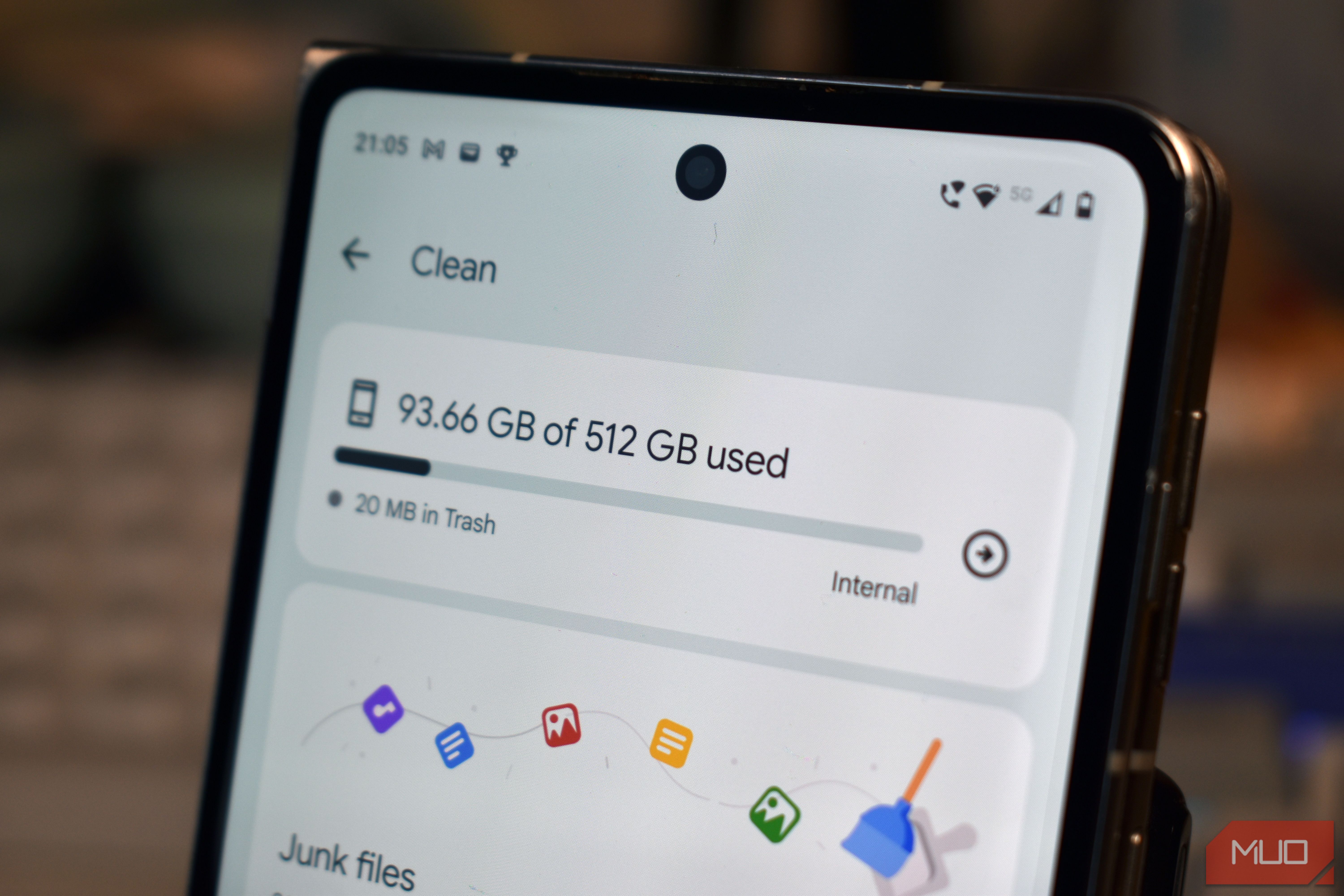
Keep 10 percent of your storage free. It’s the Android storage mantra that’s been repeated for years, passed around almost like folk wisdom.
It’s not wrong exactly; in fairness, it’s just not quite right, which is why it doesn’t behave as it should across different devices. Different phones at the same fill percentage will be affected differently because, for many storage types, the percentage isn’t the problem — it’s all down to the storage type in your phone and how your device manages it.
Related
I found gigabytes of invisible junk on my Android that the default manager never shows
I freed up gigabytes of storage on my Android in minutes — this free app showed me exactly where it was hiding.
Where the magic 80-90 storage figure comes from
Why is that the universal number for Android slowdown?
Received wisdom tells us that once an Android device’s storage hits more than 80-90 percent full, the rest of the device begins to slow down. It’s one of the reasons why you can’t assume a slow phone is down to the processor, and I hear it all the time.
The numbers aren’t made up, but they come from storage behavior rather than Android itself. And because not every phone uses the same storage technology, the “leave 10% free” advice doesn’t affect every device equally.
Furthermore, these numbers don’t always relate specifically to Android storage. The percentage of your storage you’re meant to keep free actually started back with hard drives, when those spinning disk platters required additional space to complete the defragmentation process. If the drive had no room, it would mean the defrag wouldn’t work properly.
But it’s also the same on NAND flash storage — the type that powers the SSD in your computer, and the same storage holding onto your documents, photos, and more in your smartphone. I should note that it’s not for defragmentation on modern NAND flash storage. Instead, the extra free space gives the controller somewhere to move data while it performs garbage collection and wear leveling.
Android has been handling this since 2013
TRIM has been cleaning up your drive since Android 4.3
Now, modern SSDs and other types of NAND flash storage have a handy tool to help fix this problem: TRIM.
In fairness to Android, it has run a TRIM process for more than a decade, since version 4.3, first launched in 2013. That means that when your device is above the correct charge threshold, your smartphone automatically begins some spring cleaning in the background.
The spring cleaning process helps to tidy up your drive and keep it all running smoothly. It’s a drive maintenance process that’s basically completely automated, checking storage blocks marked unused and for deletion, and so on.
But the type of storage and its generation also make a difference
Older storage will suffer more from slowdown
The key information the oft-touted 90-percent figure typically glosses over is how your phone handles TRIM across storage types. Basically, if you’ve got a smartphone with older eMMC storage, you’re going to experience that slowdown feeling twice as much as a smartphone using modern UFS storage.
That’s because eMMC storage effectively runs at half the speed of UFS. It can read or write, but can’t do both. There is also no command queue, so all operations, including TRIM, have to wait their turn. So, even if your smartphone hits the other requirements for TRIM to run and tidy up the drive, it can still be blocked and delayed by other required actions.
And that’s not forgetting that TRIM runs slower on these drives, too.
Now, UFS is much, much faster, and is what you’ll find in most modern smartphones, especially those from leading manufacturers like Samsung, Motorola, Google, and similar. It’s full-duplex, so it can read and write at the same time, and it uses SCSI-style Command Queuing to reorder and interleave operations instead of processing them one at a time. TRIM runs in the gaps between your actual usage rather than blocking it outright.
So, two phones can have the same outward figures for storage and appear similar in terms of overall use, but the underlying tech will make the slowdown feel much worse for one device.
Not every UFS chip is equal, either
UFS drives also have a trick you don’t know about
Close-up view of a Samsung UFS 5.0 storage chip showing the green circuit board and metallic contact pins.Credit: Samsung
Of course, there is also more nuance than “eMMC bad” and “UFS good.” I mean, that’s a large part of it, but there are differences even between UFS chips depending on their generation.
There are numerous UFS generations — 2.0, 2.1, 3.0, 3.1, 4.0, and now 5.0 — each with different performance levels when it comes to bandwidth and data management, and that also plays into how your smartphone experiences slowdown.
For example, UFS 2.1 topped out around 600-900MB/s sustained writes, while the latest version, UFS 5.0, is rated for up 10.8GB/s. UFS 5.0 isn’t currently commercially available, but we expect it in early January or February 2027, likely with the Samsung Galaxy S27.
But UFS has another trick it doesn’t shout about. Well, not massively, anyway. From UFS 2.2, manufacturers can implement a feature called WriteBooster, which uses a portion of TLC or QLC NAND as a fast pseudo-SLC cache to accelerate write performance. Okay, so why do we care about making performance faster when we’re worried about storage space?
There is a good reason, as it all ties in together for modern smartphones. The really clever bit is that this cache is usually dynamic. When your phone has plenty of free storage, the controller can dedicate more flash to the pseudo-SLC cache, helping absorb incoming writes before they’re moved into the main TLC or QLC storage. As your storage fills up, though, that cache gradually shrinks because there are fewer free blocks left to work with.
This is a specific reason why the often-touted 80-90 percent storage figure isn’t hard and fast anymore. Modern phones have several ways of masking the effects of a full drive, and a dynamic write cache is one of them. Two smartphones sitting at 88 percent full can perform very differently because one still has plenty of spare blocks available for WriteBooster, garbage collection, and wear leveling, while the other is already running short.
Eventually, though, every phone reaches that point. The fuller your storage becomes, the less room the controller has to juggle data in the background. WriteBooster becomes less effective, background maintenance has less breathing room, and write performance starts to fall away. So while newer UFS storage can let you get much closer to the edge before you notice any slowdown, it doesn’t eliminate the need to leave some free space.
So, is the 90 percent storage rule wrong?
Well, no, not quite. The 80-90 percent rule still makes sense, and most of the time, it’s a generally good practice. Keeping headroom free is still sensible and gives your device the best chance of performing, especially if you’re unsure about what type of storage your device is using.
But if you’ve ever wondered why two devices both sitting at 85 percent storage perform so differently, this is exactly why.
Related
I doubled my phone’s storage without a microSD slot
A MagSafe SSD is all you need to expand your phone’s capacity.
