

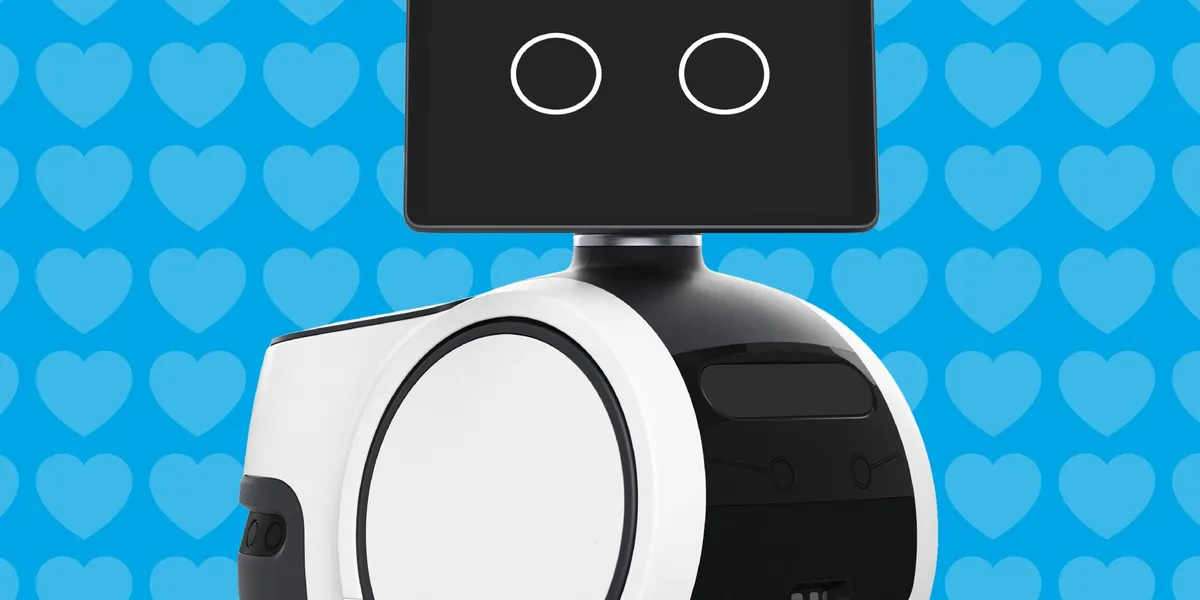

In 2018, Amazon brought me in as the lead UX Sound Designer for Astro, their first consumer home robot. Astro used cameras and other sensors to map and navigate your home and workplace, and could proactively patrol, check up on loved ones, and transport small items using its built-in cargo bin. While there was a well-defined feature set and form factor, initially there was no character direction. In fact, even before Astro had a name, there were two main questions—was it simply Alexa on wheels, or was it a robot with its own character?
The Astro team was divided. One option was to focus on Alexa, and treat the mobile robot simply as an added utility. I argued for Astro to not focus on Alexa, along with the majority of the UX team. Our belief was that a thing that moves through your home and turns toward you with intent can never be just an appliance. People would ascribe character to whether we wanted them to or not, and so the only question was whether we shaped that character or let it happen by accident.
Ultimately, Astro became Astro rather than Alexa, and user testing backed up our decision. People didn’t see the robot as Alexa. They saw it as its own character, and that’s what they wanted it to be. Alexa on the device felt somewhat strange and creepy, but building Astro its own voice was too slow and expensive in 2018. So, we settled on Alexa as a supporting character that handled any actual talking, while Astro was the main character, communicating as much as it could without words, through sound, motion, and facial expressions.
I had been brought on to the Astro team to define the robot’s sound design language and voice. But there was no one to flesh out the robot’s actual character. You cannot make a single real decision about a character without defining it first. Every choice about how Astro moved, sounded, paused, or reacted was a character choice, and those choices required all disciplines working together. As Sound Lead, I was weaving together sound, motion, and character, and how they played together inside each story moment. The animators, who programmed Astro’s motion and facial expressions, were extraordinary at what they did, but the emotional arc they were animating came from the sound (and therefore character) work first. So I stepped into that role, which is where my real work started. What I learned about building character for robots applies to nearly everything being built in embodied AI right now.
Character Is a Design System
Developing a character for Astro meant answering questions that had never been asked about a product at Amazon: What is the emotional range of this robot’s baseline state? How does this robot communicate uncertainty without eroding trust? Where is the line between being expressive and annoying? What are the vulnerabilities of this device’s character?
These are design questions. They have real answers, and every team working on the product has to build from them. For example, Astro’s emotional range was designed to be relatively small at first. We never wanted Astro to get too sad or too angry. It could play sad, but would snap out of it quickly and end the reaction on a high note to keep things positive.
Character leaks out of every seam and can create a disjointed experience if not defined correctly. Even if it’s just animation timing that’s slightly off, or a response that’s technically correct but contextually tone-deaf, users feel every one of these inconsistencies, even if they can’t name them. Watch what happens at the beginning and end of this Sing sequence:
Astro goes from nothing, into the emotional moment, and then lands back on nothing. No build up, no cool down, no sense that the feeling came from somewhere or had anywhere to go. I pushed hard for better character stitching, the transitions in and out of expressive moments that make a performance feel continuous rather than assembled, but it never got implemented. The moment itself works. But without the stitching, it reads as a clip playing on a robot rather than coming from within the robot character itself.
Story and Sound at the Beginning
We had decided that Astro would have no spoken dialogue, but it had something that functioned the same way: a vocabulary of sounds, tones, and rhythms that acted as its voice. This vocabulary became the leading output of the character’s personality. The robot’s motion and facial expressions were built around it.
Astro’s wake-up sequence is a great example. Waking wasn’t just a boot animation on the screen; it was an entire performance. Slow and humble at first, the robot oriented itself quietly, then stretched its screen, checked its wheels, and finally, with an upward gesture toward its telescoping mast, it popped it up slightly, and did a little dance of joy. Sound, motion, and eyes hit every beat together in full choreography.
The character’s output in that sequence was first written as a story. Astro is waking up in its new home for the first time. Its main aspiration is to be part of a family, so this is the moment it has been waiting for, this is its purpose. Being the responsible character that it is, it wants to make sure everything is good to go before it introduces itself and starts learning its new home.
This narrative came first because it drove every other decision that we made. After the story was written, sound gave that story a metaphorical voice: the excited tones, the pacing as it checked its wheels, and the bright melodic phrase as Astro looked up at its new family for the first time and introduced itself. Once the sound was laid down, animation did their thing with motion and facial expressions, taking cues from the emotional arc the sound had established. Motion didn’t lead—it followed the feeling of the story and the sounds, the same way an animator follows a recorded vocal take.
That wake up sequence became one of the most-discussed moments in early user testing. People described it as “alive.” What they were responding to wasn’t any single element. It was all three channels (sound, motion, and facial expressions) expressing the same defined character in harmony.
Context Is Where Character Becomes Real
The most compelling characters are defined not by a fixed disposition but by how they respond to their environments and the people in them. They’re still recognizably themselves even as they adapt. This is what I call contextual character. A robot living in a home doesn’t occupy a single emotional state. It moves through rooms with different energy, encounters people in different moods, operates at different times of day, and responds to an endless range of social situations it was never explicitly designed for.
We got close to a contextual character output with Astro’s sound. When a specific piece of environmental context was fed in, the system adapted beautifully, and Astro felt completely alive. But every state like this was still a prediction we made by hand—a situation we had to imagine in advance and design a response for. A random home throws more situations at a robot than anyone can possibly predict, so there was always a longer tail of moments the system was never prepared for.
The difference between a product people describe as “smart” and one they describe as “aware” often comes down to this. Smartness is capability. Awareness is context. Presence is character. And character is always in reaction to the people around it, to its environment, to its own evolving state. That’s what makes it feel like something is emotionally present with you.
This is where AI changes the game for character design in ways that go well beyond what was possible with Astro. AI-driven adaptation doesn’t require the contextual predictions that we relied on. It learns the specific rhythms, preferences, and emotional context of the people it lives and works with. The character doesn’t just respond to context. It grows into it.
What Industry Is Missing
The character and soul of the impending wave of embodied AI products appears to almost always be an afterthought. And character defined late is character defined by default. It becomes the sum of a thousand small decisions made by different people thinking about anything but character. People project character onto devices whether you plan for it or not, especially if those devices move—a robot that moves is already a character. If nobody has designed this character, the result will be products that feel like nothing, or worse, feel confusing and not trustworthy. Technically impressive, but lifeless.
We did not get this fully right with Astro. So many things were moving in parallel that character was rarely treated as a utility, and it made sense why. When you are building a first-of-its-kind product, the things that are the loudest are the ones that break, the deadlines, the costs, the features a customer can point to on a box. Character is quieter than all of that. It’s easy to assume it can come later. On a team as large as the Amazon Astro team, it’s lucky to get any idea onto the roadmap when it is competing with a hundred others that all feel more urgent in the moment. None of this came from people not caring. It came from character being the kind of thing that is hard to prioritize until you see what its absence costs you.
My Asks to Product Leaders
If you are building a product that will share physical or conversational space with people, three things are worth considering:
Define character before you define interactions. You need a defensible character with enough emotional logic to answer hard questions consistently. Find answers to character questions early, and have every discipline build from the same foundation.
Build story and sound into the character pipeline, not the production pipeline. Story and sound developed alongside character definition has the chance to inform motion, expression, and interaction logic. This requires a different kind of collaboration, and a different kind of hire.
Design for adaptation, not just consistency. A consistent character is necessary, but the products that will matter most in people’s lives are the ones that deepen through use. The infrastructure to support that is more and more accessible, but the design thinking to take advantage of it is still rare.
An unabridged version of this story can be read on Medium.
From Your Site Articles
Related Articles Around the Web
