



The company claims that the model exhibits the first signs of compositional generalization, a term for AI systems’ ability to perform skills they’ve never been exposed to by recombining ones learned in their training data. One test involved asking a model to “load a sweet potato into the air fryer”—a task it had never previously encountered. In a demonstration video, the machine futzes around a little, makes a few false starts, and eventually manages a reasonable effort, though it doesn’t finish the task completely.
Sergey Levine, a professor at the University of California, Berkeley, and a cofounder of PI, is excited by the potential: “It’s actually the first time that we’ve convincingly seen that kind of compositional generalization, where we can basically ask the model to do tasks that we did not specifically collect data for and train it to do, and it’ll actually make a passable attempt.”
The success led the team to wonder how the model was able to achieve such a feat. After some digging, they found snippets of relevant labeled teleoperation data lurking in the training material, including two examples of a human controller using the robot to push an air fryer basket into the fryer. Those shreds of data might have been enough to enable π0.7 to almost air-fry a sweet potato.
For now, it remains unclear just how impressive π0.7’s abilities to generalize are. Still, given how fleeting the model’s exposure to air fryers had been, it offers a glimpse into how far cutting-edge research can currently take robots.
“70% success is like it doesn’t work”
You might be sensing a disconnect between the halting baby steps robots are making in labs—“Look! It put a sweet potato into an air fryer!”—and the dazzling, lifelike nimbleness on view during many demonstrations and videos, where robots are seen doing everything from dancing on a stage to courteously serving drinks. Such demos often don’t clearly reveal a key fact: In many instances, humans are controlling the robot or have carefully scripted its actions. (The robot that appeared onstage with Nvidia CEO Jensen Huang in March 2025, for example, seemingly responding to his instructions and following him around, was remote-controlled by what its makers called “a puppeteer behind the scenes.”)
For now, fully autonomous motion planning so that a robot knows where it should go—especially in new, chaotic environments like a construction site or a unfamiliar home—remains a largely unsolved challenge. A bigger challenge still—albeit one that is often related—lies in getting robots to tackle larger, more ambiguous jobs that include multiple tasks and require decisions about how and in what order they’re done. This would be the difference between a robot that can put a plate into a microwave and one that can successfully respond to the prompt “Make dinner” by exploring the refrigerator, chopping ingredients, and firing up the stove. Google DeepMind’s best attempts at something like this—which involved asking its robot to survey a kitchen and pack all the ingredients for a mushroom risotto into a basket—have so far resulted in failure.
Adding to the challenge, a practical robot must essentially get it right every time. With VLAs, “people are very excited when their result goes from 50% success to 70% success,” says Marc Raibert, founder of Boston Dynamics. “But 70% success is like it doesn’t work, right?”
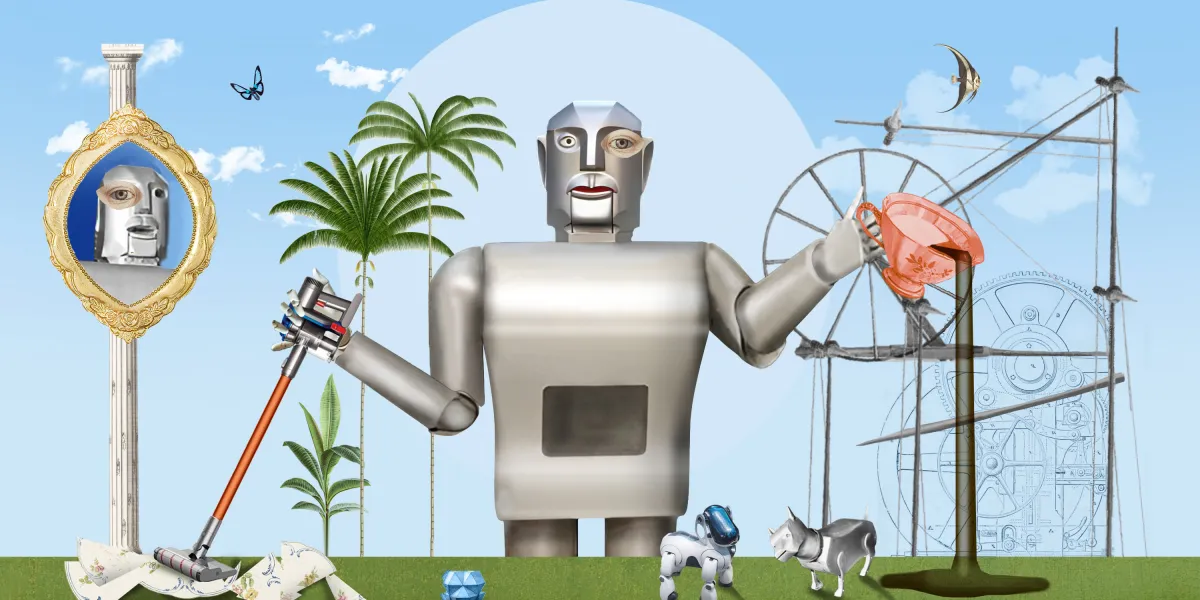
Demonstrations often make robots look useful, but the machines still mess up far too often to be used reliably in homes and factories.
AP IMAGES, SHUTTERSTOCK, 1X, AGILITY ROBOTICS, GOOGLE DEEPMIND
The few humanoids that are being tested in real-life settings are undertaking extremely limited tasks in tightly controlled environments. They’re far from generalists. Agility has hundreds of robots deployed across trials in facilities owned by GXO Logistics, Amazon, and Schaeffler, according to the company. But for now, Hurst says, the robots are targeting simple tasks such as moving bins and totes around. Even then, he adds, it took years to develop robots safe enough for logistics firms to even contemplate using them. For his part, Elon Musk claimed in May 2025 that “thousands” of his Optimus robots would be working at Tesla factories by the end of the year, but in January of this year he said that the company had only “some of the Tesla Optimus robots doing simple tasks in the factory.”
While humanoids are starting to venture onto the factory floor, making the jump to households will be even more difficult. Right now, should you so desire, you can preorder the 1X Neo home robot, expected to be ready for delivery sometime later this year. Yours for $20,000, it promises to take on “the boring and mundane tasks around the house”—putting away dishes, answering the door, tidying the living room—“so you can focus on what matters to you.” The idea is for this five-foot-six-inch robot to one day perform all those tasks autonomously, but for now a remote human operator is needed for it to do most things. (Yes, a person would need permission to peer into your home through the robot’s cameras.) Asked how long it will be until fully autonomous robots are ready for domestic work, Hurst said, “If I had to pick a number, I’d say it’s 10 years before robots are … actually doing useful things in people’s homes.”
When that happens, the robots might well be Chinese, as China is well ahead of the West in terms of production. Nearly 90% of the roughly 15,000 humanoid robots shipped in 2025 were made by Chinese companies, according to the market intelligence company Omdia and the Chinese robotics firm Unitree. One model produced by Unitree, which shipped more humanoid robots than any other company last year, costs less than $6,000. Such an affordable price could go a long way toward making robots more attractive to consumers, though the company expects its machines to be used in industrial applications first. (If you’re wondering who is buying all these Chinese robots, by the way, the AP recently reported that orders come predominantly from corporate and academic labs and state-owned enterprises.)
We’ve been here before
The dream of building a humanoid robot runs deep: As far back as 1495, Leonardo da Vinci sketched out designs for a mechanical knight, controlled by cables and pulleys. Through the 20th century, machines of sci-fi fever dreams have come and gone.
Westinghouse’s Elektro was a sensation at the 1939 World Fair.
GETTY IMAGES
Westinghouse’s seven-foot-tall box on legs, Elektro, hit the New York World’s Fair in 1939, smoking a cigarette. WABOT-1, built by Waseda University in Japan in 1973, was the first full-scale, programmable humanoid robot. Honda’s ASIMO, unveiled in 2000, was probably the first such machine to prove at all competent—it could, at least to some degree, climb steps, recognize faces, and autonomously move through spaces. But the robot was discontinued in 2018, unable to advance far enough beyond what it could do in demonstrations to be useful.
All, at the time, were impressive—even jaw-dropping—feats of engineering. But none were ready to navigate the real world. Today’s robots, even with the transformative power of advanced AI, still face the same existential challenge.


