

May 26, 2026
2 min read
Add Us On GoogleAdd SciAm
A toothless, beaked, bipedal crocodile cousin roamed Earth 200 million years ago
Like modern crocodiles, this bizarre ancient reptile was likely a carnivore, but otherwise it bears little resemblance to them
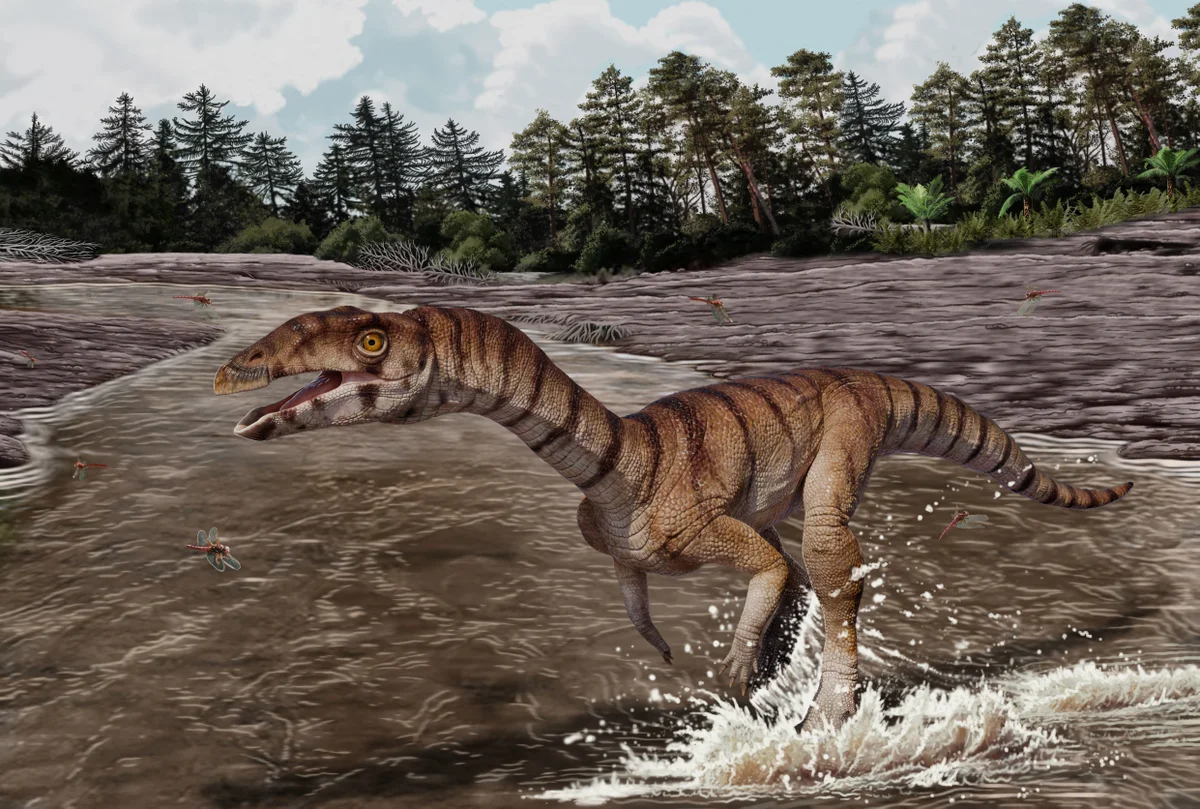
Jorge Gonzalez; Copyright NHMLAC Dinosaur Institute
More than 200 million years ago a bizarre, beaked, toothless reptile with tiny arms stomped around on its hind legs in what’s now New Mexico. It may not have looked like it, but this newly identified creature was an ancient relative of a group of modern-day animals with a fearsome reputation—crocodiles.
The reptile’s remains were originally discovered in 2006 in a New Mexico quarry that is well known among paleontologists for its rich trove of Triassic-era fossils. The bones closely resemble those belonging to the two recognized North American species of Shuvosauridae, a clade of ancient bipedal reptiles that lived through the Late Triassic. But the new Shuvosauridae specimen appeared just slightly different, says Alan Turner, a professor of anatomical sciences at Stony Brook University and leader of the team that discovered the remains. First, the bones were dated to around 212 million years ago, which was more recent than one of the North American Shuvosauridae species and later than other. And there were subtle physiological differences, such as in its humerus. Turner and his colleagues outlined the findings in a study in Journal of Vertebrate Paleontology.
“We look at those fine details, because those are the things that the evolutionary processes are shaping, and that lets us get at their family tree that way,” he says.
On supporting science journalism
If you’re enjoying this article, consider supporting our award-winning journalism by subscribing. By purchasing a subscription you are helping to ensure the future of impactful stories about the discoveries and ideas shaping our world today.
Called Labrujasuchus expectatus, the new species belongs to a lineage that today includes crocodiles—but the relationship is a distant one. Importantly, L. expectatus is “definitely not direct ancestors to modern alligators and crocodiles,” Turner says. “You can think of them as like a very, very distant cousin. They split hundreds of millions of years ago from the group that eventually leads us to alligators and crocodiles. It’s sort of a side branch.”
Modern crocodiles are known for their rows of razor-sharp teeth, but L. expectatus didn’t have any. Teeth or no teeth, it’s difficult to determine what its diet consisted of, Turner says. Birds also have a beak and no teeth, and that doesn’t stop an eagle from being a carnivore. And L. expectatus evolved so long ago that fruit didn’t really exist. While it’s not possible to say definitively, Turner believes the reptile was a meat eater and possibly a scavenger.
The new species helps fill in some more of our constantly expanding understanding of evolutionary history. L. expectatus was technically not a dinosaur, despite looking and likely having acted a lot like one, Turner points out. Learning more about it can further science’s understanding of convergent evolution, he says.
“That’s the thing I think I find the most interesting about an animal like L. expectatus,” Turner adds. “It’s one more data point that we have in furthering these models about that important evolutionary process.”
It’s Time to Stand Up for Science
If you enjoyed this article, I’d like to ask for your support. Scientific American has served as an advocate for science and industry for 180 years, and right now may be the most critical moment in that two-century history.
I’ve been a Scientific American subscriber since I was 12 years old, and it helped shape the way I look at the world. SciAm always educates and delights me, and inspires a sense of awe for our vast, beautiful universe. I hope it does that for you, too.
If you subscribe to Scientific American, you help ensure that our coverage is centered on meaningful research and discovery; that we have the resources to report on the decisions that threaten labs across the U.S.; and that we support both budding and working scientists at a time when the value of science itself too often goes unrecognized.
In return, you get essential news, captivating podcasts, brilliant infographics, can’t-miss newsletters, must-watch videos, challenging games, and the science world’s best writing and reporting. You can even gift someone a subscription.
There has never been a more important time for us to stand up and show why science matters. I hope you’ll support us in that mission.
